AI Music and Trust-Based Creative Systems: Building Ethical Foundations for 2026
Explore how AI music and trust-based creative systems are redefining ethical design in 2026.
AI Music and Trust-Based Creative Systems
The fusion of artificial intelligence and music production has evolved beyond novelty. By 2026, AI music represents not only a technical breakthrough but also an ethical challenge. Musicians, producers, and AI researchers now face pressing questions about authorship, consent, and transparency in creative AI systems. As machine learning in music matures, the conversation has turned toward the trustworthiness of these systems—the need to ensure fair treatment of artists and reliable creative output.
What is AI music and why does trust matter more in 2026?
AI music refers to compositions, soundscapes, or full tracks generated using artificial intelligence. Early systems focused on pattern prediction and audio synthesis, often trained on vast, scraped datasets. By 2025, the problem became clear: models lacked proper licensing and attribution mechanisms, leaving artists uncompensated. In 2026, the focus has shifted to ethical design—creating AI systems that respect artistic integrity and build genuine trust.

Trust in AI art doesn’t happen automatically. It demands transparent data sourcing, verifiable attribution, and long-term accountability. Musicians want assurance that their signature styles, performances, or cataloged material contribute to the AI ecosystem legally and meaningfully. Ethical design in creative AI systems now defines the new frontier of digital expression.
How do ethical design principles apply to creative AI systems?
Ethical design in music-based AI systems means embedding respect for rights, consent, and fairness at every stage of the development pipeline. Rather than treating AI as a purely generative tool, developers now design frameworks that guarantee:
- Licensed data sourcing: Every sample or piece of training material originates from properly authorized datasets instead of web scraping.
- Explainability: Creators can audit AI music outcomes and identify which influences shaped the track.
- Traceable compensation: Artists receive ongoing royalties when AI-generated outputs use their licensed data.

This ethical architecture is essential for creative technologists and digital ethics professionals. In an environment where generative models can produce endless variations, maintaining artist integrity becomes both a technical and moral responsibility.
What are the emerging trends shaping AI music ethics in 2026?
Several major trends have emerged in the landscape of AI music creation:
- Legally compliant datasets: Training models increasingly depend on licensed and consent-based catalogues. This aligns with new global copyright regulations introduced between 2024 and 2025.
- Trust through transparency: Platforms prioritize clear disclosure of model training sources and attribution paths.
- Persistent artist royalties: Subscription models and partner programs enable recurring compensation whenever generated music gets streamed or used commercially.
- Collaborative AI composers: Systems blend human intention and machine learning agility, allowing producers to maintain creative direction while leveraging AI capabilities.
For deeper insights on current trends, see this analysis of music industry trends and learn how technology continues to shape the way artists monetize creativity.
Industry observers note that AI-generated tracks are now competing alongside human-made songs on major charts, underscoring the importance of trust, rights, and traceability.
Why trust-based creative systems are critical for the music economy
In traditional digital distribution, streaming platforms manage revenue splits through well-understood licensing structures. AI-generated works introduce uncertainty: who owns the output of a model trained on 10,000 tracks? Trust-based systems resolve this by tracing metadata, licensing history, and model fingerprints.
Without trust, adoption stagnates. Professional musicians resist AI tools they perceive as exploitative or opaque. Ethical systems, by contrast, create a safe creative environment, opening opportunities for hybrid production workflows where human and machine collaboration flourish.
Trust also affects commercial viability. Labels and enterprises require audit trails to confirm compliance, especially when AI outputs enter monetized circulation. A verified trust infrastructure ensures AI music remains legally usable and ethically defensible.
What role does machine learning play in modern AI music creation?
Machine learning drives the generative depth of AI music systems. Models analyze rhythmic, harmonic, and timbral patterns to synthesize new compositions that evoke human-like creativity. However, machine learning in music is only as ethical as its input data and output attribution.
By 2026, ethical developers use permissioned models that embed artist DNA—unique sonic fingerprints representing distinct creative identities. This method not only enhances stylistic authenticity but also safeguards ownership rights by linking outputs to licensed origins.
This connects with the concept of Descriptive AI, which structures existing music data into human-readable tags, improving both transparency and compliance.
Systems such as Soundverse DNA exemplify this model. Instead of blending anonymous datasets, they use consent-based artist catalogs to produce music that is both original and accountable. For a deeper dive, watch our tutorial on how to make music or check the guide on creating Deep House music on our YouTube channel.
How to make AI music ethically with Soundverse The Ethical AI Music Framework
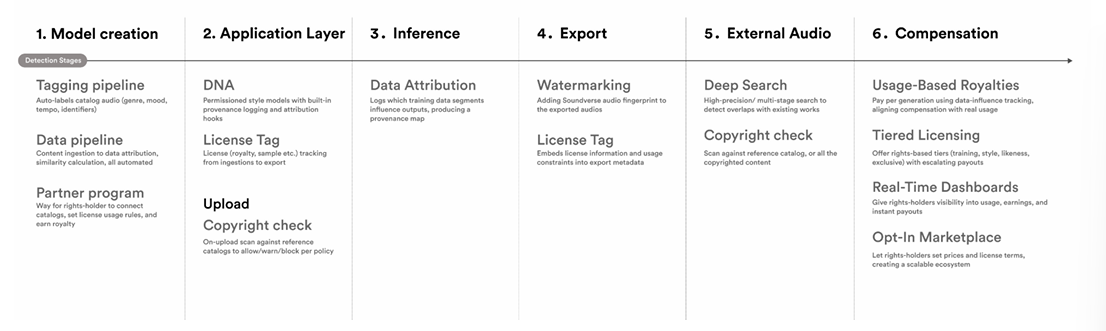
Soundverse’s Ethical AI Music Framework stands out as a milestone for responsible creativity. It offers a comprehensive infrastructure that bridges innovation and artist integrity through a six-stage transparent pipeline:
- Licensed Data Sourcing (Stage 1): All data comes from legal, verified, non-scraped sources.
- Permissioned Models (Stage 2): Artists opt-in via the Content Partner Program to license their music DNA for generation.
- Explainable Inference (Stage 3): Each generated track includes full attribution, making influence sources discoverable.
- Traceable Export (Stage 4): Outputs embed watermarks that link back to their generation history.
- Deep Search (Stage 5): Tracks can be externally scanned to verify licensing integrity across platforms.
- Recurring Compensation (Stage 6): Rights-holders earn royalties based on usage patterns discovered through attribution.
Through this framework, AI becomes predictable, transparent, and fair. It turns generative models into trust-based creative systems, providing tangible ways for producers and rights-holders to collaborate.
If you’re exploring alternatives for ethical generation, review best AI music generators or compare Soundverse as a Mubert alternative. Each resource showcases how systems are adapting toward explainable, rights-conscious creation.
How Soundverse Trace and DNA extend ethical creation
Beyond its main framework, Soundverse supports two powerful components:
- Soundverse Trace: Embeds a comprehensive trust layer ensuring attribution and rights protection across project lifecycles. Ideal for label auditing and enterprise licensing.
- Soundverse DNA: Generates music grounded in artist-specific sonic identities, allowing producers to draw inspiration from authentic licensed catalogs.
- Content Partner Program: Introduces recurring, usage-based royalties, reinforcing long-term fairness in AI music monetization.
Together, these tools turn the creative process into a transparent ecosystem. Producers can generate high-quality instrumentals while maintaining compliance with modern copyright regulations.
How can creators and researchers build trust in AI art?
For producers and AI researchers alike, trust begins with accountability. Steps to enhance ethical AI music creation include:
- Document all training data sources.
- Use partner programs that guarantee consent and compensation.
- Embed traceable metadata in AI-generated assets.
- Prefer explainable inference models over black-box generators.
Soundverse promotes these practices, ensuring every creative act aligns with modern standards of AI ethics in creativity. Learn more about secondary applications and creative optimization through Soundverse’s AI Magic Tools and their role in supporting transparent, scalable music workflows. You can also explore our “Explore” Tab tutorial to better navigate creative tools.
Start Creating AI Music That Inspires Trust and Innovation
Experience Soundverse’s intelligent AI music tools designed to enhance your creative flow, build ethical soundscapes, and open new possibilities in collaboration. Generate, refine, and share your next masterpiece effortlessly.
Create Music with Soundverse AI
Related Articles
- How an AI Music Generator Inspires Creative Fusion: Discover how AI systems are blending genres and reshaping the boundaries of musical creativity.
- AI Music Generator and Human Composers: A Future Together: Explore how AI and humans collaborate to produce emotionally resonant, one-of-a-kind compositions.
- The Role of AI Music in Film and Television: Learn how AI music is changing soundtrack composition and providing fresh creative opportunities for filmmakers.
- How AI-Generated Music is Transforming the Music Industry: Uncover the ways AI tools like Soundverse are driving innovation and altering traditional music workflows.
Here's how to make AI Music with Soundverse
Video Guide

Here’s another long walkthrough of how to use Soundverse AI.
Text Guide
- To know more about AI Magic Tools, check here.
- To know more about Soundverse Assistant, check here.
- To know more about Arrangement Studio, check here.
Soundverse is an AI Assistant that allows content creators and music makers to create original content in a flash using Generative AI. With the help of Soundverse Assistant and AI Magic Tools, our users get an unfair advantage over other creators to create audio and music content quickly, easily and cheaply. Soundverse Assistant is your ultimate music companion. You simply speak to the assistant to get your stuff done. The more you speak to it, the more it starts understanding you and your goals. AI Magic Tools help convert your creative dreams into tangible music and audio. Use AI Magic Tools such as text to music, stem separation, or lyrics generation to realise your content dreams faster. Soundverse is here to take music production to the next level. We're not just a digital audio workstation (DAW) competing with Ableton or Logic, we're building a completely new paradigm of easy and conversational content creation.
TikTok: https://www.tiktok.com/@soundverse.ai
Twitter: https://twitter.com/soundverse_ai
Instagram: https://www.instagram.com/soundverse.ai
LinkedIn: https://www.linkedin.com/company/soundverseai
Youtube: https://www.youtube.com/@SoundverseAI
Facebook: https://www.facebook.com/profile.php?id=100095674445607
Join Soundverse for Free and make Viral AI Music

We are constantly building more product experiences. Keep checking our Blog to stay updated about them!