AI Music and the Evolution of Creative Ownership
Explore AI music ownership and how Soundverse protects artist rights in 2026.
AI Music and the Evolution of Creative Ownership
As artificial intelligence reshapes every corner of the music industry, questions around AI music ownership have evolved from niche debates to defining discussions about creative integrity. By 2026, musicians, producers, and rights experts are no longer asking if AI-generated music is transformative—they’re asking who owns it, how ethical frameworks can govern it, and what role transparency plays in shaping fair compensation.
What does AI music ownership mean in 2026?
AI music ownership refers to the legal and ethical attribution behind music created or assisted by artificial intelligence. Traditionally, creative ownership was clear—a composer wrote a melody, a label distributed it, and collective management organizations handled royalties. Today, AI-generated music complicates that process. Did the machine compose it independently? Was the dataset trained on licensed works? Are artists whose material powered training models entitled to compensation?

In 2026, industry legislation continues to refine these questions, echoing earlier court debates from 2024 and 2025 about intellectual property and generative technologies. With tools capable of producing full-length compositions from text prompts, the fine line between inspiration and infringement grows thinner. Musicians must now understand not just copyright law, but digital ethics and data provenance.
How do creative rights in artificial intelligence evolve?
Creative rights in artificial intelligence involve balancing innovation with the moral rights of creators. The evolution of ethical frameworks—like transparent data usage and verifiable attribution—is central to today’s AI music ecosystem. Gone are the years of training models on scraped data without permission. Now, leading companies emphasize licensed sourcing and user consent to maintain legitimacy and artist trust.
For instance, in recent trend analyses on the music industry, transparency emerged as the top priority among rights organizations and federations worldwide. Artists increasingly demand that AI models disclose exactly where inspiration comes from, prompting major technology providers to embrace traceable infrastructures. These changes align with predictions from AI Music and the Law in 2026: What Creators Can and Cannot Do, which highlights the rise of enforceable ethical standards.
What are the ethical implications of AI-generated music?
The ethical implications of AI music stretch beyond authorship—they impact cultural preservation and creative accountability. When AI synthesizes the styles of thousands of artists, the outcome risks diluting unique voices while amplifying homogenized trends. Ethical frameworks combat that by centering creators in the process.
Key issues include:
- Consent: Artists must agree before their work is used for training AI models.
- Attribution: Generated outputs should always credit source contributors.
- Recurrence: Compensation models should ensure continued payment whenever AI-derived tracks are commercialized.
Balancing these ethics gives rise to a new era where innovation aligns with respect for creators—a principle embedded deeply within Soundverse’s mission. To see these principles in action, watch our guide on creating Deep House music and tutorial on how to make music from the Soundverse YouTube channel.
How does AI reshape the economics of music copyright?
Music copyright and AI are converging into a new hybrid economy. Instead of static royalties, creators now benefit from dynamic tracking, digital watermarking, and recurring revenue systems. Such technology ensures that no AI creation circulates without proper credit. In parallel, labels and publishers now audit AI usage with blockchain-like transparency.
The shift also affects how platforms handle public domain input. For instance, a growing number of AI tools launched in 2025 promised royalty-free compositions but offered limited clarity regarding data origins. By contrast, ethical models in 2026 follow established frameworks that distinguish between licensed and open-source material. This distinction preserves artistic ownership, anchoring the industry in lawful sustainability. These developments reflect insights in AI copyright and licensing in 2026 explained - Artlist Blog and Can You Sell AI Generated Music Without Violating Copyright Law?, both outlining the growing legal consensus surrounding AI ownership.
Recent reports, like those featured in AI music generator comparisons, reveal that creators now value datasets with verifiable lineage over free but opaque sources. Ethical AI isn’t just policy—it’s business strategy.
What does the future of music production look like with AI?
The future of music production blends automation with human creativity. AI-driven tools now handle arrangement, mastering, and style transfer while allowing artists to direct emotional tone and composition intent. This collaboration makes workflows faster and safer but also invites new licensing models.
As seen in resources like how AI-generated music is transforming the music industry, producers are leveraging machine learning to expand genre diversity, create adaptive soundtracks, and maintain copyright confidence by using transparent platforms. Ownership in this hybrid workflow becomes co-defined—AI as a contributor, the artist as the visionary.
For extended exploration, check out our tutorial on the Explore tab to understand Soundverse’s creative interface for navigating AI compositions.
How to make ethically owned AI music with Soundverse The Ethical AI Music Framework
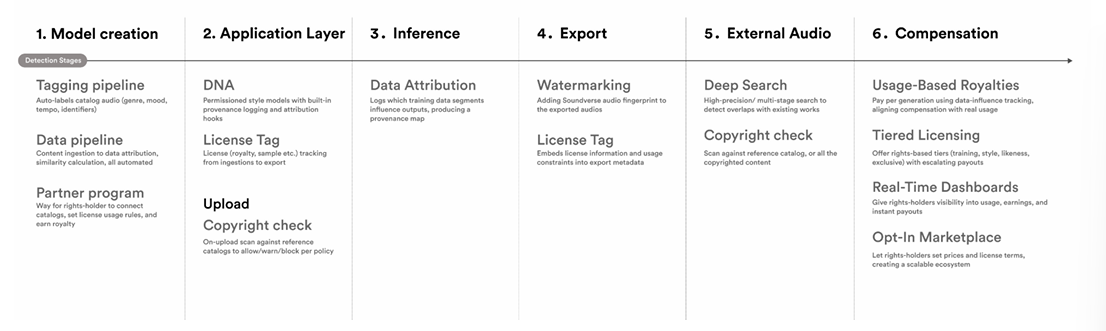
Soundverse leads the ethical AI movement through its flagship solution, The Ethical AI Music Framework, a complete infrastructure built to protect artist rights while enabling innovation.
It works across a six-stage transparent pipeline:
- Licensed Data Sourcing: Soundverse never scrapes the web. All training material comes from licensed contributors and verified partnerships.
- Permissioned Models (DNA): Through Soundverse DNA, artists can train AI on their sonic identity. The framework ensures their signature style is respected, monetized, and never cloned unethically.
- Explainable Inference: Every AI output reveals its lineage—who contributed what dataset elements—enabling traceable attribution.
- Traceable Export (Watermarking): Every generated track embeds metadata that identifies its source and ownership status.
- Deep Search Scanning: External networks and DSPs are scanned to locate derivative works or unauthorized reproductions.
- Recurring Compensation: Rights holders receive ongoing royalties via the Soundverse Content Partner Program based on usage metrics and attribution performance.
By integrating this pipeline, Soundverse resolves the core dilemmas of AI music ownership: transparency, control, and compensation. It also powers specialized tools:
- Soundverse Trace, protecting datasets and outputs at each generation stage.
- Soundverse DNA, empowering artists to create licensed AI versions of their musical fingerprints.
- Content Partner Program, offering recurring revenue for rights owners participating in AI training.
Each component adheres strictly to asynchronous workflows—users upload or record music, Soundverse processes it, then returns a result with traceable metadata. This ensures full compliance without sacrificing creativity.
Why musicians and rights experts choose Soundverse
For musicians and producers exploring AI-generated composition, Soundverse provides peace of mind and ethical assurance. By linking data usage to consent and tracking royalties through automated attribution, artists retain both creative control and financial reward. Compared with competitors like Mubert or Soundraw, Soundverse emphasizes legitimacy, not mere automation.
Soundverse has also become a pivotal partner for educational institutions and digital rights organizations developing new curricula on AI ethics. Its infrastructure simplifies compliance reports and empowers labels to certify AI-origin music as responsibly produced.
As the global AI music landscape expands, creators can use supportive articles like Generate AI music with Soundverse text-to-music and Soundverse AI Magic Tools to explore genre-specific production workflows, ensuring that artistic invention aligns with ownership safeguards.
Take Control of Your AI Music Ownership Journey
Create music with Soundverse and explore a world where AI empowers your creativity without compromising ownership. Generate, customize, and distribute your music with full control over how it’s used and shared.
Start Creating with Soundverse
Related Articles
- How AI-Generated Music Is Transforming the Music Industry — Discover how AI is redefining creativity and challenging traditional music ownership models.
- Copyright-Free vs Royalty-Free Music: What Creators Should Know — Learn the crucial differences between copyright-free and royalty-free music to protect your AI-generated work.
- Navigating the World of Royalty-Free and Copyright-Free Music Using Soundverse AI — Explore how Soundverse helps creators find and manage royalty-free music for stress-free creative ownership.
- AI Music Generator and Human Composers: A Future Together — Uncover how AI and human creativity can collaborate to build a new era of music production and ownership.
Here's how to make AI Music with Soundverse
Video Guide

Here’s another long walkthrough of how to use Soundverse AI.
Text Guide
- To know more about AI Magic Tools, check here.
- To know more about Soundverse Assistant, check here.
- To know more about Arrangement Studio, check here.
Soundverse is an AI Assistant that allows content creators and music makers to create original content in a flash using Generative AI. With the help of Soundverse Assistant and AI Magic Tools, our users get an unfair advantage over other creators to create audio and music content quickly, easily and cheaply. Soundverse Assistant is your ultimate music companion. You simply speak to the assistant to get your stuff done. The more you speak to it, the more it starts understanding you and your goals. AI Magic Tools help convert your creative dreams into tangible music and audio. Use AI Magic Tools such as text to music, stem separation, or lyrics generation to realise your content dreams faster. Soundverse is here to take music production to the next level. We're not just a digital audio workstation (DAW) competing with Ableton or Logic, we're building a completely new paradigm of easy and conversational content creation.
TikTok: https://www.tiktok.com/@soundverse.ai Twitter: https://twitter.com/soundverse_ai Instagram: https://www.instagram.com/soundverse.ai LinkedIn: https://www.linkedin.com/company/soundverseai Youtube: https://www.youtube.com/@SoundverseAI Facebook: https://www.facebook.com/profile.php?id=100095674445607
Join Soundverse for Free and make Viral AI Music

We are constantly building more product experiences. Keep checking our Blog to stay updated about them!