AI Music and Sustainable Monetization Ethics in 2026
Explore ethical AI music monetization, fair pay, and artist rights in 2026.
AI Music and Sustainable Monetization Ethics
In 2026, as artificial intelligence continues to reshape creative industries, few transformations have been as striking—or as controversial—as in the realm of music. The rise of AI music monetization has empowered creators and platforms to generate massive amounts of new compositions, but it’s also reopened longstanding debates about ownership, attribution, and artist compensation. With rapid advancements in generative AI and synthetic sound design, the questions of who gets paid, how transparency is ensured, and what ethical boundaries must guide AI-generated music have become central to sustaining the music economy.
Why is AI music monetization a critical issue in 2026?

Music is no longer just a human endeavor. AI systems can now produce entire orchestral scores, genre hybrids, and soundtracks at the click of a button. However, beneath this incredible convenience lies a complex challenge: ensuring that human artists—the creators whose work often trains these models—receive fair recognition and revenue.
In early 2024 and 2025, many AI music tools faced backlash for training on copyrighted works without proper licenses or compensation structures. By 2026, regulatory frameworks and ethical standards have started converging, demanding greater transparency in how training data is sourced and how AI-generated outputs are monetized. The focus has shifted from simply producing music quickly to ensuring that such creation happens responsibly.
With AI-generated music revenue increasing sharply this year, many stakeholders are asking: who truly owns an AI composition, and how can we maintain sustainable business ethics in this new creative economy?
What defines ethical AI in music today?

Ethical AI in music means more than compliance—it’s about ensuring permission, preserving artist integrity, and maintaining transparency throughout the creative process. In 2026, this typically involves three key pillars:
- Consent and Licensed Data Use: Only dataset materials explicitly cleared by rights-holders should be used for model training and composition.
- Traceable Attribution: Every AI-generated track should embed metadata or watermarks indicating its source influences and creators who participated indirectly through their licensed data.
- Fair Pay for Artists: Artists whose work contributes to model intelligence should receive recurring payments based on usage, not just one-time licensing fees.
Systems without these principles risk not only legal scrutiny but also reputational damage, as consumers increasingly demand ethical transparency from the platforms they use.
How is sustainable monetization redefining the music industry?
Music industry sustainability now depends on shifting from exploitative models to equitable ecosystems. Sustainable monetization ensures that revenue flows are distributed not only to labels or AI developers but to artists, lyricists, and contributors across the supply chain.
A large part of sustainable revenue management in 2026 involves technological accountability. Artists are turning to platforms that promise transparent attribution, while AI developers are creating contracts embedded within blockchain-like systems to track performance revenues from streaming, advertising, and licensing. This approach ensures fair distribution of earnings and compliance with AI copyright ethics.
For instance, decentralized metadata registries make it possible to trace the origin and ownership of each AI-generated song. When properly integrated, every play on a streaming service triggers a royalty payment routed automatically to all eligible participants. According to iMusician’s 2026 music industry report, by late 2025 more than one-third of uploaded tracks were fully AI-generated, underscoring how urgent these ethical systems have become.
What ethical challenges still remain for AI-generated music revenue?
Despite advancements, some issues persist:
- Attribution Ambiguity: Determining whether an AI-generated melody sufficiently resembles its training data to trigger royalty obligations remains complex.
- Compensation Mechanisms: While recurring royalties exist on some ethical platforms, standardization across the industry is still developing.
- Transparency Gaps: Not all providers have end-to-end audit tools, leading to differences in how provenance is tracked.
Ethical AI development means addressing these challenges openly and continuously. Governments and organizations are creating clearer licensing laws, but true sustainability also requires the industry to self-regulate using transparent frameworks.
How to make AI music monetization ethical with Soundverse The Ethical AI Music Framework
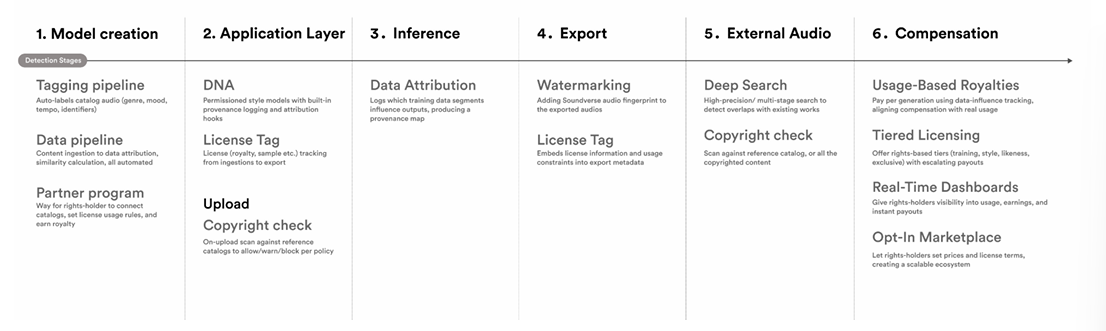
Soundverse addresses these concerns head-on through The Ethical AI Music Framework, a transparent six-stage architecture designed to align innovation with artist integrity. Rather than relying on black-box AI systems, this framework ensures legal and moral accountability across every creative and monetization phase.
The Six Stages of Transparency
- Licensed Data Sourcing – Every dataset begins with permissioned, licensed materials. Soundverse categorically avoids scraping or unlicensed sampling.
- Permissioned Models (DNA) – Models are trained on data only when rights-holders opt in, maintaining a verified content DNA.
- Explainable Inference (Attribution) – Each track generated can be traced back to its influence parameters so developers and artists can verify outputs.
- Traceable Export (Watermarking) – All generated audio is embedded with traceable watermarks for reliable source validation.
- Deep Search (External Scanning) – The framework scans external databases to detect overlaps, ensuring originality and compliance.
- Recurring Compensation (Partner Program) – Through the Content Partner Program, rights-holders receive ongoing, usage-based royalties when their data powers a model’s output.
Together, these stages create an interoperable, auditable infrastructure that transforms AI composition from an opaque process into a transparent, ethically monetized ecosystem. This approach supports fair pay for artists and guarantees that creative innovation does not come at the cost of integrity.
For creators exploring vocal or genre diversification, Soundverse’s tutorial on making music and its Deep House production guide provide practical insights into how AI tools can remain ethical while boosting creativity.
To understand how this model supports creative output in other genres, explore how artists use text-to-music tools in Generate AI Music with Soundverse, or review trend guides like Music Industry Trends to see where responsibly produced AI compositions are gaining ground.
How does Soundverse Trace strengthen AI copyright ethics?
Complementing the Ethical AI Music Framework, Soundverse Trace provides an additional verification layer—embedding attribution and rights metadata across the entire music lifecycle. With this technology, every piece of generated music maintains an auditable record linking it to its licensed data, helping mitigate copyright conflicts and support regulatory audits.
This strengthens the ethical foundation for AI music monetization, as every transaction or distribution tied to a Soundverse-generated track contributes measurable value to its source creators. The combination of traceable technology and recurring royalties brings accountability to a sphere that has long operated in ambiguity. Spotify’s 2026 artist payout report reinforces the importance of maintaining transparency in all royalty ecosystems.
Why sustainable monetization matters for the future of creative AI
The momentum of AI-first creation will only grow beyond 2026. Without robust monetization ethics, artists risk being detached from the very technologies they helped inspire. By integrating transparent revenue distribution and ethical pipelines like Soundverse’s framework, the music industry can transform AI from a disruptive force into a collaborative ally.
Future-forward platforms must balance creative freedom with accountability, ensuring that tomorrow’s digital artists thrive alongside machines—not in their shadow. As creators and enterprises continue to adopt solutions that uphold AI copyright ethics, we move toward a future where automated composition fuels innovation while respecting the people who make music possible.
In the same way Soundverse reimagines proactive compensation frameworks, tools such as Soundverse AI Magic Tools and AI-assisted genre systems like those outlined in How to Create Jazz Music with Soundverse AI demonstrate that responsible AI integration can boost both creativity and fairness.
Start Creating Ethical AI Music Today
Leverage Soundverse’s advanced AI music creation tools to produce original tracks that resonate with your audience while ensuring sustainable monetization practices. Turn your creative ideas into reality effortlessly.
Related Articles
- How AI-Generated Music Is Transforming the Music Industry: Learn how AI-generated compositions are redefining music creation and the business models that sustain it.
- AI Music Generator and Human Composers: A Future Together: Discover how collaboration between AI and human artists is creating new opportunities for music monetization and creativity.
- Navigating the World of Royalty-Free and Copyright-Free Music Using Soundverse AI: Understand the legal and ethical aspects of AI music use and monetization for creators everywhere.
- The Role of AI Music in Film and Television: Explore how AI music tools help filmmakers and producers access high-quality, monetizable music for media projects.
Here's how to make AI Music with Soundverse
Video Guide

Here’s another long walkthrough of how to use Soundverse AI.
Text Guide
- To know more about AI Magic Tools, check here.
- To know more about Soundverse Assistant, check here.
- To know more about Arrangement Studio, check here.
Soundverse is an AI Assistant that allows content creators and music makers to create original content in a flash using Generative AI.
With the help of Soundverse Assistant and AI Magic Tools, our users get an unfair advantage over other creators to create audio and music content quickly, easily and cheaply.
Soundverse Assistant is your ultimate music companion. You simply speak to the assistant to get your stuff done. The more you speak to it, the more it starts understanding you and your goals.
AI Magic Tools help convert your creative dreams into tangible music and audio. Use AI Magic Tools such as text to music, stem separation, or lyrics generation to realise your content dreams faster.
Soundverse is here to take music production to the next level. We're not just a digital audio workstation (DAW) competing with Ableton or Logic, we're building a completely new paradigm of easy and conversational content creation. TikTok: https://www.tiktok.com/@soundverse.ai Twitter: https://twitter.com/soundverse_ai Instagram: https://www.instagram.com/soundverse.ai LinkedIn: https://www.linkedin.com/company/soundverseai Youtube: https://www.youtube.com/@SoundverseAI Facebook: https://www.facebook.com/profile.php?id=100095674445607
Join Soundverse for Free and make Viral AI Music

We are constantly building more product experiences. Keep checking our Blog to stay updated about them!