AI Music and Platform Trust Engineering: Building Integrity into the Future of Music Creation
Explore how AI music and trust engineering are redefining integrity and rights protection in 2026.
AI Music and Platform Trust Engineering
In 2026, artificial intelligence has permeated nearly every aspect of music creation. From composition to mastering, AI music platforms are now capable of generating professional-grade tracks that rival human creativity. However, this rapid evolution has surfaced one of the most pressing challenges in music technology — trust. As AI-generated music becomes commonplace, questions around data provenance, rights attribution, and digital ethics have demanded new forms of system design and platform governance.
What is the relationship between AI music and platform trust engineering in 2026?
AI music systems rely on vast datasets, often sourced from existing recordings or digital archives. While this enables astonishing creative diversity, it introduces complexity around ownership and authorship. Platform trust engineering aims to create an infrastructure that makes training and output transparent — ensuring artists, rights-holders, and creators can trace influence and claim fair compensation.
In 2026, top research in digital trust engineering has extended beyond privacy and security to include creative authenticity. For music technology professionals and system architects, this means that trust isn’t just a checkbox; it’s part of the design philosophy of AI music ensembles and platforms.

Why is trust engineering critical to system design for AI-generated music?
Traditional system design focused on performance, scalability, and user experience. In contrast, AI music platforms integrate a fourth pillar: integrity. Integrity ensures that every piece of generated audio can be traced — not to punish creativity but to protect it. When platforms embed trust protocols, they enable traceability from dataset to distribution. Doing so mitigates infringement, ensures the ethical reuse of audio samples, and provides fair royalty mapping.
Digital trust engineering brings together technologies like watermarking, attribution logging, and content verification to prove where data originated. These systems also make contracts between AI models and contributors explicit — a foundation of what the 2026 music technology ecosystem now calls "authentic AI music creation."

How are AI music platforms addressing rights and transparency concerns?
Major music AI platforms have faced increasing regulation since 2024, forcing them to adopt transparent frameworks for both creators and model developers. Post-2025, the focus shifted from compliance to innovation — designing solutions that make transparency beneficial, not burdensome.
Systems like attribution tagging now log which training data influences output. Audio watermarking embeds inaudible fingerprints into generated songs, allowing platforms to verify provenance instantly. These developments are vital for AI researchers designing new generative systems and for artists contributing training assets under opt-in royalty programs.
For those exploring how ethical design principles are applied across the AI music landscape, the Soundverse AI Magic Tools showcase a leading example of transparent workflow integration, while other articles such as Navigating the World of Royalty-Free Music highlight how creators can benefit from fair licensing frameworks.
What system design principles define trustworthy AI music platforms?
Platform trust engineering incorporates techniques long used in secure computing into creative systems. The most influential principles include:
- Transparency by Design: Every dataset, model, and generated output includes an accessible attribution trail.
- Ethical Consent Modeling: Creators explicitly opt-in and monitor how their content is used.
- Resilient Attribution Layering: Even if music is remixed or transcoded, digital fingerprints remain intact.
- Rights Preservation Protocols: Licenses are embedded from ingestion through to final export.
- Scalable Trust Analytics: Platforms perform deep search scans across catalogues to detect overlaps (1:1 and 1:N) and confirm compliance.
These principles now guide enterprise-grade system design, ensuring that when AI generates sound, the resulting track remains anchored to clear provenance and ethical accountability.
How does Soundverse Trace strengthen trust in AI music?
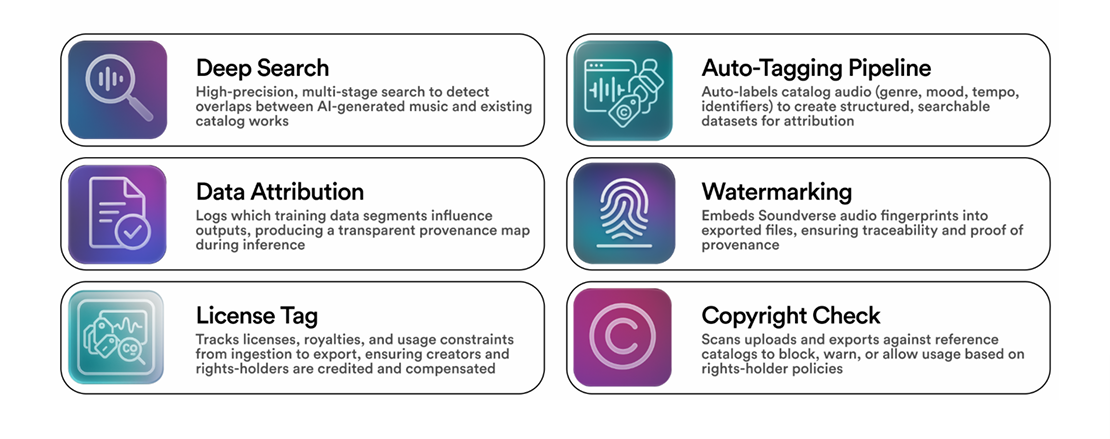
Soundverse has emerged as a leader in music technology innovation. Its flagship trust layer, Soundverse Trace, offers a comprehensive solution for attribution, verification, and rights management within AI-generated music workflows.
Core Capabilities of Soundverse Trace
- Deep Search: Enables high-precision scanning, comparing AI outputs against vast catalogues to detect overlaps (1:1 and 1:N detection). This allows platforms to identify reused segments and validate originality.
- Data Attribution: Logs exactly which training data influenced a given AI-generated output. This ensures creators remain credited throughout the entire lifecycle.
- Audio Watermarking: Embeds robust, inaudible fingerprints directly into generated audio, providing a tamper-proof signature that travels with the file.
- License Tagging: Preserves rights metadata from ingestion to final export, ensuring that derivative works respect existing terms and royalties.
Primary Use Cases
Soundverse Trace empowers platform architects and content managers to:
- Prevent copyright infringements before distribution.
- Track catalog usage for royalties and payouts.
- Verify the provenance of AI-generated audio through traceable metadata.
- Automate takedowns or payouts for rights-holders when unauthorized usage occurs.
In tandem with the Ethical AI Music Framework, Soundverse bridges the gap between innovation and artist integrity, ensuring that creativity and compensation coexist harmoniously. The framework’s transparent six-stage pipeline guarantees consent and recurring reward cycles — essential for fair participation in large-scale AI training.
For those designing enterprise infrastructures, the integration with Soundverse API enables programmatic control over generation, modification, and verification processes. This ensures AI music creation systems are not just powerful but accountable.
For a deeper dive into creative AI systems, watch our guide on creating Deep House music or learn the basics in our tutorial on how to make music.
How does digital trust engineering shape innovation in music technology?
Beyond compliance, trust layers are becoming creative accelerators. When musicians and sound engineers can confidently trace their work within AI ecosystems, they’re more likely to collaborate. Trust removes friction between human composers and AI co-producers.
In practice, this transformation extends to platforms supporting hybrid workflows. Developers use trust engineering to build adaptive filters — where attribution data informs creative decisions. For example, verified datasets can enhance AI model tuning and unlock new genres safely. Related readings such as AI Music Generator and Human Composers: A Future Together highlight how this synergy builds creative confidence across professional networks.
By incorporating trust analytics directly into content pipelines, system designers now produce data-driven creativity dashboards that track ethical compliance while accelerating music generation. The result is an ecosystem where transparency becomes a sound design tool, not just a legal safeguard.
What are the current trends shaping AI music trust systems in 2026?
Several converging trends are defining the future of AI music system design:
- Rights-Transparent APIs: APIs built for compliance now deliver trust analysis alongside generation outputs.
- AI Music Provenance Standards: Industry-wide protocols are emerging to standardize attribution logs across music AI platforms.
- Decentralized Attribution Records: Blockchain-backed metadata trails ensure immutable verification.
- Ethical Licensing Programs: Initiatives like Soundverse’s Content Partner Program reward contributors through recurring usage royalties.
- Integrated Watermark Scanning Tools: Software automation validates track authenticity before release.
Together, these advancements guarantee that AI-generated sound can coexist with creative authenticity and legal clarity. Professionals in 2026 are designing systems where trust is measurable — the same way fidelity, tone, and mix quality are.
How can music professionals leverage AI music responsibly and confidently?
For producers, researchers, and architects entering this space, implementing a trust-first mindset is key. It begins with selecting platforms that embed transparency as a core feature. Tools like Soundverse Trace ensure digital assets remain protected while creative workflows stay seamless.
Building secure music AI pipelines involves collaborating with partners who align with ethical data practices and rights reciprocity. The linkage between technology like Soundverse Trace and frameworks like the Ethical AI Music Framework offers a reliable foundation for future-ready studios.
Professionals interested in applied exploration can review complementary articles like How AI-Generated Music is Transforming the Music Industry or Creating Faceless Video Messages with Free AI Tools, both showcasing how trust and innovation coexist.
Create Your First AI Track Today
Explore limitless creativity with Soundverse’s AI music tools. Generate original, copyright-free songs and experiment with genres, moods, and instrument layers — instantly.
Start Creating with AI
Related Articles
- How AI-Generated Music Is Transforming the Music Industry: Discover how AI is revolutionizing music creation and distribution across the global music landscape.
- The Role of AI Music in Film and Television: Explore how AI-generated compositions are redefining soundtracks and background scores for visual media.
- AI Music Generator and Human Composers: A Future Together: Learn how AI and human creativity can collaborate in crafting next-generation musical experiences.
- Soundverse Assistant: Your AI Music Co-Producer: Meet your AI-powered collaborator that helps unlock faster, smarter music creation workflows.
Here's how to make AI Music with Soundverse
Video Guide

Here’s another long walkthrough of how to use Soundverse AI.
Text Guide
- To know more about AI Magic Tools, check here.
- To know more about Soundverse Assistant, check here.
- To know more about Arrangement Studio, check here.
Soundverse is an AI Assistant that allows content creators and music makers to create original content in a flash using Generative AI. With the help of Soundverse Assistant and AI Magic Tools, our users get an unfair advantage over other creators to create audio and music content quickly, easily and cheaply. Soundverse Assistant is your ultimate music companion. You simply speak to the assistant to get your stuff done. The more you speak to it, the more it starts understanding you and your goals. AI Magic Tools help convert your creative dreams into tangible music and audio. Use AI Magic Tools such as text to music, stem separation, or lyrics generation to realise your content dreams faster. Soundverse is here to take music production to the next level. We're not just a digital audio workstation (DAW) competing with Ableton or Logic, we're building a completely new paradigm of easy and conversational content creation.
TikTok: https://www.tiktok.com/@soundverse.ai
Twitter: https://twitter.com/soundverse_ai
Instagram: https://www.instagram.com/soundverse.ai
LinkedIn: https://www.linkedin.com/company/soundverseai
Youtube: https://www.youtube.com/@SoundverseAI
Facebook: https://www.facebook.com/profile.php?id=100095674445607
Join Soundverse for Free and make Viral AI Music

We are constantly building more product experiences. Keep checking our Blog to stay updated about them!