AI Music and Fair Compensation: Building a Sustainable Creator Economy in 2026
Explore AI music ethics, creator economy trends, and fair royalty models shaping the music industry in 2026.
AI Music and Fair Compensation
In 2026, the AI music landscape looks vastly different from the early experimental years of 2024 and 2025. After the first wave of generative tools flooded the market, debates around transparency, creator rights, and fair royalties began intensifying. Behind the buzzwords like 'AI music' and 'machine creativity' lies a complex ethical and financial web—one that shapes how musicians, technologists, and policymakers collaborate to define the future of sound.
What is AI Music and Why Does Compensation Matter in 2026?
AI music refers to compositions generated or assisted by artificial intelligence systems that can produce melodies, harmonies, or entire tracks from text prompts or data training. These systems have become integral to modern music-making, powering everything from advertising soundtracks to independent releases. Yet as models learn from existing recordings, the question arises: who deserves compensation when AI-generated songs mimic or reference the styles of human artists?

Over the last two years, the music industry has shifted toward more ethical AI frameworks. Conversations about creator economy fairness now dominate conferences and roundtables, emphasizing rights management and transparency over mere innovation. Global institutions have started drafting standards for the ethical use of training data, drawing parallels to copyright laws that evolved in the early streaming era. As noted in How AI Music Impacts Music Licensing in 2026 - Soundverse AI, music licensing mechanisms are central to reshaping rights and royalties in this AI-driven market.
How Has the Creator Economy Evolved with AI Music?
The creator economy in 2026 is no longer limited to influencers or digital content producers—it now includes music creators collaborating with AI platforms. Unlike traditional royalty structures, where artists earned fixed percentages per stream, AI platforms enable dynamic compensation models. These account for both the original intellectual contribution and the AI’s computational input.

This shift has led to hybrid revenue streams combining human creativity with algorithmic assistance. Platforms that prioritize transparency outperform black-box models, as professionals demand traceability. For instance, technologies discussed in Soundverse’s blog on How AI-Generated Music Is Transforming the Music Industry highlight how creators retain a new layer of control in the digital music era. Additionally, BMI’s position outlined in BMI and AI reveals how the industry is recognizing the need to understand creators’ perspectives on AI-generated works. For a deeper dive, watch our guide on creating Deep House music or learn how to make music with AI step-by-step via the Soundverse YouTube tutorial series.
What Ethical Challenges Does the Music Industry Face with AI-Generated Songs?
Three major ethical challenges define the 2026 debate:
- Attribution and Authorship – Determining who should receive credit for an AI-generated song when its style, vocals, or composition resemble an existing creator.
- Informed Consent – Ensuring artists agree before their works or voices are used for AI model training.
- Royalty Recurrence – Developing systems that pay artists fairly whenever their songs contribute to AI output.
These issues became urgent after numerous cases of AI models trained on unlicensed music surfaced during 2024–2025. Accessibility exploded, but transparency lagged behind. Ethical solutions such as traceable watermarking and consent-based data sourcing have since become industry benchmarks. As underscored in Saving Country Music's New Policy on AI Music for 2026, these challenges capture the existential risk AI poses to human creators and musical authenticity.
Why Transparency Is Central to AI Music Ethics in 2026
Transparency ensures that both musicians and enterprises know exactly how AI systems use creative data. Opaque models erode trust and create legal ambiguity, while explainable inference pipelines restore accountability. In 2026, music technology researchers emphasize explainability as the top criterion for regulatory approval in AI music production.
Trust layers now form integral components of ethical AI systems. These layers guarantee visibility into dataset origin, model permissions, and export tracking—a concept reinforced through Soundverse's recent updates described in Soundverse AI Revolutionizing Music Creation for New Age Content Creators. Such transparency fosters a sustainable creator economy where rights-holders can confidently participate.
How to Make Ethical AI Music with Soundverse The Ethical AI Music Framework
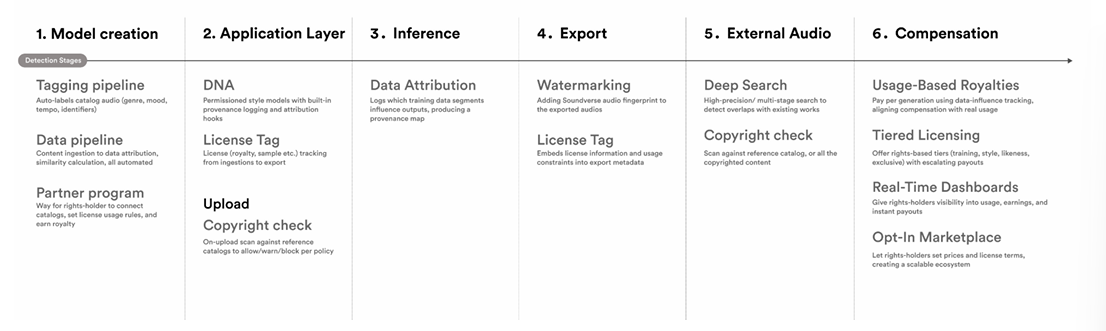
Soundverse’s Ethical AI Music Framework is designed specifically to bridge innovation and artist integrity. Unlike traditional generative systems that rely on opaque scraping, this framework introduces a six-stage transparent pipeline:
- Stage 1: Licensed Data Sourcing (No Scraping) – Every sound used for AI training comes from licensed, consenting contributors.
- Stage 2: Permissioned Models (DNA) – Models carry embedded permissions documenting dataset origins.
- Stage 3: Explainable Inference (Attribution) – Outputs are traceable, allowing clear attribution and contributor recognition.
- Stage 4: Traceable Export (Watermarking) – AI-generated songs include export watermarks for post-release auditing.
- Stage 5: Deep Search (External Scanning) – Scanning tools verify model and dataset integrity across digital ecosystems.
- Stage 6: Recurring Compensation (Partner Program) – Creators earn ongoing royalties whenever their data contributes to an AI-generated track.
Together, these stages institutionalize fairness in the creator economy. Enterprise partners gain legal compliance while artists benefit from transparent royalty structures. The Soundverse Content Partner Program complements this ethical pipeline by offering rights-holders an opt-in licensing model where they receive usage-based royalties via attribution tracking. The Soundverse Trace technology extends protection even after music export, serving as a trust layer across datasets and AI outputs.
You can explore similar ecosystem advancements and creation workflows through other insights such as Generate AI Music with Soundverse Text-to-Music and Soundverse Assistant: Your AI Music Co-Producer. For more on platform mechanics, check the Explore tab tutorial on Soundverse YouTube.
What Does Fair Compensation Look Like in the AI Music Era?
Fair compensation means that creators reap economic benefits proportional to their work’s contribution within AI models. In the era of AI music, this goes beyond artist royalties—it encompasses data ethics. Creators who license their stem files, vocals, or melodies must receive recurring payouts every time those assets influence a new song.
Industry watchdogs and advocacy groups now push for transparent reporting standards similar to blockchain ledger implementations. These standards give artists visibility into how AI interacts with their licensed materials and ensure they remain stakeholders, not mere data sources. Legislation For Creators - SoundExchange aligns with this objective through proposed acts empowering musicians to collectively negotiate with AI and streaming platforms.
Why Policymakers Are Paying Attention
Governments and legal authorities have entered the conversation with fresh urgency. In 2026, several nations introduced guidelines requiring AI music generators to disclose training datasets and royalty models. This oversight reinforces ethical principles while supporting innovation—especially for emerging creators leveraging AI tools for their careers.
For example, the concept of watermarking and explainable inference fits perfectly into policymaker priorities because it balances protection with creative freedom. By adopting transparent frameworks like Soundverse's Ethical AI Music Framework, regulatory bodies can standardize fairness across platforms without stifling technological growth. The introduction of a bipartisan bill to protect creators, stated in Dean, Moran Introduce Bipartisan Bill to Protect Creators from Unauthorized AI Training, illustrates this trend in legislative action.
Looking Ahead: A Transparent and Profitable Future for Artists and AI
AI music is no longer about replacing human sensation with algorithmic efficiency—it is about partnership. The most successful creators of 2026 leverage AI technology responsibly, ensuring equitable rewards between humans and machines. As AI-generated songs permeate streaming services and advertising campaigns, ethical frameworks form the backbone of sustainable creative workflows.
For professionals, researchers, and policymakers, the call to action is clear: ethical AI music systems must prioritize consent, transparency, and compensation. Only then will innovation uplift rather than disrupt the creator economy.
Start Creating Fairly with AI Music
Empower your creativity while ensuring fair recognition and compensation. Join Soundverse to generate, share, and monetize your music—powered by AI, guided by ethics.
Related Articles
- AI Music Generator and Human Composers: A Future Together — Discover how AI music technology can collaborate with human creativity to craft a balanced musical future.
- How AI-Generated Music Is Transforming the Music Industry — Explore how AI is redefining production, songwriting, and compensation models across the music industry.
- The Role of AI Music in Film and Television — Learn how filmmakers and producers are turning to AI music to enhance storytelling and streamline sound production.
- The Benefits of Composing with an AI Music Generator — Uncover why composers and producers are embracing AI to unlock inspiration and boost efficiency.
Here's how to make AI Music with Soundverse
Video Guide

Here’s another long walkthrough of how to use Soundverse AI.
Text Guide
- To know more about AI Magic Tools, check here.
- To know more about Soundverse Assistant, check here.
- To know more about Arrangement Studio, check here.
Soundverse is an AI Assistant that allows content creators and music makers to create original content in a flash using Generative AI. With the help of Soundverse Assistant and AI Magic Tools, our users get an unfair advantage over other creators to create audio and music content quickly, easily and cheaply. Soundverse Assistant is your ultimate music companion. You simply speak to the assistant to get your stuff done. The more you speak to it, the more it starts understanding you and your goals. AI Magic Tools help convert your creative dreams into tangible music and audio. Use AI Magic Tools such as text to music, stem separation, or lyrics generation to realise your content dreams faster. Soundverse is here to take music production to the next level. We're not just a digital audio workstation (DAW) competing with Ableton or Logic, we're building a completely new paradigm of easy and conversational content creation.
TikTok: https://www.tiktok.com/@soundverse.ai
Twitter: https://twitter.com/soundverse_ai
Instagram: https://www.instagram.com/soundverse.ai
LinkedIn: https://www.linkedin.com/company/soundverseai
Youtube: https://www.youtube.com/@SoundverseAI
Facebook: https://www.facebook.com/profile.php?id=100095674445607
Join Soundverse for Free and make Viral AI Music

We are constantly building more product experiences. Keep checking our Blog to stay updated about them!