AI Music and Data Attribution: Building a Transparent Future for Music Creation in 2026
Explore AI music, data attribution, and transparent training frameworks shaping ethical music creation in 2026.
AI Music and Data Attribution
Introduction
In 2026, the world of AI music has reached a defining crossroads. The rapid adoption of generative AI tools across composition, production, and licensing has sparked both artistic innovation and ethical debate. While AI models now rival human producers in creating soundscapes and full-length tracks, questions around data attribution, artist consent, and copyright compliance have become impossible to ignore.
Over the past two years, the music industry has witnessed significant legal and cultural tension. Lawsuits filed in 2024 and 2025 over unlicensed training data forced developers and platforms to reevaluate how datasets are built and credited. As we move deeper into 2026, the focus has shifted from raw innovation to accountability and transparency—not just in model training but throughout every step of AI music generation.
This article explores what data attribution means for the future of AI-generated music, how industry players are using traceability tools to ensure ethical data use, and how Soundverse Trace provides a practical, integrated solution for creators and rights-holders alike.
What does data attribution mean in the context of AI music?
Data attribution refers to the process of identifying, logging, and crediting the specific datasets or source materials that influenced an AI-generated output. In the world of AI music, this means connecting every sound, beat, or melody that a model learns from back to its rightful creator.
When AI systems were still in their infancy, most operated as black boxes. Developers would train models on massive collections of songs, often scraped without transparent licenses, and release new compositions that blurred ownership lines. The result? Artists who unknowingly contributed to datasets received no recognition or compensation.
By 2026, this paradigm has shifted. Platforms now employ auditable attribution layers, ensuring any output can be traced back to verified datasets. This evolution supports ethical music creation and enables fair royalty distribution systems.

Why AI training transparency is critical for generative music ethics
Transparency in AI training is essential to maintaining creative trust. Artists, producers, and AI developers are beginning to agree that it’s not enough to simply declare that a model is trained—stakeholders must know how, on what, and with whose permission.
AI training transparency helps address several issues:
- Artist Data Rights: Musicians retain ownership over their original compositions, and training consent ensures those rights remain intact.
- Generative AI Ethics: Transparent model design limits bias, prevents plagiarism, and establishes accountability.
- Music Copyright Compliance: Transparent metadata chains simplify how rights-holders prove ownership when disputes occur.
In 2026, these three pillars underpin the new global standard for ethical AI music deployment. Tools that fail to provide full attribution are rapidly losing favor with both artists and production houses.

How data attribution strengthens music copyright protection
When AI music generators respect copyright through verifiable attribution layers, they safeguard not only legal frameworks but also the creative economics of the industry. High-profile lawsuits such as UMG Recordings v. Uncharted Labs and other 2025 cases further underscored the urgency for attribution standards.
Consider the growing use of AI-generated backing tracks in gaming, film, and social media. Without traceability, confirming whether an AI track is royalty-free or copyright-safe becomes daunting. Data attribution directly solves this by tying the final export to a transparent training lineage. This practice allows:
- Automatic royalty tracking: Each generated audio file contains embedded metadata linking it to specific licenses.
- Fair payouts: Labels and contributors receive payments proportional to their data’s influence.
- Efficient takedown processes: If infringement is discovered, automated systems can immediately identify and address violations.
As explored in Soundverse’s previous studies on AI-generated music transforming the music industry, robust copyright models are shaping how creators profit from AI collaboration. For a technical walkthrough, watch our Soundverse Tutorial Series - How to Make Music.
What are the emerging frameworks for artist data rights in 2026?
Artist data rights have evolved dramatically since 2025. The concept now extends far beyond copyright to include data consent, usage visibility, and compensation automation. Three core frameworks dominate this year:
- Consent-First Dataset Licensing – Training datasets must now include documented consent records for every audio stem or sample.
- Attribution-Driven Compensation – AI platforms link revenue distribution to verified dataset usage logs.
- Rights-Bound Metadata Standards – Audio exports carry immutable metadata that persists across every use case, from streaming to remixing.
More platforms are joining Soundverse’s Content Partner Program, an opt-in licensing initiative that incentivizes rights-holders by granting recurring royalties when their audio informs AI training. Such programs illustrate how ethical infrastructure can coexist with creative freedom.
How Soundverse Trace ensures transparency and rights integrity in AI music
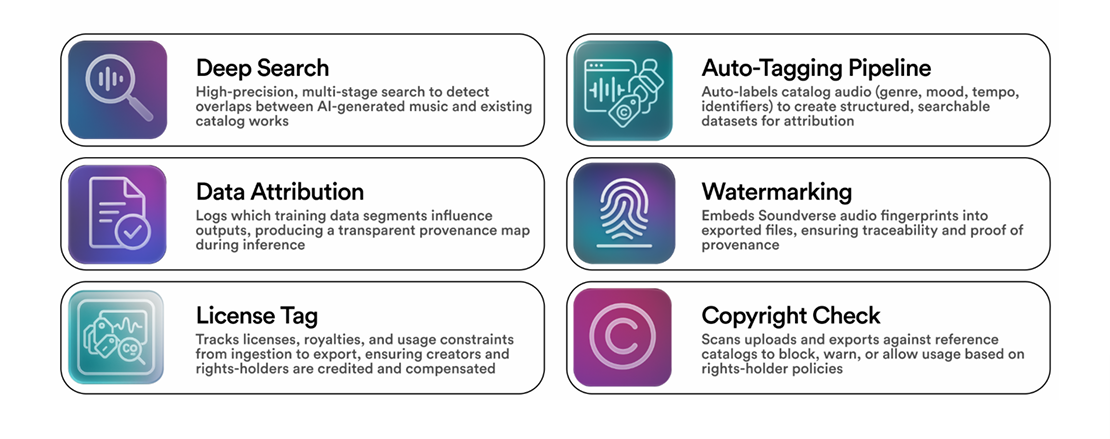
The Soundverse platform continues to set global benchmarks for ethical AI music production, and Soundverse Trace sits at the center of this evolution.
Official Description
Soundverse Trace is a comprehensive trust layer for AI music that embeds attribution, deep search, and rights protection across the entire lifecycle—from dataset creation to final export.
Core Capabilities
- Deep Search: Performs high-precision 1:1 and 1:N scans to detect overlaps between new outputs and existing datasets.
- Data Attribution: Maintains verifiable logs revealing which training data influenced each output.
- Audio Watermarking: Inserts robust, inaudible fingerprints into generated files for authenticity verification.
- License Tagging: Preserves rights metadata continuously from ingestion to export.
Primary Use Cases
- Preventing copyright infringement in AI-generated tracks.
- Tracking catalog usage for royalty automation.
- Verifying provenance across collaborators and distributors.
- Enabling faster takedowns or automatic payouts for registered rights-holders.
With Soundverse Trace, data lineage becomes a creative asset rather than a legal risk. The platform’s integration with the Ethical AI Music Framework provides developers and producers the infrastructure to maintain compliance without sacrificing workflow efficiency.
You can also explore how Soundverse’s innovation ecosystem enables artists to generate AI music effortlessly or check out the AI Magic Tool suite for advanced functionality. For a quick introduction, see our Soundverse Tutorial - Explore Tab.
What does the future of AI music attribution look like?
By 2026, AI music attribution is no longer an experimental feature—it’s a regulatory expectation. Governments and music rights organizations are pushing for traceable model transparency reports. These legislative efforts could soon make it standard for AI audio platforms to publicly disclose licensed dataset contributors.
In practice, this means future music creation tools will integrate dynamic licensing dashboards capable of calculating royalties in real time (asynchronously, not instantaneously). Content creators can confidently sample, remix, and produce AI-generated material, knowing that attribution channels handle compliance automatically.
How Soundverse drives ethical innovation across its ecosystem
Beyond Soundverse Trace, the company continues to expand a suite of tools designed around trust and creative empowerment:
- The Ethical AI Music Framework bridges the gap between algorithmic capability and human artistry by implementing a transparent, six-stage pipeline covering consent, attribution, and compensation.
- The Content Partner Program rewards rights-holders participating in AI training datasets through recurring, attribution-based payouts.
- Soundverse Tutorial Series - Make Deep House Music demonstrates practical sound design techniques aligned with ethical data use. Watch it here.
Together, these initiatives demonstrate how AI and human creativity can reinforce each other rather than compete. Artists get paid, data contributors receive recognition, and innovation thrives within an ethical ecosystem.
Start Creating Smarter AI Music Today
Unlock the power of intelligent composition tools that let you generate songs, stems, and soundscapes in seconds. Experience how Soundverse transforms ideas into professional-grade music effortlessly.
Try Soundverse Free →
Related Articles
- How AI-Generated Music Is Transforming the Music Industry — Discover how artificial intelligence is reshaping the music industry—from production to distribution.
- AI Music Generator and Human Composers: A Future Together — Explore how human creativity and AI collaboration are redefining modern music creation.
- The Role of AI Music in Film and Television — Learn how filmmakers and producers are using AI-driven compositions to set the perfect tone for visual media.
- The Benefits of Composing with an AI Music Generator — Understand the creative and practical benefits of using AI tools to compose music faster and more efficiently.
Here's how to make AI Music with Soundverse
Video Guide

Here’s another long walkthrough of how to use Soundverse AI.
Text Guide
- To know more about AI Magic Tools, check here.
- To know more about Soundverse Assistant, check here.
- To know more about Arrangement Studio, check here.
Soundverse is an AI Assistant that allows content creators and music makers to create original content in a flash using Generative AI.
With the help of Soundverse Assistant and AI Magic Tools, our users get an unfair advantage over other creators to create audio and music content quickly, easily and cheaply.
Soundverse Assistant is your ultimate music companion. You simply speak to the assistant to get your stuff done. The more you speak to it, the more it starts understanding you and your goals.
AI Magic Tools help convert your creative dreams into tangible music and audio. Use AI Magic Tools such as text to music, stem separation, or lyrics generation to realise your content dreams faster.
Soundverse is here to take music production to the next level. We're not just a digital audio workstation (DAW) competing with Ableton or Logic, we're building a completely new paradigm of easy and conversational content creation.
TikTok: https://www.tiktok.com/@soundverse.ai
Twitter: https://twitter.com/soundverse_ai
Instagram: https://www.instagram.com/soundverse.ai
LinkedIn: https://www.linkedin.com/company/soundverseai
Youtube: https://www.youtube.com/@SoundverseAI
Facebook: https://www.facebook.com/profile.php?id=100095674445607
Join Soundverse for Free and make Viral AI Music

We are constantly building more product experiences. Keep checking our Blog to stay updated about them!
Image Steps: []