AI Music and Cultural Responsibility: Building Ethics into Creativity in 2026
Explore the cultural and ethical responsibilities of AI music in 2026.
AI Music and Cultural Responsibility
Introduction
As 2026 continues to redefine the music landscape, the conversation around AI music has evolved from mere curiosity to cultural reckoning. Artificial intelligence is no longer a background tool; it has become an active participant in composition, production, and even live performance. While tools like Soundverse, Mubert, and Soundraw have made music generation widely accessible, this growing creative power demands a new level of accountability. The rise of AI-generated tracks has sparked debates among musicians, producers, and academics about ownership, consent, and ethics. In this year of rapid technological maturity, cultural responsibility has become the deciding factor between innovation and exploitation.
This article explores the ethical dimensions of AI in music production, its cultural implications, and how transparent systems like the Ethical AI Music Framework from Soundverse aim to align creative progress with artist rights.
What is AI music and why does it matter in 2026?
AI music refers to compositions or productions created, assisted, or influenced by artificial intelligence algorithms. These systems can analyze musical patterns, generate melodies, and even replicate stylistic nuances from vast datasets. In 2026, AI music tools are used across the industry — from indie creators producing royalty-free soundtracks to major labels exploring automated songwriting workflows.
The importance of AI music lies not just in its capability but in its widespread influence. As highlighted in this industry trends report, more than 70% of digital productions now use some form of AI-assisted composition. However, with this popularity comes the ethical burden of ensuring that creators whose work shaped these models are respected and compensated.
How does AI music affect cultural integrity?

AI systems learn from culture — its rhythms, sounds, and voices. But when algorithms are trained on unlicensed or misappropriated data, they can unintentionally reinforce cultural erasure. Traditional genres or indigenous sound signatures risk being replicated without the context, meaning, or permission of the communities that created them.
For example, an AI generator might reproduce the vocal ornaments of Southeast Asian folk traditions or African percussion patterns without acknowledging their origins. This not only distorts cultural authenticity but also raises essential questions of equity in a globalized creative economy.
To protect cultural heritage, AI developers are now urged to adopt ethical music frameworks that prioritize consent and representation. Responsible AI in art is not only about avoiding copyright infringement — it’s about honoring the cultural stories embedded within sound.
Why is ethical accountability crucial for AI in music production?
The ethics of creative AI go far beyond technical compliance. Music holds social and emotional value, and any misuse of data can harm both individual artists and entire communities. Ethical accountability ensures three main outcomes:
- Transparency: Creators deserve to know how their work is used for model training.
- Attribution: Artists should be credited when their style or sonic DNA influences AI output.
- Sustainability: Economic models must reward contributors over time, not just at the point of data collection.
As Soundverse’s deep dive into AI art ethics explains, the future of music creation depends on systems that bridge innovation with integrity. For a hands-on look at composition, watch our guide on creating Deep House music and the introductory series on how to make music.
What are the key cultural impacts of AI-driven creativity?
AI-generated music affects culture in several ways:
- Democratization of creation: Anyone can now generate studio-quality tracks without traditional musical training. This inclusivity expands creative participation.
- Diminished cultural context: When AI reproduces stylistic elements without understanding their meaning, cultural expression becomes commodified.
- Evolution of artistry: Musicians are blending human interpretation with algorithmic patterns, giving rise to entirely new genres.
- Changing notions of authorship: The definition of a composer or producer is evolving. AI now acts as both collaborator and co-author.
- Global fusion: AI tools allow instant cross-pollination of styles, as seen in AI-generated world music explorations, but this fusion must occur respectfully to maintain authenticity.
In 2026, cultural impact is no longer an afterthought — it’s the foundation of trust in any creative AI ecosystem.
How to make AI music ethical and responsible
Ethical creation in AI music involves conscious design choices, transparent data sourcing, and fair compensation systems. Developers should align technology with ethical frameworks, while musicians should demand clarity from the tools they use. Responsible AI design considers both technological precision and cultural humility.
Musicians and producers can begin implementing these principles by:
- Choosing platforms with traceable datasets.
- Partnering with ethical AI providers.
- Educating themselves on global cultural rights.
- Avoiding models that lack documented data consent.
As highlighted in Soundverse’s AI Magic Tool overview, technical innovation and ethical responsibility are not mutually exclusive — they flourish together. For additional context, explore our “Explore” tab overview on YouTube.
How to make ethical AI music with Soundverse The Ethical AI Music Framework
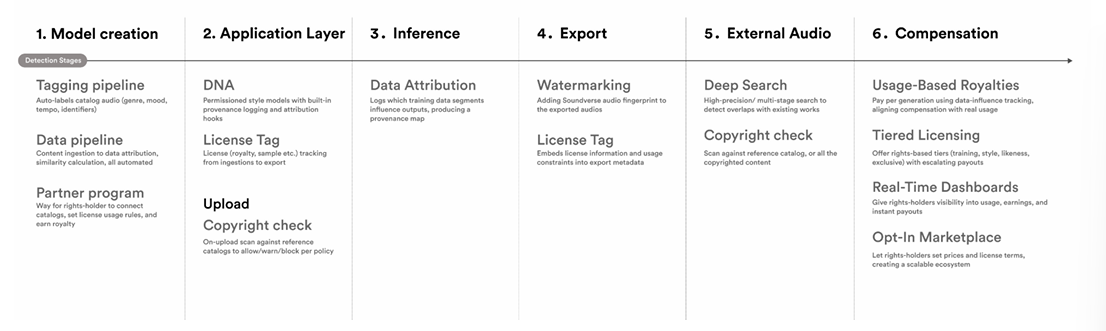
The Ethical AI Music Framework by Soundverse was created to protect creative integrity while enabling innovation. It’s a comprehensive end-to-end infrastructure that ensures transparency from dataset acquisition to monetization. Instead of using black-box AI systems, it employs a six-stage pipeline:
- Licensed Data Sourcing (No scraping): All training data originates from licensed or opt-in partners, ensuring full author and rights-holder consent.
- Permissioned Models (DNA): Models are trained with Soundverse DNA — artist-approved sonic identifiers that preserve stylistic ownership.
- Explainable Inference (Attribution): Every generated track includes metadata tracing its stylistic sources for proper credit.
- Traceable Export (Watermarking): Each song export embeds a secure watermark linking back to its source model.
- Deep Search (External Scanning): This stage verifies that AI-generated works have not unintentionally replicated protected recordings.
- Recurring Compensation (Partner Program): Artists receive ongoing royalties based on usage, ensuring a sustainable creative economy.
Real-world applications
- Enterprise compliance: Music brands use the framework to certify songs as ethically sourced before commercial release.
- Artists’ rights: Musicians can safely contribute their catalogs to the system and earn from future generations.
- Education and research: Scholars study transparent attribution chains to understand how AI models evolve.
Together with related tools such as Soundverse Trace for deep attribution scanning and the Content Partner Program for automated royalty tracking, Soundverse ensures that AI innovation remains aligned with artistic dignity.
The future of ethical AI and cultural responsibility
By 2026, the role of AI in music production is intertwined with moral consciousness. Generative technologies can either amplify humanity’s cultural richness or reduce it to algorithmic mimicry. The difference lies in responsible design. Frameworks like Soundverse’s demonstrate that ethical transparency is not just good practice — it’s a creative advantage.
Looking ahead, experts predict that National Music Councils and digital labels will standardize AI auditing in licensing policies, echoing the same value system embedded in Soundverse’s infrastructure. As the boundaries between human and machine blur, maintaining cultural context, consent, and compensation remains the ethical compass guiding progress.
Create Thoughtful AI Music Today
Explore Soundverse’s cutting-edge AI music tools and bring your creative vision to life while respecting cultural authenticity and artistry.
Start Creating with Soundverse
Related Articles
- The Role of AI Music in Film and Television: Discover how AI soundscapes are transforming soundtrack creation and storytelling in visual media.
- AI Music Generator and Human Composers: A Future Together: Learn how AI complements human creativity and opens new possibilities for collaboration in music production.
- How an AI Music Generator Inspires Creative Fusion: Explore the artistic synergy that happens when AI assists musicians in merging genres and unique influences.
- AI Music in the USA: Understand how AI-generated music is shaping the American music scene and influencing cultural trends.
Here's how to make AI Music with Soundverse
Video Guide

Here’s another long walkthrough of how to use Soundverse AI.
Text Guide
- To know more about AI Magic Tools, check here.
- To know more about Soundverse Assistant, check here.
- To know more about Arrangement Studio, check here.
Soundverse is an AI Assistant that allows content creators and music makers to create original content in a flash using Generative AI. With the help of Soundverse Assistant and AI Magic Tools, our users get an unfair advantage over other creators to create audio and music content quickly, easily and cheaply. Soundverse Assistant is your ultimate music companion. You simply speak to the assistant to get your stuff done. The more you speak to it, the more it starts understanding you and your goals. AI Magic Tools help convert your creative dreams into tangible music and audio. Use AI Magic Tools such as text to music, stem separation, or lyrics generation to realise your content dreams faster. Soundverse is here to take music production to the next level. We're not just a digital audio workstation (DAW) competing with Ableton or Logic, we're building a completely new paradigm of easy and conversational content creation.
TikTok: https://www.tiktok.com/@soundverse.ai
Twitter: https://twitter.com/soundverse_ai
Instagram: https://www.instagram.com/soundverse.ai
LinkedIn: https://www.linkedin.com/company/soundverseai
Youtube: https://www.youtube.com/@SoundverseAI
Facebook: https://www.facebook.com/profile.php?id=100095674445607
Join Soundverse for Free and make Viral AI Music

We are constantly building more product experiences. Keep checking our Blog to stay updated about them!