AI Music and Cultural Equity: Building a Fair Future for Creative Technology in 2026
Explore how AI music is advancing cultural equity and fair representation through ethical frameworks in 2026.
AI Music and Cultural Equity
In 2026, AI music has evolved from a niche novelty into a cornerstone of global creative industries. As artificial intelligence systems generate increasingly sophisticated compositions and sonic landscapes, questions about cultural equity, fair representation, and ethical collaboration have moved to the forefront. Music professionals, developers, and policy makers are asking not only what AI can do but how it can do so responsibly.
What is AI music and why does cultural equity matter in 2026?
AI music refers to compositions or soundscapes produced or influenced by machine learning algorithms. These systems analyze vast databases of musical patterns to generate original tracks or assist creators with songwriting, arrangement, and production. By 2026, such tools have become essential for content creators, sound designers, and even education platforms.
Yet, as artificial creativity spreads globally, cultural equity has become a defining concern. The use of unlicensed datasets, lack of transparency, and the underrepresentation of minority sound traditions have raised alarms among cultural researchers. Ethical development of AI music now requires that creators, artists, and technologists prioritize fairness in data sourcing, representation, and compensation.
How is the music industry addressing fair representation in AI-generated music?
In the past, many AI models were trained on web-scraped audio without permissions. This practice excluded underrepresented artists and reinforced existing systemic biases. Cultural integrity in 2026 means more than protecting copyrights—it involves proactively including a wide range of musical heritages and ensuring that every sound identity has a voice.

Various initiatives are leading this transformation. Music technology companies are integrating licensed data partnerships, creating transparent pipelines, and supporting attribution-based royalty systems. For developers and rights-holders alike, these frameworks allow creative participation without exploitation. This mirrors global trends where major labels are investing in AI partnerships, such as Universal Music Group's strategic collaboration with NVIDIA, to ensure transformative yet ethical applications of AI in music.
How do ethics shape AI in creative arts today?
Music technology ethics in 2026 blend data responsibility with human artistry. Ethical frameworks now influence how AI models are trained, how outputs are distributed, and how artists receive recognition. Transparency, consent, and fair compensation have become the three pillars of innovation.
Ethical AI in creative arts means developing infrastructure that prevents cultural homogenization. Instead of producing generic tracks disconnected from origin, responsible systems help preserve stylistic authenticity. They also protect against cultural appropriation by enforcing consent-based data usage.
AI developers must now treat cultural datasets as living archives, ensuring diversity in digital music. Industry examples include platforms that collaborate with local artists to encode unique rhythmic or tonal identities—transforming AI from an imitator into a respectful amplifier of global creativity. Forums such as the Music Sustainability Forum 2026 highlight how ethics, labor, and cultural policy now intertwine.
What challenges stand in the way of cultural equity in AI music?
Although progress is substantial, challenges remain. Key obstacles include:
- Data bias – Historical preference for Western music styles leads to uneven model results.
- Opaque algorithms – Many AI systems still operate without clear attribution tracking.
- Economic disparity – Smaller artists often lack access to compensation mechanisms.
- Cultural misrepresentation – AI compositions can unintentionally blend elements from distinct traditions without context.
To overcome these issues, ethical infrastructure is essential—one that prioritizes transparency and fairness throughout the creative lifecycle. As noted in Halo Media's analysis of AI predictions for 2026, these challenges also open opportunities for collaboration and policy reform.
How to make AI music ethically with Soundverse The Ethical AI Music Framework
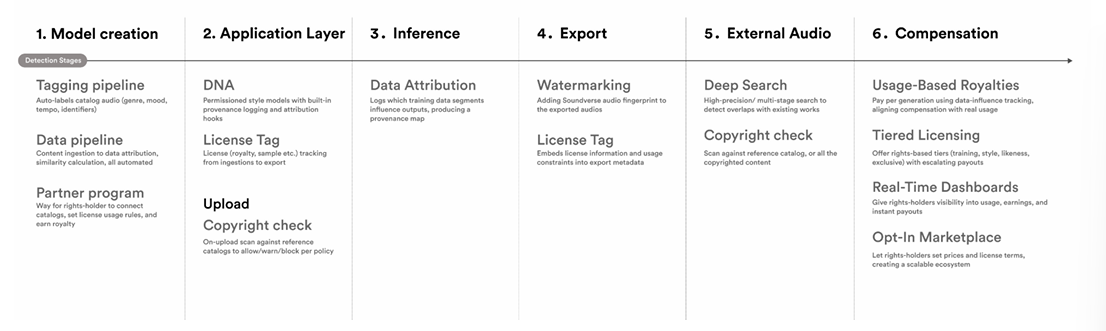
Soundverse has introduced The Ethical AI Music Framework, an end-to-end infrastructure designed for fair collaboration between AI and human artistry. It bridges innovation with artist integrity by replacing opaque systems with transparent, structured workflows that ensure consent, attribution, and recurring compensation.
Six Stages of the Ethical AI Music Framework
- Licensed Data Sourcing (No scraping) – Soundverse uses only explicitly licensed audio materials. Every dataset entry is verified for rights compliance and cultural authenticity.
- Permissioned Models (DNA) – Through Soundverse DNA, artists contribute their sonic identity via permission-based agreements, ensuring their work informs AI ethically.
- Explainable Inference (Attribution) – Every AI-generated track includes visible attribution metadata so creators, rights-holders, and auditors can trace musical origins.
- Traceable Export (Watermarking) – All exported audio is embedded with watermarking to link AI outputs to source permissions.
- Deep Search (External Scanning) – The system constantly scans external releases for attribution confirmation, protecting artists and verifying usage.
- Recurring Compensation (Partner Program) – Rights-holders receive royalties through the Content Partner Program, establishing an equitable monetization ecosystem.
This six-stage framework aligns enterprise compliance with cultural integrity, allowing music technologies to advance ethically. It also enables transparent collaboration between labels, artists, and AI developers without sacrificing creativity for legality.
Soundverse’s broader ecosystem reinforces this structured fairness. The Content Partner Program empowers artists to license their catalogs for AI training, earning usage-based royalties. Soundverse Trace serves as an audit trail, ensuring that all generated music remains copyright-safe. Meanwhile, Soundverse DNA personalizes creation by allowing music generation consistent with individual artistic identities.
For readers exploring alternative composition platforms, our resource on AI-generated music transformation offers insights into the broader impact of technology on artistry. Those seeking tools that respect artistic ownership can also review Soundverse AI Magic Tools or discover How to Create Country Music with Soundverse AI as practical examples of ethical generative workflows. For a deeper dive, watch our guide on creating Deep House music on the Soundverse YouTube channel.
Why cultural diversity matters in digital music
Cultural diversity in digital music is not only about inclusion—it’s about preserving sonic histories. In 2026, regional musical forms have become important datasets for AI learning. Folk rhythms from Africa, traditional melodies from Asia, and indigenous chanting from South America now inform balanced AI models.
Ensuring representation prevents cultural flattening. It also enables new creative possibilities: fusion genres, cross-border collaborations, and educational sound modules that teach history through music patterns. As companies apply ethical frameworks like Soundverse’s, these cultural data maps remain protected under consent-based licensing.
How can policy drive equitable AI music growth?
Policy makers have begun forming international working groups to establish fair standards for AI music. These include data licensing transparency, artist consent verification, and compensation tracking. 2026 marks the consolidation of global music data ethics charters, guiding technology companies toward responsible data governance.
By integrating ethical frameworks like Soundverse’s, institutions can bridge cultural gaps and reinforce sustainability. The collaboration between creative sectors and AI means that cultural traditions are not just preserved—they are evolved through safe digital innovation. Reports such as Manatt’s 2026 music business forecast and Bloomberg’s coverage on AI’s influence on music both confirm that 2026 marks a pivotal moment in the ethical transformation of the music industry.
For those evaluating the broader transformation of the music industry, our article on music industry trends outlines how ethics drive technological growth. Additionally, artists exploring fair participation can learn more about opportunities through the Soundverse Affiliate Program.
Start Creating Culturally-Inspired AI Music Today
Unlock the power of Soundverse to explore new genres, preserve traditions, and create music that speaks across cultures—all powered by AI. Join creators redefining the sound of the future.
Create Music with AI
Related Articles
- How an AI Music Generator Inspires Creative Fusion: Discover how AI music tools are sparking new waves of global collaboration and cultural creativity.
- AI Music Generator and Human Composers: A Future Together: Explore how human creativity and AI composition can coexist to create powerful, innovative music experiences.
- The Role of AI Music in Film and Television: Learn how AI music is shaping the soundscape of modern entertainment while keeping cultural relevance alive.
- AI Music in the USA: A deep dive into how AI-generated music is evolving within America's diverse cultural framework.
Here's how to make AI Music with Soundverse
Video Guide

Here’s another long walkthrough of how to use Soundverse AI.
Text Guide
- To know more about AI Magic Tools, check here.
- To know more about Soundverse Assistant, check here.
- To know more about Arrangement Studio, check here.
Soundverse is an AI Assistant that allows content creators and music makers to create original content in a flash using Generative AI. With the help of Soundverse Assistant and AI Magic Tools, our users get an unfair advantage over other creators to create audio and music content quickly, easily and cheaply. Soundverse Assistant is your ultimate music companion. You simply speak to the assistant to get your stuff done. The more you speak to it, the more it starts understanding you and your goals. AI Magic Tools help convert your creative dreams into tangible music and audio. Use AI Magic Tools such as text to music, stem separation, or lyrics generation to realise your content dreams faster. Soundverse is here to take music production to the next level. We're not just a digital audio workstation (DAW) competing with Ableton or Logic, we're building a completely new paradigm of easy and conversational content creation.
TikTok: https://www.tiktok.com/@soundverse.ai
Twitter: https://twitter.com/soundverse_ai
Instagram: https://www.instagram.com/soundverse.ai
LinkedIn: https://www.linkedin.com/company/soundverseai
Youtube: https://www.youtube.com/@SoundverseAI
Facebook: https://www.facebook.com/profile.php?id=100095674445607
Join Soundverse for Free and make Viral AI Music

We are constantly building more product experiences. Keep checking our Blog to stay updated about them!