AI Music and Copyright Law: A Simple Breakdown
Understand AI music copyright, legal rules, and artist protection in 2026.
AI Music and Copyright Law: A Simple Breakdown
In 2026, debates around AI music copyright have become central to the relationship between technology and creativity. As generative tools—like AI music platforms—transform how artists compose, produce, and distribute music, legal questions about ownership, authorship, and compensation have grown more complex. Musicians, producers, and legal professionals alike are looking for practical clarity: who owns an AI-generated song, and how can creators protect their rights in a landscape where algorithms contribute as much as humans?
What exactly is AI music copyright?
AI music copyright refers to the legal framework that defines ownership and protection of music made using artificial intelligence. Unlike traditional works, AI-generated songs raise unique challenges: the creator may not be a single human, and the composition may be built from training data drawn from thousands of existing recordings. The central issue is whether an AI-created composition qualifies for copyright protection—and, if so, under whose name.
In most jurisdictions as of 2026, copyright protection requires a degree of human authorship. This means that purely automated outputs—where no significant human input shapes composition or selection—may not be legally protected as creative works. However, when a producer uses AI interactively—inputting descriptions, selecting styles, or refining arrangements—the resulting music often qualifies for joint authorship, with the human recognized as the principal creator.

How do copyright rules handle AI-generated songs?
Governments and courts worldwide continue to refine music copyright rules for AI-generated songs. The current trend emphasizes transparency and consent during AI model training. Unauthorized scraping of copyrighted music to train AI models has drawn major legal disputes between rightsholders and tech companies. In future-forward legal frameworks, transparency and licensed data are paramount. A U.S. Copyright Office decision in 2025 confirmed that AI-generated works can qualify for registration if they embody meaningful human authorship, a landmark shift in policy direction.
By 2026, several nations—including those within the EU and parts of Asia—have adopted regulations requiring documented datasets and licensed permissions for generative music tools. In the United States, discussion continues, but the direction favors disclosure, consent, and traceable attribution. These shifts align with the music industry's push for ethical AI integration, allowing technology and artistry to coexist responsibly.
What role does intellectual property play in AI-created music?
Intellectual property and AI are now deeply intertwined. The underlying principle is simple: creativity deserves protection, regardless of whether its medium is analog or algorithmic. However, traditional IP laws were never designed for non-human creators. As a result, lawyers and policy makers have introduced hybrid frameworks addressing ownership of AI-generated music.
Intellectual property and AI innovations rely on three core pillars:
- Human oversight: Music created with AI is copyrightable if a human participates meaningfully.
- Data transparency: Training data must be ethically sourced and properly licensed.
- Attribution: Systems must record contribution lineage, ensuring credit to all stakeholders.
These standards support responsible creativity while discouraging unlicensed copying or misuse of existing works.
Why are legal professionals focused on AI in entertainment law in 2026?
Entertainment law has evolved dramatically to accommodate AI technologies. As generative platforms produce commercial tracks, the legal focus shifts from traditional music publishing disputes to legal AI music questions about ownership, royalty rights, and contractual obligations.
In 2026, entertainment law firms increasingly specialize in digital licensing and algorithmic authorship. They assist record labels and creators in registering AI-assisted tracks, negotiating data licenses, and verifying that their creative content won’t be infringed upon. The rise of AI in entertainment law parallels rising demand for transparent audit trails—essential for proving originality in court. For a deeper dive, watch our guide on how to make music from the Soundverse Tutorial Series.
What challenges exist for musicians and producers using AI tools?
Musicians using AI for composition face two main challenges:
- Legal uncertainty: Though laws are evolving, the absence of global uniformity means musicians must check local regulations before release.
- Data ethics: Some AI platforms still rely on scraped libraries of copyrighted music, posing risks for users who unknowingly publish derivative content.
Producers aiming to safeguard their creative integrity need tools that respect data rights and ensure continuous compensation for artists whose work contributes to AI training. This need has given rise to transparent frameworks such as Soundverse’s Ethical AI Music Framework.
How to make compliant AI music with Soundverse The Ethical AI Music Framework
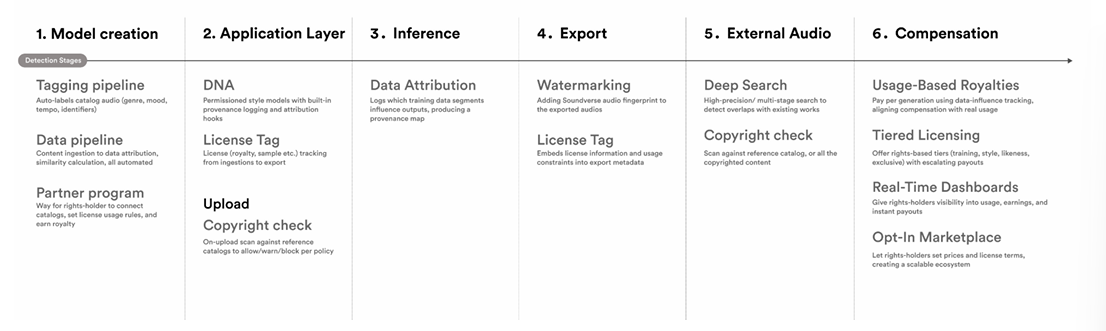
Soundverse’s Ethical AI Music Framework provides an infrastructure designed explicitly for organizations and creators who demand legal compliance and artist protection in AI music generation. Instead of relying on black-box datasets or opaque training pipelines, Soundverse uses a six-stage process that ensures consent, attribution, and recurring compensation.
Six Core Capabilities
- Licensed Data Sourcing (Stage 1): All audio used for AI training is obtained via license agreements, with no scraping or unauthorized imports.
- Permissioned Models (Stage 2): Soundverse uses permissioned DNA layers—meaning every model is aware of its authorized dataset scope.
- Explainable Inference (Stage 3): Every generated result can be traced to its creative influences through attribution reports.
- Traceable Export (Stage 4): Every track exported from Soundverse is watermarked to guarantee traceability and protect against misuse.
- Deep Search (Stage 5): External scanning capabilities detect similar melodies or samples in public databases, helping prevent infringement.
- Recurring Compensation (Stage 6): Artists contributing to AI training benefit from continuous royalties through the Soundverse Partner Program.
By following this ethical framework, musicians can create AI songs without worrying about future legal disputes. It bridges innovation with artist integrity, serving as a trusted foundation for enterprises looking to scale legally compliant AI music production. You can also explore our tutorial on making Deep House music for practical insights.
Related Solutions
Soundverse complements this framework with specialized tools:
- Soundverse Trace: Embeds attribution and rights protection from dataset creation to export lifecycle.
- Content Partner Program: Empowers rights-holders to contribute licensed audio in exchange for automatic royalty payouts.
These solutions make Soundverse the leading choice for transparent and legally sound AI music creation.
How do these frameworks reshape the music industry?
Legal compliance no longer slows innovation—it drives it. When systems such as Soundverse integrate ethical data sourcing and attribution by design, artists gain confidence and enterprises avoid litigation. As seen in ongoing evolution discussed in Music Industry Trends, transparent frameworks redefine how creative professionals collaborate with AI while keeping ownership clear.
Similarly, creators looking for responsible alternatives to other platforms can explore Mubert Alternatives or Soundraw Alternative, which highlight Soundverse’s superior compliance-infrastructure.
Legal clarity also boosts creative freedom. When producers can verify attribution using Soundverse AI Magic Tools, their trust in AI workflow increases, leading to more music innovation without risk.
What’s next for AI music copyright in 2026 and beyond?
Looking ahead, AI music copyright law is expected to pivot toward global standardization. Industry leaders advocate for interoperable rights registries—systems where AI-generated compositions are logged with their dataset lineage and creator metadata. Traceable exports and permissioned models will become the industry norm.
The conversation has shifted from prohibiting AI to guiding it responsibly. As intellectual property frameworks mature, musicians will gain new licensing opportunities, and legal compliance will increasingly enjoy automation. The future of legal AI music is not about restriction—it’s about recognition and fair collaboration between algorithmic intelligence and human creativity.
Start Creating Copyright-Safe AI Music Today
Harness Soundverse’s advanced AI tools to produce original tracks that are royalty-free and legally secure. Create, remix, and share with full confidence in your ownership.
Related Articles
- Enhancing YouTube Content with Royalty-Free and Copyright-Free Music Using Soundverse AI: Discover how Soundverse helps YouTube creators use legally safe music while elevating video production quality.
- Copyright-Free vs Royalty-Free Music: What Creators Should Know: Understand the key differences between copyright-free and royalty-free music and learn how to protect your creative rights.
- Navigating the World of Royalty-Free and Copyright-Free Music Using Soundverse AI: A guide for creators on how to navigate music licensing and simplify copyright compliance using AI-powered tools.
- The Role of AI Music in Film and Television: Explore how AI-generated music is transforming soundtracks and reshaping copyright frameworks in entertainment.
Here's how to make AI Music with Soundverse
Video Guide

Here’s another long walkthrough of how to use Soundverse AI.
Text Guide
- To know more about AI Magic Tools, check here.
- To know more about Soundverse Assistant, check here.
- To know more about Arrangement Studio, check here.
Soundverse is an AI Assistant that allows content creators and music makers to create original content in a flash using Generative AI.
With the help of Soundverse Assistant and AI Magic Tools, our users get an unfair advantage over other creators to create audio and music content quickly, easily and cheaply.
Soundverse Assistant is your ultimate music companion. You simply speak to the assistant to get your stuff done. The more you speak to it, the more it starts understanding you and your goals.
AI Magic Tools help convert your creative dreams into tangible music and audio. Use AI Magic Tools such as text to music, stem separation, or lyrics generation to realise your content dreams faster.
Soundverse is here to take music production to the next level. We're not just a digital audio workstation (DAW) competing with Ableton or Logic, we're building a completely new paradigm of easy and conversational content creation.
TikTok: https://www.tiktok.com/@soundverse.ai Twitter: https://twitter.com/soundverse_ai Instagram: https://www.instagram.com/soundverse.ai LinkedIn: https://www.linkedin.com/company/soundverseai Youtube: https://www.youtube.com/@SoundverseAI Facebook: https://www.facebook.com/profile.php?id=100095674445607
Join Soundverse for Free and make Viral AI Music

We are constantly building more product experiences. Keep checking our Blog to stay updated about them!