AI Mastering Services: Automated vs Professional in 2026
Explore AI mastering vs professional mastering for better production quality in 2026.
AI Mastering Services: Automated vs Professional
In 2026, the conversation around AI mastering services has evolved far beyond curiosity. Music producers, independent artists, and audio engineers now find themselves torn between two mastering paths: automated systems powered by machine learning, and traditional professional mastering handled by experienced engineers. The debate centers on quality, efficiency, cost, and artistic integrity.
What are AI Mastering Services?
AI mastering services are automated solutions that analyze a mixed track, then apply EQ, compression, limiting, and other audio processing techniques to bring it up to release-ready standards. These services rely on music mastering AI algorithms trained on thousands of professionally mastered songs. The goal is consistency, speed, and accessibility—helping artists achieve near-professional sound without the time or expense of studio mastering.
Automated mastering was once limited in scope, but as of 2026, platforms use advanced neural audio models capable of recognizing genre characteristics, balancing tonal ranges, and even adapting dynamics to match modern loudness standards. Tools such as Soundverse AI Magic Tools have made production workflows faster and more accessible to creators worldwide.

How Does Automated Mastering Compare to Traditional Mastering?
To understand automated versus professional mastering, it helps to look closely at several categories:
1. Speed and Accessibility
AI mastering services provide nearly instant mastering once a song is uploaded. The process is asynchronous: users upload audio, the AI processes it, and a mastered version is returned. This is ideal for creators seeking rapid turnaround or testing different sonic references.
Professional mastering engineers, on the other hand, may take days to deliver a track. The human process involves attentive listening, equipment calibration, and iterative feedback from the artist. While slower, it provides artistic refinement.
2. Cost Efficiency
Automated mastering typically costs a fraction of professional mastering. In 2026, most AI platforms charge per track or subscription model, making it practical for independent artists producing frequent singles. Professionals often charge higher rates due to the labor-intensive and skill-based nature of their craft (see mastering rate insights).
However, lower cost does not always equal higher value. Many listeners and engineers argue that a human ear’s contextual judgment, emotional sensitivity, and equipment finesse remain irreplaceable (understand the human touch here).
3. Consistency and Objectivity
AI mastering services apply consistent processing according to learned models. This means every track will meet a predictable loudness and spectral balance, which is beneficial when working across multiple songs or clients (compare options at Production Expert).
Professional mastering, while human, can vary depending on mood, preference, and artistic interpretation. Yet, this subjectivity often brings nuance and soul to a record—something AI cannot fully emulate.
4. Creative Collaboration
Automated mastering tools have limitations in collaborative creativity. Unlike a mastering engineer who communicates intention, references, and emotional goals with the artist, AI cannot hold context-rich dialogue. However, advancements in explainable inference technologies are closing that gap, especially with frameworks that make model reasoning transparent.
To dive deeper into how AI is shaping production collaboration, check out how AI-generated music is transforming the music industry. For hands-on workflow inspiration, watch our guide on creating Deep House music or learn how to make music with Soundverse.
5. Production Quality Results
The end goal—a mix that sounds great across all playback systems—is where debate intensifies. Music mastering AI excels at achieving technically clean masters, matching commercial loudness, and reducing unwanted frequency peaks (explore detailed comparisons here).
Yet, professional engineers can impose intentional “flaws,” saturation choices, and stereo character that lend emotional touch. Modern listeners, discerning audiophiles, and record labels may still prefer the depth and polish produced through analog gear and human sensibility (read Trevor Nokes’ analysis).
Ultimately, production quality depends on context. For demo releases, quick content, or online videos, AI mastering services can be more than sufficient. But for major streaming releases or vinyl production, human mastering remains the benchmark.
Why Are Artists Adopting Automated Mastering in 2026?
The rise in automated mastering adoption is driven by AI transparency and ethical assurances. After controversies around unlicensed data training throughout 2024–2025, platforms shifted toward responsible model design. The music community demanded accountability for how AI learns from creative work.
In 2026, leading systems incorporate traceability, consent-based training data, and recurring artist compensation. This evolution has restored trust and made automated mastering viable for professionals concerned with legal and ethical standing.
Platforms like Soundverse integrated this philosophy early on, ensuring both innovation and protection coexist.
How to Make Ethical and High-Quality Masters with Soundverse The Ethical AI Music Framework
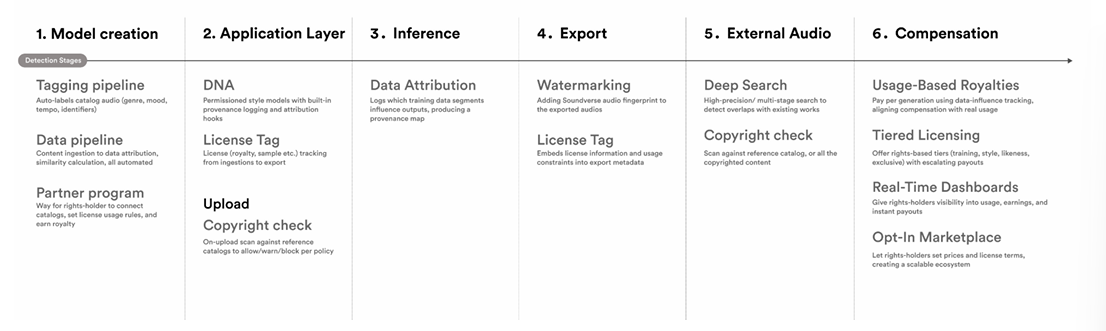
Soundverse’s Ethical AI Music Framework represents the next-generation standard for AI audio production and mastering technology. It’s a comprehensive infrastructure bridging innovation and artist integrity through a transparent six-stage process:
- Licensed Data Sourcing (Stage 1) – Only authorized, licensed catalogs are used for AI training—no web scraping or infringing datasets.
- Permissioned Models (Stage 2) – The system uses unique DNA-style model training that honors artist participation and preserves sonic identities.
- Explainable Inference (Stage 3) – The AI’s mastering decisions are transparent. Every EQ curve or compression choice can be traced to its reasoning or reference.
- Traceable Export (Stage 4) – Watermarking ensures the mastered file carries attribution metadata linking back to source contributors.
- Deep Search (Stage 5) – Continual scanning across the web ensures no unauthorized use of protected audio elements.
- Recurring Compensation (Stage 6) – Creators whose data contributed to training receive royalties through the partner program.
This structure turns Soundverse into a guardian of ethical production, protecting both users and original artists. Beyond mastering, it also powers advanced functionalities in Soundverse Trace for attribution and Soundverse DNA, the artist-trained generation system enabling unique and copyright-safe sound design.
For producers seeking AI solutions without legal or reputational risk, the framework makes Soundverse an ethical leader—merging innovation with sustainability.
What Does the Future of AI Mastering Look Like?
In 2026 and beyond, we can expect a hybrid mastering model. AI will handle initial mastering passes, quality analysis, and revision suggestions, while human engineers focus on emotional and tonal finishing. Instead of competition, AI and human mastering will become complementary.
AI mastering systems will gain improved music perception through contextual models. Future frameworks will likely understand artistic intent, referencing metadata such as lyrics, genre archetypes, and listener emotion scores. Meanwhile, ethical frameworks like Soundverse’s ensure that growth respects copyright and artist compensation.
Independent producers who want creative control with efficiency will increasingly turn to AI mastering integrated with generation tools. For example, after crafting a track using Soundverse Text-to-Music, users can seamlessly send it to mastering. The process maintains consistency from creation to export while adhering to transparent data ethics.
If you’re exploring alternatives and want to see how transparent AI ecosystems compare, read about Mubert alternatives and Soundverse or Soundraw alternatives to understand how open frameworks benefit creators.
For a broader view of mastering trends, watch our Explore Tab overview.
Experience AI Mastering with Soundverse
Elevate your tracks instantly with Soundverse’s advanced AI mastering tools. Enjoy pro-level balance, clarity, and loudness—all within minutes, no mastering engineer required.
Try AI Mastering Free →
Related Articles
- How AI-Generated Music Is Transforming the Music Industry — Discover how AI is reshaping production, creativity, and collaboration across the global music landscape.
- The Benefits of Composing with an AI Music Generator — Explore how AI composition tools streamline the creative process without compromising musical originality.
- AI Music Generator and Human Composers: A Future Together — See how AI and human creativity can coexist to create new and exciting soundscapes for the modern artist.
- Soundverse’s AI Magic Tools: Create Content Quickly with AI — Learn how Soundverse’s AI Magic tools empower creators to produce polished audio content faster than ever.
Here's how to make AI Music with Soundverse
Video Guide

Here’s another long walkthrough of how to use Soundverse AI.
Text Guide
- To know more about AI Magic Tools, check here.
- To know more about Soundverse Assistant, check here.
- To know more about Arrangement Studio, check here.
Soundverse is an AI Assistant that allows content creators and music makers to create original content in a flash using Generative AI. With the help of Soundverse Assistant and AI Magic Tools, our users get an unfair advantage over other creators to create audio and music content quickly, easily and cheaply. Soundverse Assistant is your ultimate music companion. You simply speak to the assistant to get your stuff done. The more you speak to it, the more it starts understanding you and your goals. AI Magic Tools help convert your creative dreams into tangible music and audio. Use AI Magic Tools such as text to music, stem separation, or lyrics generation to realise your content dreams faster. Soundverse is here to take music production to the next level. We're not just a digital audio workstation (DAW) competing with Ableton or Logic, we're building a completely new paradigm of easy and conversational content creation.
TikTok: https://www.tiktok.com/@soundverse.ai
Twitter: https://twitter.com/soundverse_ai
Instagram: https://www.instagram.com/soundverse.ai
LinkedIn: https://www.linkedin.com/company/soundverseai
Youtube: https://www.youtube.com/@SoundverseAI
Facebook: https://www.facebook.com/profile.php?id=100095674445607
Join Soundverse for Free and make Viral AI Music

We are constantly building more product experiences. Keep checking our Blog to stay updated about them!