Why Ethical Defaults Matter in AI Music Design
Explore why ethical defaults in AI music design matter and how Soundverse leads the way in responsible, transparent, and artist-first AI music innovation in 2026.
Why Ethical Defaults Matter in AI Music Design
The conversation around ethical AI music design has evolved rapidly as the creative technology sector matures in 2026. With artificial intelligence now central to music production, distribution, and monetization, ethical defaults — the foundational design choices that determine how AI behaves — have never been more critical. When these systems generate art that interacts with human identity and creativity, the responsibility extends beyond code efficiency or sonic innovation—it becomes about cultural stewardship.
What does ethical AI music design mean in 2026?
Ethical AI music design refers to the practice of building and deploying AI systems that create or assist in music production with fairness, consent, transparency, and accountability as core principles. These systems are intentionally structured to respect artists’ rights, ensure attribution, and avoid unethical data sourcing. By 2026, this topic has moved from a theoretical debate to an operational necessity across recording studios, streaming services, and enterprise-level AI vendors.

Ethical defaults go beyond compliance. They dictate the system’s inherent moral posture — whether it assumes permission before use, credits contributors automatically, or prescribes how outputs are shared and monetized. When AI models generate music without licensed data or proper attribution, they undermine creators and erode trust in the technology. By contrast, ethically designed frameworks enhance value for every participant in the creative chain.
Why have ethical defaults become so important for AI-generated music?
The music industry and AI have intertwined more deeply since 2024, when generative audio tools began democratizing production. By 2026, major record labels, independent artists, and developers are demanding auditable and permission-aware ecosystems. Without ethical defaults, AI-generated music risks violating copyright laws, diluting authenticity, and perpetuating harm against original creators.

Ethical defaults serve as a preventive mechanism. They ensure that data is properly licensed, artists are compensated fairly, and outputs remain transparent. This approach builds confidence in AI-generated music as a legitimate form of creative expression, not a mechanical mimicry of human art.
The call for ethical technology in creative arts intensified after multiple high-profile disputes around dataset ownership in 2025. Artists demanded that platforms clarify how their voices, melodies, or compositions were being used to train models. The result was a global shift toward responsible AI design — a discipline that combines legal, technological, and moral frameworks for sustainable digital creativity.
What challenges do developers face in ensuring AI ethics in music?
Even when intentions are good, achieving true AI ethics in music is complex. Developers must reconcile innovation with artist protection. Challenges include:
- Dataset consent and transparency: AI systems rely heavily on large datasets. Without clear consent protocols, datasets may contain copyrighted works, creating legal and ethical conflicts.
- Attribution tracking: It’s often difficult to trace how a generated piece was influenced by specific training materials. Without traceability, fair attribution becomes impossible.
- Compensation structures: Traditional royalty systems weren’t built for generative AI. Tools that can automatically generate thousands of compositions need scalable frameworks for equitable payment.
- Cross-border legal differences: Global AI deployment introduces conflicts between jurisdictions with varying copyright and data privacy laws.
These challenges have made the search for responsible AI design frameworks an urgent priority in 2026. Organizations are investing in explainable systems that document their creative lineage and provide an auditable chain of generation.
How are ethical defaults integrated into responsible AI design?
Designing ethical defaults means programming ethical behavior from the start rather than treating it as an afterthought. In AI music creation, this can take several forms:
- Transparent data policies: Every dataset used to train AI music models should have traceable provenance and explicit licensing agreements.
- Explainable model architecture: Generative systems must be explainable — users should know how the AI derived a musical pattern or why it sounds a certain way.
- Opt-in contribution programs: Musicians should have the option to contribute data knowingly, benefiting from usage-based royalties and co-ownership structures.
- Built-in attribution and watermarking: Ethical defaults require that every output carries metadata linking it to its source influences or contributors.
These mechanisms not only ensure legal compliance but also establish AI as a credible partner in artistic innovation rather than an exploitative tool. As more creators and researchers turn toward AI-generated music, the expectation is that every system upholds these baseline principles. For a deeper dive, watch our guide on creating Deep House music.
How to make ethical AI music design work with Soundverse The Ethical AI Music Framework
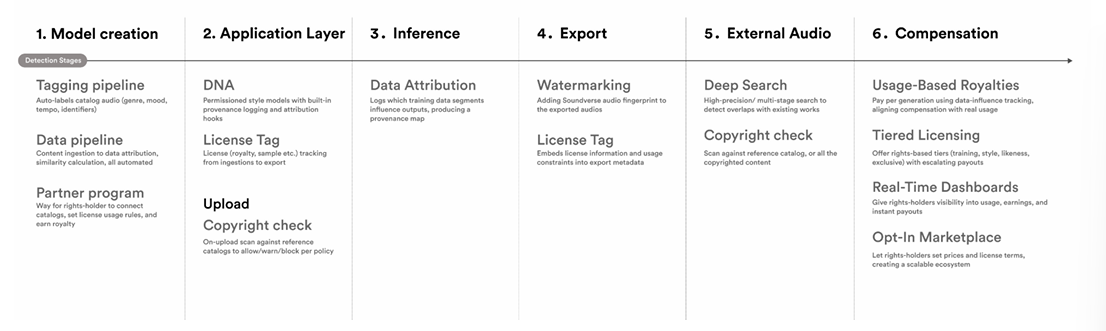
Soundverse sets a benchmark in 2026 for aligning creative innovation with ethical integrity. Its Ethical AI Music Framework is a comprehensive, six-stage infrastructure that ensures transparency and fairness at every point in the AI music lifecycle. Rather than relying on opaque black-box models, Soundverse is structured around explainable, permissioned processes that link human creativity to machine intelligence responsibly.
Core capabilities that define Soundverse’s ethical approach:
- Stage 1: Licensed Data Sourcing (No scraping) – Only licensed catalogs are used for training. Soundverse avoids scraping publicly available content without consent, resulting in a dataset that’s legally robust and morally sound.
- Stage 2: Permissioned Models (DNA) – Through Soundverse DNA, artists can create AI versions of their own sonic identities. These permissioned models reflect genuine creative consent.
- Stage 3: Explainable Inference (Attribution) – Each generated output can be traced back to its underlying data sources, ensuring transparency in influence mapping.
- Stage 4: Traceable Export (Watermarking) – Every piece of AI-generated audio includes a digital watermark, maintaining attribution integrity during sharing and distribution.
- Stage 5: Deep Search (External Scanning) – Through integration with Soundverse Trace, users can scan for potential overlaps or unauthorized sample reuse across the internet.
- Stage 6: Recurring Compensation (Partner Program) – The Content Partner Program ensures ongoing revenue for rights-holders based on generated track usage, defining a fair economic model for ethical AI.
Together, these stages bridge the gap between AI innovation and artist protection, turning ethical defaults into operational realities.
How do ethical frameworks benefit the music industry in 2026?
Adopting ethical AI frameworks like Soundverse’s model benefits all stakeholders — from creators to developers and listeners:
- For artists, it means assurance that their work is respected, monetized, and traceable throughout its life cycle.
- For companies, it ensures legal compliance and brand trust, reducing reputational and financial risk.
- For researchers and technologists, it provides a model for replicable, transparent systems that can be audited and improved collaboratively.
The music industry and AI now coexist in a shared ecosystem of accountability. Platforms that once competed only on sound quality are now competing on values — ethical transparency is the new metric of innovation.
How can ethical AI design influence the future of creativity?
Ethical defaults shape how future creators and AI systems collaborate. Instead of replacing human musicians, AI becomes a contextual co-creator, honoring artistic DNA while enabling exponential creative diversity. When responsibly designed, AI bridges disciplines — from marketing jingles to film scoring — while reinforcing respect for original artistry.
Moreover, ethical frameworks expand creative possibilities for hybrid roles: engineers who understand music theory, artists who understand machine learning, and policymakers who navigate AI regulation. These new human-AI dynamics will define the next decade of digital art.
Create Music the Ethical Way—Start with Soundverse
Discover how our AI tools empower creators while upholding fairness and transparency in music design. Build tracks that honor your creative values and innovation ethics.
- How AI-Generated Music Is Transforming the Music Industry — Explore how AI is reshaping the music landscape and redefining composition, creativity, and collaboration across the industry.
- AI Music Generator and Human Composers: A Future Together — Learn how AI and human creativity can work side by side to create more expressive, innovative, and ethical music.
- The Role of AI Music in Film and Television — Discover how ethical AI design is influencing music production for visual media and ensuring creative integrity in storytelling.
- The Benefits of Composing with AI Music Generator — Find out how AI-assisted composition can boost productivity and creativity while respecting artistic ethics and originality.
Here's how to make AI Music with Soundverse
Video Guide

Here’s another long walkthrough of how to use Soundverse AI.
Text Guide
- To know more about AI Magic Tools, check here.
- To know more about Soundverse Assistant, check here.
- To know more about Arrangement Studio, check here.
Soundverse is an AI Assistant that allows content creators and music makers to create original content in a flash using Generative AI. With the help of Soundverse Assistant and AI Magic Tools, our users get an unfair advantage over other creators to create audio and music content quickly, easily and cheaply. Soundverse Assistant is your ultimate music companion. You simply speak to the assistant to get your stuff done. The more you speak to it, the more it starts understanding you and your goals. AI Magic Tools help convert your creative dreams into tangible music and audio. Use AI Magic Tools such as text to music, stem separation, or lyrics generation to realise your content dreams faster. Soundverse is here to take music production to the next level. We're not just a digital audio workstation (DAW) competing with Ableton or Logic, we're building a completely new paradigm of easy and conversational content creation.
TikTok: https://www.tiktok.com/@soundverse.ai
Twitter: https://twitter.com/soundverse_ai
Instagram: https://www.instagram.com/soundverse.ai
LinkedIn: https://www.linkedin.com/company/soundverseai
Youtube: https://www.youtube.com/@SoundverseAI
Facebook: https://www.facebook.com/profile.php?id=100095674445607
Join Soundverse for Free and make Viral AI Music

We are constantly building more product experiences. Keep checking our Blog to stay updated about them!