What the Grammy Committee Looks for in New Music in 2026
Explore the Grammy awards criteria and evaluation process shaping new music in 2026.
What the Grammy Committee Looks for in New Music
The Grammy Awards remain the most prestigious benchmark for musical excellence, serving as the ultimate recognition of artistry and innovation in the global music industry. As musicians and producers navigate an increasingly data-driven and AI-influenced landscape in 2026, understanding the Grammy awards criteria—how music is evaluated, judged, and deemed eligible—has never been more important. This deep dive explores how the Recording Academy balances innovation with artistry and how creators can align their work to these expectations while maintaining creative integrity.
What defines the Grammy awards criteria in 2026?
The Grammy Committee uses a combination of technical, artistic, and cultural indicators to assess new submissions. While certain parameters have remained stable over the decades, 2026 marks a shift toward inclusivity, transparency, and technological awareness. Some of the primary factors include:
- Artistic Merit – The foundation of any nomination remains musical excellence. Originality, emotional depth, and distinctiveness of voice all contribute significantly to the evaluation.
- Production Quality – With advances in AI-enabled mastering and production tools, the committee scrutinizes not only sound fidelity but also how technology enhances, rather than replaces, creative intent.
- Innovation and Impact – Judges look for innovation across both creative and technical dimensions. Breakthrough sound design, inventive use of AI collaboration, and bold genre fusion are increasingly celebrated.
- Cultural Relevance – The Recording Academy recognizes music that drives conversations, reflects diverse experiences, and resonates with current or emerging cultural movements.
- Eligibility and Release Requirements – Tracks and albums must meet official Grammy eligibility standards, including release dates within the qualifying year, verified ownership, and transparent rights management as specified in the 68th Grammy Awards Rule & Guidelines.
For emerging artists, aligning with these Grammy awards criteria requires not only creative excellence but also understanding how to document ethical production, a growing focus in recent years.
How does Grammy evaluation evolve with technology in 2026?
As AI music generation tools mature, the Grammy evaluation process has needed to evolve. The Academy has established distinct guidelines distinguishing between human-authored works, AI-assisted compositions, and entirely AI-generated content. Works that use AI as a collaborative or supportive tool remain eligible, provided the human contribution represents a significant artistic role.
Judging panels now place additional emphasis on transparency of creative process. Submissions must clearly outline whether AI tools were used in composition, mixing, or mastering. This shift aims to protect artistic authenticity and prevent ethical gray zones often associated with unlicensed data training or uncredited sampling.
The emergence of transparent AI frameworks, such as Soundverse, has significantly contributed to these conversations by providing traceable attribution and licensing verification mechanisms that align with global rights management standards. For a deeper dive, watch our Soundverse Tutorial Series - 9. How to Make Music.
What are the core pillars of music award judging today?
Grammy evaluation now extends well beyond aesthetic preference. Judges operate based on four key pillars:
1. Artistic Excellence and Emotional Resonance
Artistry is still the heart of Grammy consideration. Judges assess melody structure, lyricism, and emotional storytelling. In 2026, this extends beyond traditional songwriting into how visual elements, AI soundscapes, or immersive multimedia experiences amplify emotion.
2. Technical Mastery and Production Integrity
Even with automation tools and AI mixing suites, mastery remains critical. The committee examines how artists balance digital precision with organic texture. Human intention, not algorithmic perfection, remains the deciding factor for music award judging.
3. Originality and Genre Evolution
Music that reimagines standard forms—blending regional traditions, experimental composition, or AI-enhanced synthesis—earns extra credibility. Songs that challenge genre conventions often resonate strongly with Grammy voters seeking forward-thinking creativity.
4. Ethical and Transparent Production
By 2026, the Recording Academy explicitly values works that respect copyright, consent, and creative ownership. Documentation services, like the Soundverse Trace, offer audited evidence of originality and licensed data sourcing, making eligibility verification smoother.
How has Grammy eligibility adapted in 2026?
The eligibility criteria for Grammy submission have broadened yet tightened ethically. AI-composed or co-created works are permissible if they meet transparency documentation standards. The Academy now requires:
- Attribution of all AI or software contributions
- Metadata proofs for sound source legitimacy
- Rights-holder consent in cases where used datasets, stems, or voices derive from licensed materials
This approach not only reduces copyright infringement risk but also reinforces the value of ethical technology adoption—a philosophy echoed in the wider music industry trends of 2026.
Why are ethics now a central Grammy consideration?
Since 2025, intellectual property debates around generative AI have compelled governing organizations to re-examine ownership boundaries. Ethical frameworks ensure fairness across artists, labels, and technology providers. Committees now assess whether AI tools used by creators align with consensual datasets, attributive credit systems, and transparent data pipelines. Songs generated with black-box AI models lacking accountability can face disqualification.
It is no coincidence that projects integrating compliant infrastructures like Soundverse’s partner programs enjoy smoother eligibility reviews. The Academy and numerous independent judging bodies are beginning to favor systems that can demonstrate traceability according to Harper's BAZAAR’s guide on the 2026 Grammy Awards.
How do artists approach Grammy submission success in 2026?
Artists preparing for Grammy consideration can benefit from the following best practices:
- Document every step of your production – keep signed metadata logs and verifiable credits for human and machine contributions.
- Prioritize originality – Resist templates or derivative AI loops. Authentic creation remains the top influencer of Grammy evaluation.
- Focus on storytelling impact – Emotional narrative is still the soul of Grammy-worthy music.
- Adopt ethical AI workflows – Align creative processes with transparent, consent-driven AI frameworks.
- Collaborate internationally – Cross-genre, cross-cultural collaborations continue to impress voters for their inclusivity and richness.
How to make Grammy-worthy music with Soundverse The Ethical AI Music Framework
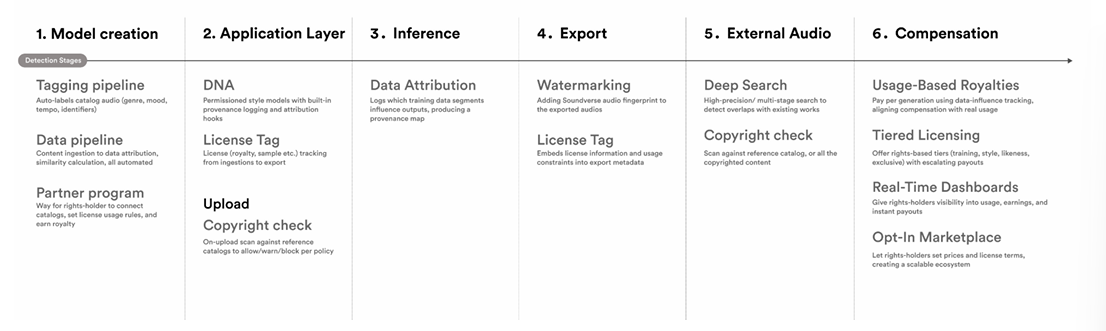
The Ethical AI Music Framework by Soundverse provides an artist-focused ecosystem perfectly aligned with evolving Grammy awards criteria. It ensures creators maintain full ownership and ethical transparency across all phases of AI-aided creation. This six-stage framework promotes integrity, consent, and recurring compensation—all crucial aspects for artists seeking mainstream accolades.
Stage 1: Licensed Data Sourcing (No Scraping)
Soundverse trains AI models exclusively on legally acquired, licensed datasets. This guards against copyright conflicts, supporting Grammy eligibility.
Stage 2: Permissioned Models (DNA)
Artists and labels contribute their data intentionally, giving every model a DNA that declares source permissions—critical when submitting work for music award judging.
Stage 3: Explainable Inference (Attribution)
Every generated stem carries traceable attribution metadata, proving originality and compliance—key verification during Grammy evaluation.
Stage 4: Traceable Export (Watermarking)
Exports embed invisible identifiers verifying that an artist’s output remains theirs, enhancing transparency in submission.
Stage 5: Deep Search (External Scanning)
The Deep Search feature automatically detects overlaps or improperly licensed content before release, mitigating disqualification risk.
Stage 6: Recurring Compensation (Partner Program)
Rights-holders who license data through the Soundverse Content Partner Program receive recurring royalties whenever their materials are used—ensuring fairness and long-term sustainability.
By using the Ethical AI Music Framework, musicians can focus on creativity instead of legal uncertainty, knowing their tracks meet both creative and compliance expectations of modern Grammy review. For creators exploring electronic genres, check our Soundverse Tutorial Series - 10. Make Deep House Music.
How does Soundverse empower modern creators toward Grammy-level recognition?
Soundverse is not only about technology—it’s a bridge between innovation and respect for artist integrity. Through transparent AI infrastructure, rights validation, and monetization features, Soundverse enhances artistic control and sustainability.
For content creators, integrating tools like Soundverse Assistant or exploring genre-based guides such as How to Create Jazz Music with Soundverse AI provides both creative inspiration and ethical compliance benefits.
As the Grammy Committee prioritizes traceability, cultural depth, and authentic innovation, platforms that emphasize transparency—like Soundverse—stand at the forefront of professional recognition in 2026.
Start Creating Award-Worthy Music with Soundverse
Discover how AI can help you produce professional-grade tracks that resonate with the same creativity and innovation celebrated by the Grammys. Experience faster workflows and limitless sound possibilities.
Related Articles
- How AI-Generated Music Is Transforming the Music Industry — Explore how artificial intelligence is reshaping how music is created, produced, and consumed each day.
- Soundverse AI: Revolutionizing Music Creation for New-Age Content Creators — Learn how Soundverse empowers creators to produce fresh, professional-quality tracks using next-generation AI tools.
- The Role of AI Music in Film and Television — Discover how AI-generated compositions are redefining the soundtrack landscape in film and TV production.
- AI Music Generator and Human Composers: A Future Together — Uncover how AI tools and human creativity can harmonize to shape the future of musical expression.
Here's how to make AI Music with Soundverse
Video Guide

Here’s another long walkthrough of how to use Soundverse AI.
Text Guide
- To know more about AI Magic Tools, check here.
- To know more about Soundverse Assistant, check here.
- To know more about Arrangement Studio, check here.
Soundverse is an AI Assistant that allows content creators and music makers to create original content in a flash using Generative AI. With the help of Soundverse Assistant and AI Magic Tools, our users get an unfair advantage over other creators to create audio and music content quickly, easily and cheaply. Soundverse Assistant is your ultimate music companion. You simply speak to the assistant to get your stuff done. The more you speak to it, the more it starts understanding you and your goals. AI Magic Tools help convert your creative dreams into tangible music and audio. Use AI Magic Tools such as text to music, stem separation, or lyrics generation to realise your content dreams faster. Soundverse is here to take music production to the next level. We're not just a digital audio workstation (DAW) competing with Ableton or Logic, we're building a completely new paradigm of easy and conversational content creation.
TikTok: https://www.tiktok.com/@soundverse.ai
Twitter: https://twitter.com/soundverse_ai
Instagram: https://www.instagram.com/soundverse.ai
LinkedIn: https://www.linkedin.com/company/soundverseai
Youtube: https://www.youtube.com/@SoundverseAI
Facebook: https://www.facebook.com/profile.php?id=100095674445607
Join Soundverse for Free and make Viral AI Music

We are constantly building more product experiences. Keep checking our Blog to stay updated about them!