What Makes a Song Grammy-Eligible in 2026?
Understand Grammy eligibility 2026, rules, and submission process.
What Makes a Song Grammy-Eligible in 2026?
The Grammy Awards remain the most prestigious recognition in the global music industry, celebrating excellence across performance, composition, and production. As we move through 2026, musicians, producers, and songwriters are asking one important question: what exactly makes a song Grammy-eligible this year? Understanding the Grammy eligibility 2026 framework is essential not only for artists aiming to win but also for music professionals navigating an ever-evolving landscape shaped by digital platforms, AI-assisted production, and ethical technology.
What does Grammy eligibility mean in 2026?
Grammy eligibility 2026 refers to the official criteria that determine whether a song, album, or recording qualifies for submission and consideration by the Recording Academy. Eligibility covers aspects such as release dates, distribution formats, originality, and authorship. The Recording Academy constantly updates its rules to reflect changes in music creation and distribution trends, particularly the inclusion of AI and streaming-dominated releases.
For 2026, the eligibility window typically covers songs released between October 1, 2024, and September 30, 2025. This aligns closely with the official Grammy eligibility window announcement. Works must be newly recorded or substantially different from prior versions. Moreover, tracks should be commercially available via recognized platforms — including major streaming services, digital stores, or physical releases.

What are the latest Grammy rules for AI-generated or AI-assisted music?
AI-generated music is no longer a fringe concept. However, the Recording Academy has clarified that for a song to be Grammy-eligible, human creative contribution remains mandatory. A completely AI-composed track with no human authorship does not qualify for a Grammy. Instead, submissions where AI was used as a tool — under the creative direction or authorship of a human — are accepted.
For instance, if a producer uses an AI system for instrumental generation but retains compositional control, edits the performance, and finalizes the master recording, that piece may qualify. This nuanced approach ensures artistic integrity while embracing innovation. On June 12, 2025, new eligibility updates were confirmed by the Recording Academy, reinforcing that human authorship is the foundation for qualification.
Musicians and producers leveraging AI tools to create music must ensure proper attribution, copyright clearance, and human oversight in their process. For practical implementation guidance, watch our Soundverse Tutorial Series - How to Make Music.
What are the music award criteria for song and album submissions?
To meet the Recording Academy’s music award criteria, entries must adhere to both technical and creative requirements:
- Originality: The song must feature original lyrics and compositions. Sampling or interpolation is allowed only if the necessary licenses are secured.
- Release Format: Entries must be released publicly and accessible to the general public via recognized digital or physical platforms.
- Authorship and Credits: Full credit lists are essential. Any contributing songwriter, producer, and featured artist must be disclosed.
- Audio Quality: The master recording must meet industry-standard audio specifications.
- Distribution Verification: Submissions should be verifiable through ISRC codes or distribution identifiers. Additionally, songs used in films, commercials, or games can qualify if they are primarily musical works, not just background pieces.
How does the Grammy submission process work in 2026?
The Grammy submission process involves three main phases: entry submission, screening, and voting.
- Submission Phase: Eligible members or registered entities submit their works via the Recording Academy’s official entry portal. During this stage, artists must confirm eligibility, copyrights, and distribution proof.
- Screening Phase: Expert panels review entries to validate their category placement and compliance. AI-assisted works undergo further review to confirm human authorship.
- Voting Phase: Voting members of the Academy cast ballots in their fields of expertise, leading to nomination rounds and final award decisions.
For a practical guide to preparing Grammy-ready tracks, you can explore the music industry trends shaping modern sound production and artist visibility in 2026. You can also check our Soundverse Tutorial Series - Explore Tab for navigation tips and insights.
What are the Recording Academy’s eligibility requirements for artists?
Grammy eligibility 2026 also extends to the individuals or groups submitting works. Artists must:
- Be officially credited by name on the submitted work.
- Ensure that the project was distributed commercially during the eligibility year.
- Provide accurate documentation verifying ownership or licensing rights.
- Confirm that human creative control guided any AI involvement.
These conditions apply across all categories, from Best New Artist to Song of the Year. The Academy emphasizes ethical creation practices, setting a clear precedent in the age of algorithmic music. For a hands-on tutorial, see our Soundverse Tutorial Series - Make Deep House Music.
How do ethical AI practices enhance Grammy compliance?
The ethical frontier of music production is one of 2026’s biggest talking points. Ethical AI frameworks ensure that artists retain ownership, credit, and fair compensation even when AI technology contributes to the creative process. Transparency has become a core value not only for Grammy eligibility but also for industry credibility.
Using technology responsibly means clear consent between data sources, clear attribution to all creators, and a traceable record of how the music was made. This aligns with the Recording Academy’s mission to preserve integrity in musical achievement.
How Soundverse protects artists through The Ethical AI Music Framework
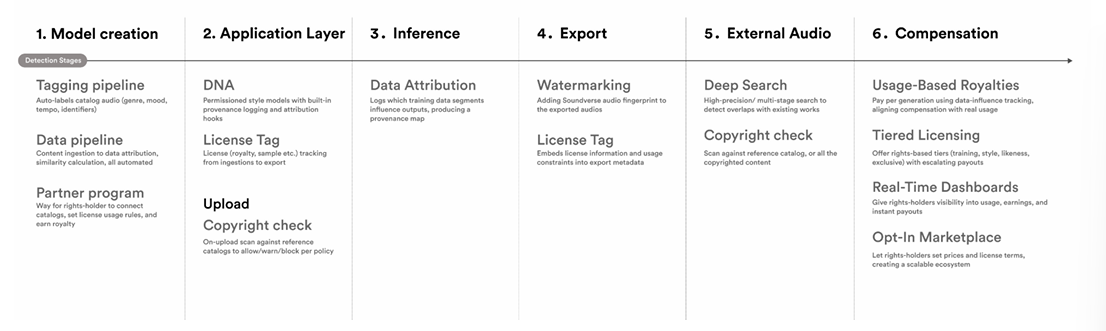
As AI continues to shape the creative landscape, Soundverse has positioned itself as a critical ally for musicians ensuring compliance with both award standards and ethical best practices. The Ethical AI Music Framework by Soundverse offers a transparent, six-stage infrastructure that replaces opaque 'black box' models with a system grounded in consent, attribution, and recurring compensation.
- Stage 1: Licensed Data Sourcing ensures all training datasets are legally obtained — no scraping or unauthorized use.
- Stage 2: Permissioned Models (DNA) create artist DNA profiles that preserve creator identity.
- Stage 3: Explainable Inference (Attribution) enables transparent tracing of how AI outputs relate to human input.
- Stage 4: Traceable Export (Watermarking) embeds identifiers for verification and authenticity.
- Stage 5: Deep Search (External Scanning) continuously checks for potential infringement to protect artists and labels.
- Stage 6: Recurring Compensation (Partner Program) introduces perpetual revenue sharing for every use of licensed music elements.
By integrating this framework, producers and songwriters can confidently submit works that meet Recording Academy guidelines. Ethical data sourcing and attribution ensure fair treatment and eligibility for recognition.
Other Soundverse tools, such as Soundverse Trace (for embedded rights protection) and the Content Partner Program (for revenue-sharing licensing), expand this trust ecosystem. Whether you’re creating EDM or experimenting with AI-powered jazz generation, these solutions help keep your projects artistically authentic and legally compliant.
Why ethical AI compliance matters for the Grammys
The Recording Academy’s updated policies clearly reward transparency, collaboration, and ownership acknowledgment. As generative tools grow in popularity, frameworks like Soundverse’s Ethical AI Music Framework ensure that AI-driven innovation aligns with traditional artistic values. This bridge between creativity and compliance not only safeguards copyright integrity but also elevates the legitimacy of award submissions.
Create Award-Worthy Music with Soundverse AI
Unlock your creative potential and compose professional-level tracks ready for the spotlight. Soundverse’s AI tools make production seamless so your next song could be Grammy-eligible.
Related Articles
- How AI-Generated Music Is Transforming the Music Industry: Discover how artificial intelligence is reshaping music creation, production, and recognition worldwide.
- AI Music Generator and Human Composers: A Future Together: Explore how human creativity and AI collaboration are forging the next era of musical excellence.
- The Role of AI Music in Film and Television: Learn how AI-generated compositions are elevating storytelling and sound design for screens big and small.
- Navigating the World of Royalty-Free and Copyright-Free Music Using Soundverse AI: Understand how to legally use and distribute your music with royalty-free and copyright-free solutions.
Here's how to make AI Music with Soundverse
Video Guide

Here’s another long walkthrough of how to use Soundverse AI.
Text Guide
- To know more about AI Magic Tools, check here.
- To know more about Soundverse Assistant, check here.
- To know more about Arrangement Studio, check here.
Soundverse is an AI Assistant that allows content creators and music makers to create original content in a flash using Generative AI. With the help of Soundverse Assistant and AI Magic Tools, our users get an unfair advantage over other creators to create audio and music content quickly, easily and cheaply. Soundverse Assistant is your ultimate music companion. You simply speak to the assistant to get your stuff done. The more you speak to it, the more it starts understanding you and your goals. AI Magic Tools help convert your creative dreams into tangible music and audio. Use AI Magic Tools such as text to music, stem separation, or lyrics generation to realise your content dreams faster.
Soundverse is here to take music production to the next level. We're not just a digital audio workstation (DAW) competing with Ableton or Logic, we're building a completely new paradigm of easy and conversational content creation.
TikTok: https://www.tiktok.com/@soundverse.ai
Twitter: https://twitter.com/soundverse_ai
Instagram: https://www.instagram.com/soundverse.ai
LinkedIn: https://www.linkedin.com/company/soundverseai
YouTube: https://www.youtube.com/@SoundverseAI
Facebook: https://www.facebook.com/profile.php?id=100095674445607
Join Soundverse for Free and make Viral AI Music

We are constantly building more product experiences. Keep checking our Blog to stay updated about them!