What is Soundverse Agent One? Meet the AI Producer That Actually Thinks
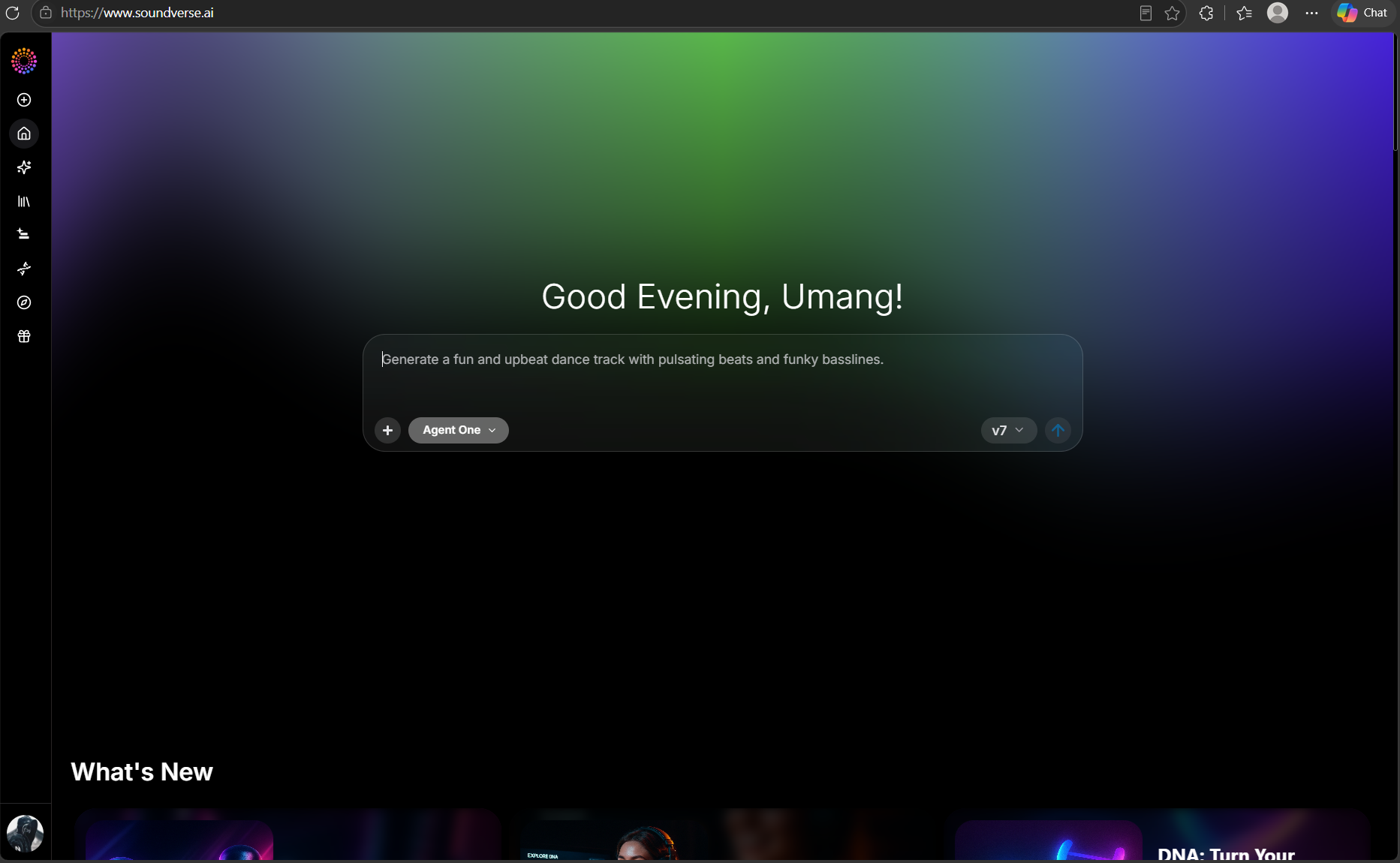
Meet the AI producer that actually thinks. Agent One isn't a music generator, it's a conversational AI that plans, executes, and remembers. Tell it what you want in plain language and it handles the rest, from tool selection to multi-step execution, all in one conversation.
If you've ever tried to make music with AI, you know the drill. You type a prompt. You get a song. You don't love it. You type another prompt. You get another song. You're not really creating, you're spinning a wheel and hoping it lands somewhere close to what you had in your head.
Agent One is built to end that loop. It's not a generator. It's not a chatbot with a music plugin bolted on. Agent One is a conversational AI producer, the kind that doesn't just respond to what you say, but actually thinks about what you mean, plans how to get there, and executes the whole thing while you watch.
The Problem With Every Other AI Music Tool Most AI music tools work the same way. One input. One output. Done. You describe a song. It makes a song. If you want to change the chorus, you describe the whole thing again. If you want to translate it into Hindi, you go find a different tool. If you want to add reverb only on the bridge, well good luck explaining that to a tool that only speaks in full-song generations.
The problem isn't the quality of the music. The problem is that these tools treat every request as isolated. There's no memory of what you just made. No understanding of what you actually meant. No plan for getting from your rough idea to a finished track. What you end up with is a tool. What you actually needed was a producer.
So What Does Agent One Actually Do? The simplest way to explain Agent One is this: you tell it what you want in plain language, and it figures out everything else.
Not as a single generation. As a sequence of real decisions, which tools to use, in what order, and how to connect them so the output actually matches what you asked for. Say you send this message: "Take this song, translate it into Spanish, raise the key by two semitones, and make me a 30-second version for Reels that starts with the hook."
A regular AI tool would either fail, or do one of those four things and ignore the rest. Agent One runs them all. It translates the lyrics. It isolates the vocals and re-renders them at the new key so there are no pitch artifacts. It finds the hook using section analysis. It trims the arrangement to 30 seconds starting from that hook. It gives you one clean output.
You sent one message. Behind it, four tools ran in the right order. You didn't have to know what any of them were called.
The Three Things That Make Agent One Different
1. It plans before it acts When you ask Agent One for something complex, it doesn't pretend it can do everything in a single step. It maps out the sequence first. What needs to happen before what. Which tools depend on each other. Where it can run things in parallel to save time. This is why a request like "generate ten variations of this hook in my DNA style" returns much faster than ten separate generations would because Agent One runs them simultaneously rather than waiting for each one to finish before starting the next.
2. It remembers everything in your conversation Context memory is what separates a real creative collaborator from a glorified search bar. Agent One tracks the current track you're working on. The section you last edited. The reference you pasted three messages ago. The effect you just adjusted. So when you say "a bit more" it knows what it is. When you say "same thing but on the bridge" _ it knows what same thing means. When you say "undo that, but keep the EQ"_ it knows exactly which change to reverse.
You never have to repeat yourself. The conversation builds on itself the same way it would with a real producer in the room.
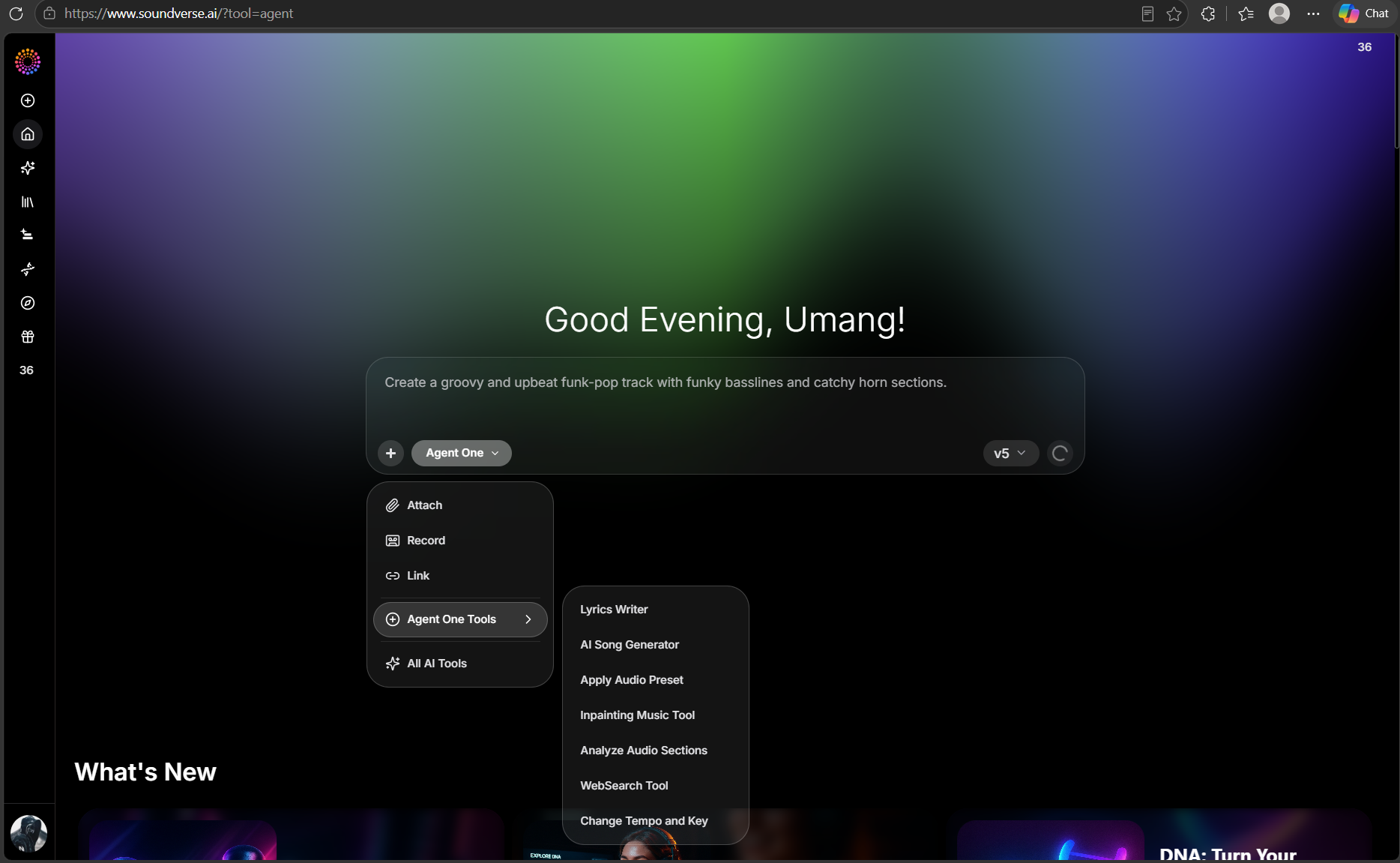
3. It has access to every tool on the platform Agent One isn't a standalone product, it's the orchestration layer that sits above every single capability on Soundverse. Song generation. Stem separation. Inpainting. Voice cloning. Voice swap. Melody-to-song. MIDI conversion. Tempo and key detection. Audio effects. Web search. Your DNA models. Your library. All of it is callable from one conversation, without you ever having to leave the chat or figure out which tool does what. The agent picks the right one. You just say what you want.
What You Can Tell It Here's a small sample of what Agent One can handle in plain language: "Remix the uploaded song in a lo-fi style." "Make a song in my voice." "Find what's trending in Afrobeats right now and make me something in that style." "Add reverb to the guitar but only in the choruses, and lower the volume everywhere else." "Translate this song into four languages and give me a version in each one." "Turn my hummed melody into a full pop song with lyrics and vocals." "Make a 60-second TikTok cut that starts directly with the hook."
Each of these is one message. Each of them triggers a multi-step sequence of tool calls the agent handles on its own. What you see is one polished output. What happens behind it is a producer working through a plan.
It Learns From You Too The more you use Agent One, the more it understands you specifically. It picks up on the genres you keep coming back to. The vocal styles you tend to choose. The tempo ranges you prefer. The platforms you're making content for. The kinds of edits you almost always make after a generation. Over time, "make me a song" starts producing something that sounds less like a generic output and more like something made for you. Not because you changed the prompt but because the agent has been paying attention. None of this requires any settings. No profile to fill out. It just happens as you create.
The Workflows Tab — 18 Pre-Built Recipes
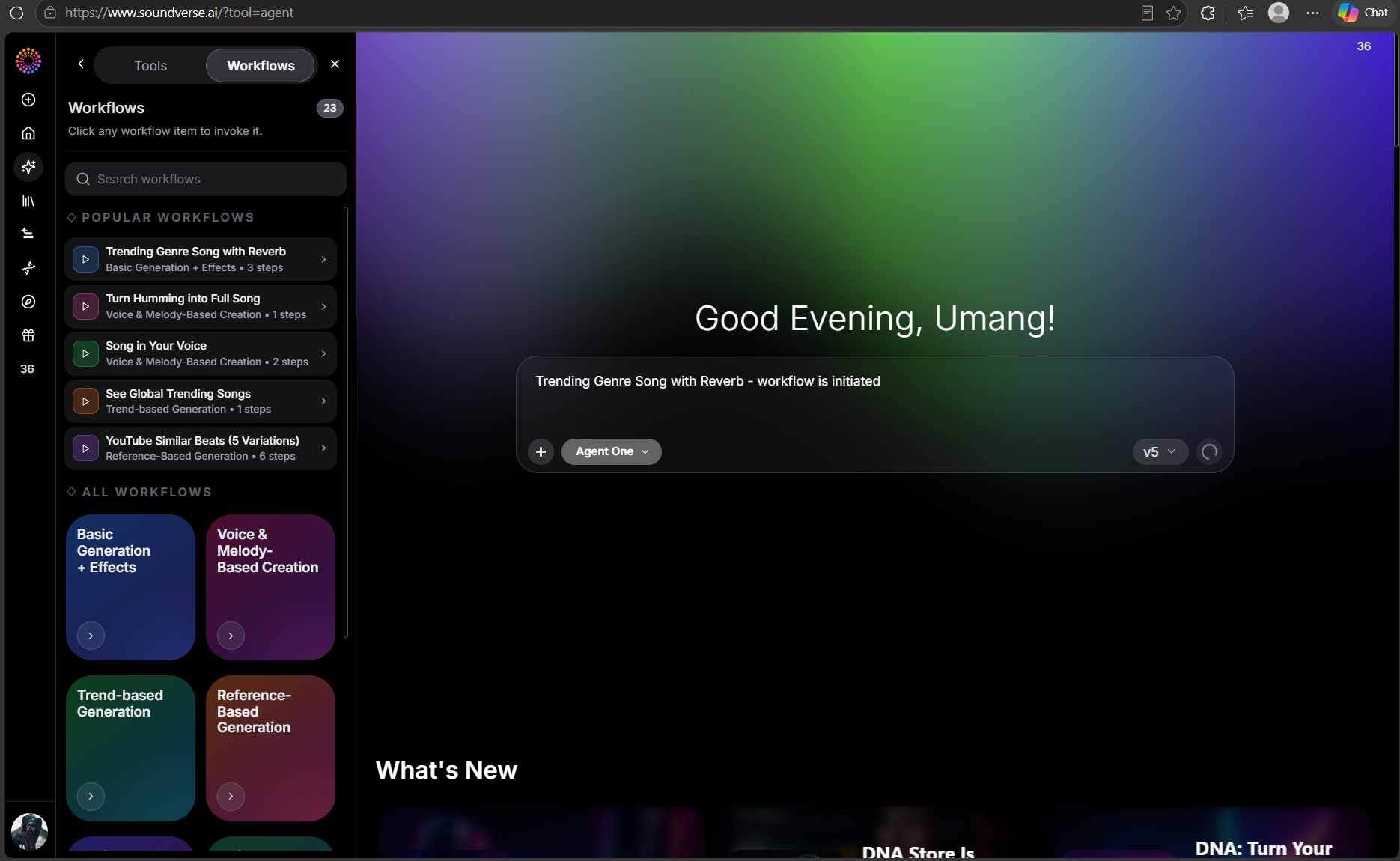
Inside Agent One, there's a tab called Workflows. Think of it as a menu of pre-built multi-step recipes the agent can run end-to-end with one click. Things like:
Trending Genre Song with Reverb searches the web for today's top trending genre, generates a song in it, applies reverb. Three steps. One tap.
YouTube Similar Beats (5 Variations) — takes a YouTube link, extracts the audio, analyses the structure, and generates five stylistically matched beats. Six steps. One tap.
Turn Humming Into a Full Song— records your melody and builds a complete arrangement around it. One tap. These aren't locked workflows either. You can start any of them and immediately take over with your own instructions. The workflow is a launchpad, not a rail.
Where to Find It Agent One is available on web at soundverse.ai/?tool=agent, and on iOS and Android with full feature parity. If you're already inside any tool on Soundverse, it's one click away through the AI Tools menu. The same agent, the same memory, the same conversation across every device you use. Start an idea on your phone. Continue it on your laptop. The agent already knows where you left off.
The Bottom Line Every other AI music tool gives you an output. Agent One gives you a process. It thinks about your request, plans the steps, picks the right tools, runs them in the right order, and hands you something that actually matches what you described not just a best guess at what you might have meant. That's the difference between a generator and a producer. And it's the reason Agent One is at the centre of everything Soundverse does.
Social Links:
Instagram: https://www.instagram.com/soundverse.ai
TikTok: https://www.tiktok.com/@soundverse.ai
Twitter: https://twitter.com/soundverse_ai
LinkedIn: https://www.linkedin.com/company/soundverseai
Youtube: https://www.youtube.com/@SoundverseAI
Facebook: https://www.facebook.com/profile.php?id=100095674445607
## Join Soundverse for Free and make Viral AI Music

We are building more product experiences. Keep checking our Blog to stay updated about them!