What High-End Audio Editing Programs Do Professional Studios Use Today?
The professional audio editing software studios run in 2026, by job: Pro Tools and other DAWs, mastering editors, RX and CEDAR repair, Melodyne.
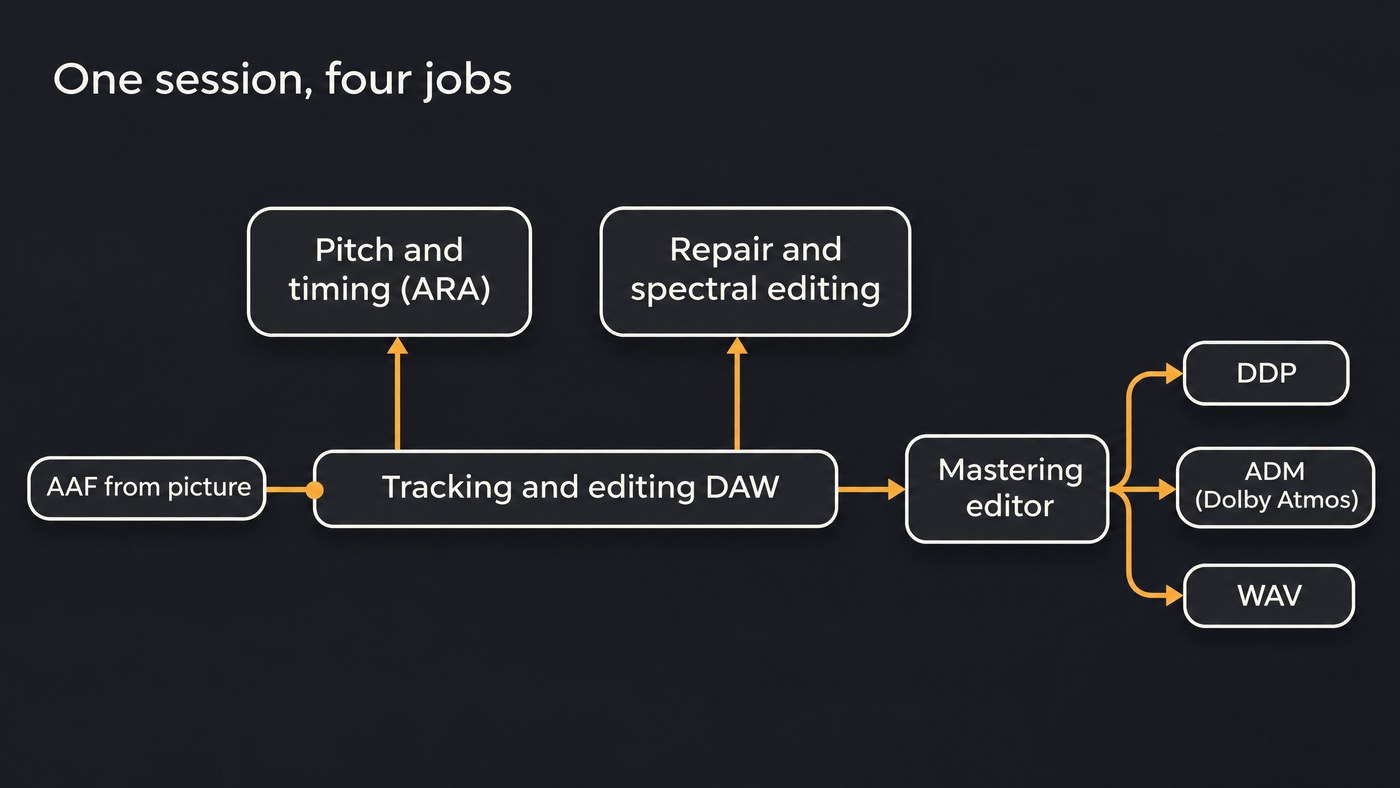
Professional audio editing software in today's studios is chosen by job: Pro Tools for tracking, editing and post, with Logic Pro, Cubase, Nuendo, Fender Studio Pro and Ableton Live beside it; WaveLab, Sequoia, Pyramix and SADiE for mastering; iZotope RX, SpectraLayers and CEDAR for repair; and Melodyne for pitch and timing. Most rooms run several.
We read each program's details on its maker's own pages on 19 November 2026. Avid's main Pro Tools pages and Fender's site blocked our tools, so those facts come from Avid's support documents and Sound On Sound, named where used. Prices are a dated snapshot.
Which DAWs professional studios use for tracking and editing
The best public read on what working engineers run is Production Expert's DAW Survey 2025, published 11 September 2025 with over 2,500 responses. Pro Tools led by a wide margin, with Logic Pro and Studio One second and third; Cubase and Nuendo combined would rank third. Among post-production users, about a quarter of Production Expert's audience, Pro Tools outnumbered Nuendo roughly 6 to 1. The authors warn that their self-selected, post-heavy audience skews toward Pro Tools. Their summary: "Pro Tools is not going anywhere. It might not be the most liked, but it remains the most used, especially where deadlines, collaboration, and interchange are involved."
Pro Tools
Pro Tools 2026.11 came out on 3 November 2026, with a 2026.11.1 update on 18 November. It adds MPE support and an Avid-built Stem Separator that splits audio into up to six stems on your own computer. Since version 2020.12, Pro Tools has included Celemony's Melodyne essential, licensed separately.
For the heaviest sessions, Avid sells HDX hardware. Its HDX page quotes 0.7 ms latency at 96 kHz with a 64-sample buffer, up to 2,048 voices with the Hybrid Engine, and up to three PCIe cards. AAX DSP plugins run on the card while tracking and natively when the hardware is unplugged, and Avid counts over 250 from other makers.
Logic Pro
Logic is Mac-only and common in writing and production rooms. Apple's Logic Pro page says its built-in Dolby Atmos tools export ADM files ready to submit to Apple Music and other streaming services. It costs $199.99 outright, or $12.99 a month or $129 a year in Apple Creator Studio.
Cubase 16 and Nuendo 15
Steinberg describes Nuendo as the choice of film, TV, game audio and immersive sound professionals. Nuendo 15 adds an Analyzer Track for dialogue-intelligibility metering based on Fraunhofer IDMT technology, MXF video import from OP1a containers, MPF and MXF/S ADM imports for MPEG-H, and DAWproject support for moving projects to other DAWs. Cubase 16 is the music sibling, and its stem separation now has dedicated piano and guitar.
Fender Studio Pro (formerly Studio One)
PreSonus's Studio One pages now redirect to Fender Studio Pro. Sound On Sound reported on 20 January 2026 that the rename took effect on 13 January, as Fender Studio Pro 8.
Ableton Live
Live is a production and performance DAW more than a post tool. Ableton says Live 13, due in early 2027, adds ARA 2 support for audio-editing plugins, and Live 13 Suite will include Melodyne essential. Intro is capped at 16 tracks; Standard and Suite aren't.
Mastering editors: WaveLab, Sequoia, Pyramix and SADiE
Mastering rooms often edit and deliver in a separate program built for album assembly, metadata and delivery formats.
- WaveLab Pro 13 (Steinberg). Version 13 adds Dolby Atmos mastering. Its Master montage inserts standard VST 3 plugins across up to 128 audio channels, and the Album montage sequences several ADM files into one album master with loudness and true-peak normalization. Steinberg's page features mastering engineers Pete Lyman and Justin Perkins.
- Sequoia 2026.5 (Boris FX). Boris FX bought Sequoia from MAGIX in August 2025. It runs on Windows only. Boris FX's Sequoia page lists album sequencing with PQ and ISRC codes, native Dolby Atmos with an ADM editor, a panner from mono to 22.2, and broadcasters ARD, ZDF and Radio France as users. It costs $95 a month, $595 a year or $1,695 perpetual.
- Pyramix 16 (Merging Technologies, now part of Neumann). Announced 31 March 2026 in Elements, Pro and Premium versions. Premium, aimed at music recording, classical production, film and immersive audio, adds DSD/DXD workflows and a built-in Dolby Atmos Renderer up to 9.1.6 with binaural output. Mac users can now run it under Parallels Desktop.
- SADiE (Prism Sound). Prism Sound now offers a free, license-free edition for new computers. Its notice says CD burning and reading and CEDAR plugin support are gone, though DDP writing remains, and SADiE 6 owners should stay on their licensed version.
For AI mastering assistants inside editors and DAWs, see our guide to audio editing tools with AI mastering.
Repair and spectral editing: iZotope RX, SpectraLayers and CEDAR
- iZotope RX 12. Announced 29 April 2026 in Elements, Standard and Advanced editions, at launch prices of $99, $399 and $1,399. New Scene Rebalance splits film and TV scenes into dialogue, music and effects tracks. Boris FX bought iZotope on 2 July 2026 and says: "RX, the industry standard in audio repair and restoration, is used on most major film and television productions."
- SpectraLayers Pro 13 (Steinberg). Opens inside Cubase, Nuendo and other hosts through ARA 2. In Pro Tools it works through an AudioSuite bridge, which in version 13 round-trips several clips at once and handles Dolby Atmos up to 9.1.6 and Ambisonics.
- CEDAR. CEDAR says it invented and patented spectral editing in 2002 with the first Retouch. Today's Retouch uses AI to find every other instance of a sound you mark, and CEDAR pitches it at mastering studios, mix suites, post houses and forensic labs. Its DNS hardware handles dialogue noise live.
For vocal cleanup on a home budget, see our list of software to clean up vocal recordings.
Pitch and timing: Melodyne and ARA
Melodyne 5 is still the current version on Celemony's site. It shows each note as a "blob" you can retune, stretch, re-time or reshape, including notes inside polyphonic parts like piano and guitar, and edits several tracks in one window.
ARA 2 matters as much as the editor. It lets Melodyne or SpectraLayers open on the DAW's own timeline, so you edit the take in place instead of bouncing audio out and back. Pro Tools includes Melodyne essential, Live 13 Suite will, and a 30-day trial of Melodyne 5 studio is free.
Why studios choose these programs
- Interchange. Picture editors send AAFs; Avid's support notes on Media Composer AAF exports explain what survives the trip into Pro Tools. Atmos deliveries travel as ADM files, CD masters as DDP, and DAWproject moves sessions between some DAWs.
- Low-latency hardware. HDX and AAX DSP let engineers track through plugins at 0.7 ms, by Avid's figure.
- ARA. Pitch and spectral editors that open on the timeline cut out bouncing on vocal-heavy sessions.
- Immersive formats. Logic, Nuendo, WaveLab, Sequoia and Pyramix all handle Dolby Atmos, while Nuendo also imports MPEG-H scenes.
- Platform and reliability. Sequoia is Windows-only and Logic is Mac-only, which often decides the room.
- More than one DAW. Production Expert found that most workflows move across at least two.
Compare professional-grade audio editing suites for music producers
Match the suite to the work you're paid for:
- Mixing and recording for other people: Pro Tools, because it's the DAW you're most likely to trade sessions with. Export stems for anyone who uses something else; our guide to exporting stems in Pro Tools walks through it.
- Writing and producing on a Mac: Logic Pro with Melodyne. Logic also covers Atmos and ADM delivery.
- Electronic production and remixing: Ableton Live Suite, with SpectraLayers or RX for stem cleanup.
- Mastering: WaveLab Pro, or Sequoia if you work on Windows; both handle ADM.
- Classical and acoustic recording: Pyramix Premium for DSD/DXD.
- Post and dialogue: Pro Tools or Nuendo, with RX Advanced or CEDAR.
Before you buy, check the edition that includes the feature you need, your host's plugin format (AAX, AU or VST 3) and ARA support. For license models and upgrade costs, see our guide to buying an AI music editing suite license. For DAWs chosen for their AI features, see the best AI DAWs in 2026.
Where Soundverse fits
Soundverse is an AI music platform that takes you from idea to audience, built for independent artists who release music. It doesn't replace a mastering editor or a post-production DAW; it sits in front of them.
AI Studio is a multitrack studio in the browser where you can record, generate parts and mix a song. Stem Separator splits a mix into 2 or 6 stems as WAV or FLAC files your DAW can use. AI Vocal Cleaner takes background noise, hum and clicks out of a vocal and softens harsh S and P sounds.
Our pages list the limits: AI Studio doesn't load VST or AU plugins, and browser export is blocked past 15 minutes or 24 tracks. A practical split is to sketch in AI Studio, export stems on Creator or above, and finish in Pro Tools or Logic. Licensing is set by plan: the Free plan is for personal use, and the Creator plan comes with a royalty-free license.
FAQ
What is the industry-standard audio editing software? For tracking, editing and post, Pro Tools: it led all three Production Expert surveys, and post users chose it over Nuendo about six to one. For repair, Boris FX calls iZotope RX the industry standard. Mastering rooms often add a dedicated editor such as WaveLab, Sequoia or Pyramix.
What software do mastering engineers use? Usually a dedicated editor: Steinberg WaveLab Pro, Boris FX Sequoia, Merging Pyramix or Prism Sound SADiE, chosen for album assembly, PQ and ISRC codes and DDP or ADM delivery. Some master in their main DAW with plugins instead.
Do I need Pro Tools to work with professional studios? No, but you need to deliver in a form they can open. Bounce stems from bar one at the session's sample rate, name them clearly, and ask whether the studio wants AAF, stems or a DAWproject file.
Why is Melodyne in so many studio setups? It edits notes rather than waveforms, including notes inside polyphonic parts, and Pro Tools ships with Melodyne essential (Live 13 Suite will too). With ARA 2 it opens on the DAW timeline, so you fix vocals in place. Version 5 is current on Celemony's site.
Sign up for Soundverse free and try AI Studio, Stem Separator and AI Vocal Cleaner in your browser. More production guides on the Soundverse blog.