What Ethical AI Music Means for the Next Generation of Creators
Discover how ethical AI music is shaping the next generation of creators through transparency, consent, and fair compensation.
What Ethical AI Music Means for the Next Generation of Creators
In 2026, the conversation surrounding ethical AI music has evolved beyond mere compliance—it has become a defining principle for creative integrity in the digital age. As artificial intelligence matured across 2024 and 2025, musicians and producers began questioning not just what AI could do, but what it should do. The next generation of creators demands technology that respects artistry, ensures transparency, and guarantees fair compensation.
Why does ethical AI music matter in 2026?
The music industry has witnessed rapid transformation through AI-based composition, vocal synthesis, and production tools. However, many early models operated as black boxes, raising ethical concerns regarding consent, attribution, and ownership. In 2026, ethical AI music bridges that gap by enforcing clear frameworks that prioritize creators' rights and data transparency.
Ethical AI music is not simply about regulation—it is a movement toward empowering artists. It ensures that the data used for model training comes from legitimate, licensed sources. Musicians and copyright holders participate in AI advancement without losing control of their identity or creations.
At its core, ethical AI music reconciles technological creativity with moral responsibility. For new artists, it means having tools that can generate tracks without infringing on others' works. For established creators, it ensures recurring compensation and public attribution for every contribution their music makes to training datasets.
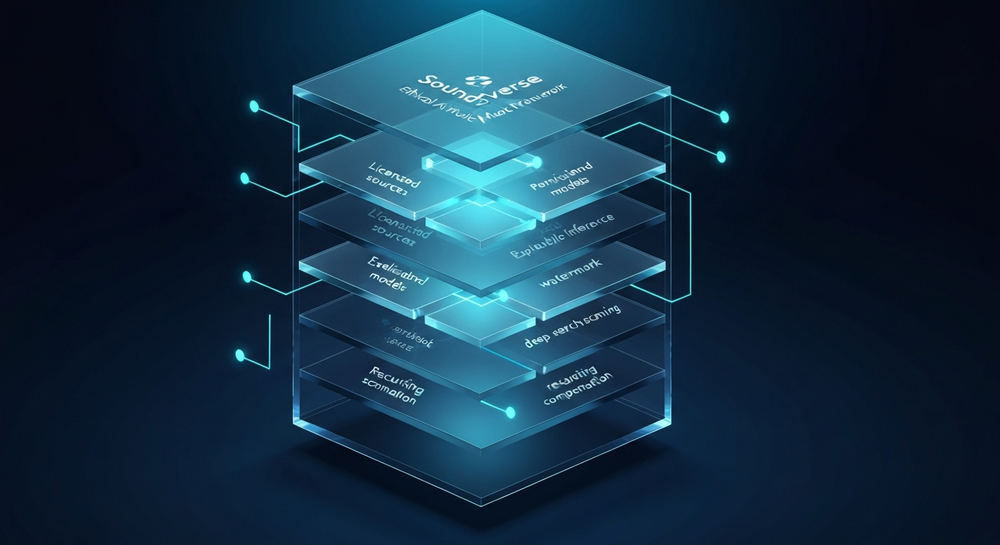
How has AI in music creation evolved to address ethical challenges?
AI in music creation has moved from experimental curiosity in 2024 into mainstream adoption by 2026. Tools like Soundverse and others have shown that AI can handle entire production pipelines—from text prompts to fully composed pieces. Yet, this progress prompted hard questions: Who owns the AI-generated track? Was the training dataset used legitimately? Can creators audit AI output?
Ethical AI music frameworks now answer these questions through traceable infrastructures. Transparent pipelines make metadata visible, attribution verifiable, and compensation automatic. Instead of scraping from public audio sources, AI now relies on permissioned data contributions under licensing programs. This approach aligns with the standards described in AI & Music Tech In 2026 and Ethics in AI Music Creation - Soundstripe.
Brands and independent producers have realized that ethical integrity pays off. Consumers increasingly prefer AI music generated under ethical standards, both for emotional authenticity and compliance assurance. When creators trust their tools, innovation thrives. For additional insights, see AI Music and Creator Trust: Building Ethical Innovation in 2026.

What role does responsible AI for musicians play in creative growth?
Responsible AI for musicians means creating an environment where technology amplifies, not exploits, artistic potential. Musicians today interact with AI as collaborators rather than competitors. Ethical frameworks guarantee that artists retain moral and financial stake in their creations.
Through responsible AI systems, a singer can allow her voice to be modeled safely while maintaining rights to monetization. A producer can explore genres they never tried before knowing that the AI respects intellectual property boundaries. Ethical transparency has become just as essential to creative freedom as musical skill.
In practical terms, responsible AI for musicians involves consent-first data training, attribution watermarks, and royalties tied to usage. These systems align creativity with fairness—a blueprint for sustainable artistic futures. For a deeper dive, watch our guide on creating Deep House music and how to make music with AI.
How AI ethics in the arts redefine creativity
AI ethics in the arts challenge traditional notions of originality. In a world where algorithms generate infinite compositions, ethics anchor value around authorship and accountability. Ethical frameworks redefine the art-making process as a partnership between human expression and machine precision.
For cultural institutions, ethical AI ensures diversity and inclusion in training material. Artistic identities, regional sounds, and historical catalogs are preserved and respected. Rather than homogenizing music culture, ethical systems reinforce its uniqueness.
As educational programs in 2026 adopt AI-assisted composing tools, students learn how data governance affects their rights as emerging artists. Teaching ethics alongside technology ensures that the next generation of creators builds not only with capability—but with conscience.
For more insights on how AI transforms the music business landscape, explore music industry trends and learn why platforms like Soundverse are leading ethical innovation.
How to make ethical AI music with Soundverse The Ethical AI Music Framework
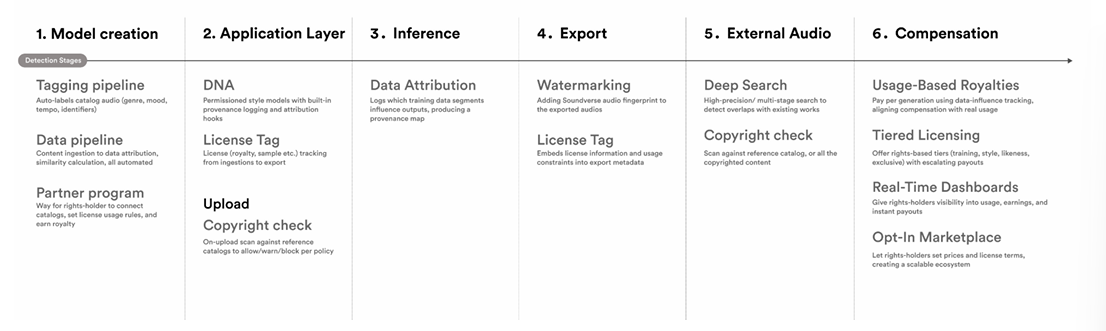
The Soundverse Ethical AI Music Framework sets a standard for transparent, accountable creation. It is a comprehensive end-to-end infrastructure bridging innovation and artist integrity through six critical stages.
Stage 1: Licensed Data Sourcing (No scraping) – Soundverse acquires training data exclusively from rights-holders and licensed libraries, ensuring legality and consent from contributors.
Stage 2: Permissioned Models (DNA) – The Soundverse DNA engine allows artists to train AI models based on their unique sonic identity. This gives creators control and a chance to monetize their distinctive sound.
Stage 3: Explainable Inference (Attribution) – Every generated track includes detailed metadata showing which artist influences or sources contributed to the model’s understanding.
Stage 4: Traceable Export (Watermarking) – AI outputs include embedded watermark identifiers that trace origin and attribution wherever the song is shared.
Stage 5: Deep Search (External Scanning) – Soundverse scans external platforms to verify legitimate usage, discouraging piracy and unauthorized replication.
Stage 6: Recurring Compensation (Partner Program) – Contributors enrolled in the Content Partner Program receive ongoing royalties based on attribution metrics and distribution reach.
This transparent pipeline solves one of the toughest challenges in AI-driven artistry—trust. Instead of asking creators to blindly believe in ethical promises, Soundverse makes every step auditable.
For users, it means being part of an ethical ecosystem. Whether generating tracks through Soundverse DNA or licensing assets via the Content Partner Program, ethical compliance is baked into every layer of operation.
If you want to see how these tools unify into a powerful ethical creation system, read Soundverse AI Revolutionizing Music Creation for New Age Content Creators or explore creative workflows at Generate AI Music with Soundverse Text to Music. For additional learning, explore our “Explore” Tab tutorial.
Why ethical AI music drives the future of music technology
By 2026, ethical governance has become the defining trend in the future of music technology. Musicians no longer debate whether AI is good or bad—they focus on how responsibly it is built. Ethical AI architectures such as Soundverse’s framework ensure a future where creativity and accountability coexist.
Future trends show cross-industry adoption of ethical AI principles—film composers, advertising producers, and game sound designers seeking transparent, royalty-compliant systems. The next generation of creators expects tools that protect their work automatically.
Platforms lacking ethical foundations face backlash for dataset opacity and unfair compensation. Conversely, ethical music engines build stronger brand loyalty, reduce litigation risk, and cultivate cultural respect.
The ecosystem in 2026 rewards creators who embrace responsible AI technologies. For instance, emerging genres powered by AI maintain cultural authenticity because training data are curated ethically. Learn more about genre and style evolution at Most Popular Music Genres.
The long-term cultural implications of ethical AI music
Ethical AI music doesn’t merely solve technical issues—it reshapes how society defines creative ownership. Transparent AI systems foster a culture of acknowledgment. Sampling, remixing, or incorporating AI-generated material becomes a traceable event, not a legal gray zone.
Communities of artists, producers, and educators are creating shared ethical standards. Platforms like Soundverse act as facilitators of these discussions, integrating the learnings into production workflows.
As we move toward the late 2020s, international cooperation on AI ethics in the arts continues to grow. Ethical infrastructures may soon become prerequisites for music licensing and global distribution. The new generation of creators will inherit a system where fairness, consent, and transparency define musical success.
Start Creating Ethical AI Music Today
Empower your sound with tools that respect artistry. Generate original, responsible AI music in seconds while keeping creative control and ethical transparency in your hands.
Related Articles
- How AI-Generated Music Is Transforming the Music Industry: Explore how AI composition tools are reshaping the way music is created, distributed, and experienced worldwide.
- AI Music Generator and Human Composers: A Future Together: See how artists and AI tools can collaborate creatively to push the boundaries of musical expression.
- The Role of AI Music in Film and Television: Discover how AI-generated soundtracks are changing scoring workflows and expanding creative opportunities for filmmakers.
- Navigating the World of Royalty-Free and Copyright-Free Music Using Soundverse AI: Learn how to ensure your content remains compliant with copyright laws while accessing high-quality, ethically sourced AI music.
Here's how to make AI Music with Soundverse
Video Guide

Here’s another long walkthrough of how to use Soundverse AI.
Text Guide
- To know more about AI Magic Tools, check here.
- To know more about Soundverse Assistant, check here.
- To know more about Arrangement Studio, check here.
Soundverse is an AI Assistant that allows content creators and music makers to create original content in a flash using Generative AI. With the help of Soundverse Assistant and AI Magic Tools, our users get an unfair advantage over other creators to create audio and music content quickly, easily and cheaply. Soundverse Assistant is your ultimate music companion. You simply speak to the assistant to get your stuff done. The more you speak to it, the more it starts understanding you and your goals. AI Magic Tools help convert your creative dreams into tangible music and audio. Use AI Magic Tools such as text to music, stem separation, or lyrics generation to realise your content dreams faster. Soundverse is here to take music production to the next level. We're not just a digital audio workstation (DAW) competing with Ableton or Logic, we're building a completely new paradigm of easy and conversational content creation.
TikTok: https://www.tiktok.com/@soundverse.ai
Twitter: https://twitter.com/soundverse_ai
Instagram: https://www.instagram.com/soundverse.ai
LinkedIn: https://www.linkedin.com/company/soundverseai
Youtube: https://www.youtube.com/@SoundverseAI
Facebook: https://www.facebook.com/profile.php?id=100095674445607
Join Soundverse for Free and make Viral AI Music

We are constantly building more product experiences. Keep checking our Blog to stay updated about them!