What Creators Should Know About AI Music Terms of Service in 2026
Understand AI music terms of service, creator rights, and platform policies in 2026.
What Creators Should Know About AI Music Terms of Service
In 2026, the landscape of AI-generated music continues to evolve rapidly, offering creators unprecedented opportunities to produce, share, and monetize music. With the rise of platforms powered by artificial intelligence, independent musicians, producers, and digital artists are exploring how AI music platforms can expand their creative reach. However, one critical factor that creators cannot overlook is understanding AI music terms of service before uploading their material or generating new compositions.
Why Do AI Music Terms of Service Matter for Creators in 2026?
AI music terms of service define how platforms use your content, handle rights, distribute royalties, and manage AI-generated outputs. As of 2026, these agreements have become more complex, incorporating clauses about dataset licensing, model attribution, and co-creation ownership. For creators, reading and comprehending these documents helps prevent unwanted losses of rights and ensures fair compensation for their contributions.

Many creators have faced challenges in previous years (2024–2025) when platforms trained models on unlicensed or scraped content. This led to copyright conflicts, ethical debates, and mistrust among artists. The current generation of platforms places transparency and artist integrity at the forefront, aligning with global digital rights movements and fair-use standards.
What Are the Most Common Points to Check in AI Music Platform Policies?
Every AI music platform has unique features, but several key clauses remain consistent across terms of service. Independent artists should pay attention to the following areas:

- Data Usage and Licensing — Understand whether your samples, vocals, or compositions will be used to train AI models. Licensing clauses should specify if the data contribution is exclusive or non-exclusive.
- Attribution and Consent — Platforms should clearly specify how attribution is handled. If AI outputs include your style or copyrighted elements, you must be credited or compensated accordingly.
- Ownership of Outputs — Decide if you retain full rights over generated tracks or share co-ownership with the platform. This determines whether the music can be commercially released.
- Revenue Share Model — Evaluate royalty structures—some platforms pay recurring usage-based royalties, while others provide one-time commissions.
- Transparency in AI Model Training — Ethical platforms disclose data sources, ensuring that no copyrighted material is used without license.
- Data Retention and Removal Policies — Check how long platforms store user uploads and whether you can request data deletion.
Platforms such as Soundverse and others now provide detailed information about rights protection. To explore alternatives, you can review tools discussed in Mubert alternatives or compare creation methods with Soundraw.
How Do AI Music Terms of Service Affect Creator Rights?
The most significant shift since 2025 involves recognizing creators as partners in the AI training process. Instead of passive data contributors, artists are now considered active rights holders. The concept of ethical AI music focuses on consent, attribution, and compensation.
In 2026, AI music licensing adopts dual frameworks:
- Training Licenses: Agreements specifying how AI systems use sample data, instrument stems, and songs for model optimization.
- Output Licenses: Terms defining how generated music may be distributed, resold, or monetized.
Creators involved in training AI models should look for transparent licensing options. For example, Soundverse’s Content Partner Program offers recurring compensation whenever your material contributes to a generated work, ensuring fair royalties.
What Risks Exist When Creators Ignore AI Music Terms of Service?
Ignoring legal terms can lead to significant risks. Unlicensed data use might violate intellectual property laws or result in your signature sound being replicated without permission. Additionally, failing to understand output ownership can cause misalignment with record labels or streaming partners.
Creators should also consider how AI-generated music impacts distribution platforms. Some streaming services now require disclosure if AI contributed to a track’s production. Platforms enforcing strong ethical standards help protect artists from unintentional misuse.
For example, Soundverse’s technology advances rights clarity compared to older generators. To learn more about how AI-generated music is transforming the industry, visit this guide for contextual insights. For a deeper dive, watch our guide on creating Deep House music.
How to Make AI Music Terms of Service Work for You
Understanding terms of service is not just about avoiding pitfalls—it’s about leveraging them to your advantage. Creators can:
- Negotiate Licensing Agreements: If you have a strong catalog or unique sonic fingerprint, request custom licensing terms.
- Join Partner Programs: Opt for transparent compensation models like Soundverse’s recurring royalty system.
- Use Platforms With Ethical Frameworks: Select tools that explicitly state how artist rights are protected throughout the AI pipeline.
- Monitor Attribution Records: Platforms providing traceable documentation help confirm where and how your contributions are used.
- Stay Updated With Industry Changes: AI music standards evolve annually; reviewing blog reports such as music industry trends helps creators stay compliant and informed.
You can also learn visually by watching Soundverse's tutorial on how to make music or exploring the Explore tab guide.
How Does Soundverse’s Ethical AI Music Framework Protect Creator Rights?
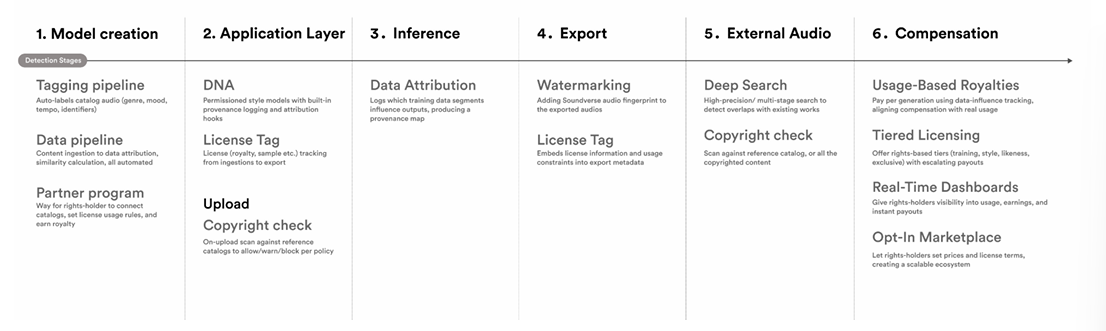
Soundverse leads the ethical AI movement through its Ethical AI Music Framework, which establishes a transparent six-stage process to balance innovation with artist integrity. Unlike traditional black-box models, this infrastructure ensures that every stage—from data sourcing to final output—is auditable and rights-compliant.
Core Stages of Soundverse’s Ethical AI Music Framework:
- Licensed Data Sourcing (Stage 1): Soundverse uses legally licensed catalogs, avoiding scraping from copyrighted material.
- Permissioned Models (Stage 2): The system incorporates DNA training, where artists explicitly grant permission to teach the AI their sonic fingerprint.
- Explainable Inference (Stage 3): Every generated track includes identifiable attribution markers.
- Traceable Export (Stage 4): Outputs include secure watermarking for future rights verification.
- Deep Search (Stage 5): External scanning technology identifies unauthorized distribution or duplication.
- Recurring Compensation (Stage 6): The framework’s partner program guarantees fair, usage-based payments to rights-holders.
Soundverse integrates these principles seamlessly across its creative tools. Together with Soundverse Trace (its trust layer) and Soundverse DNA, creators gain a secure environment for generating and managing AI-driven compositions ethically.
For those exploring how AI-powered sound creation works practically, Soundverse provides detailed tutorials such as how to create country music with Soundverse AI or generate AI music with Soundverse text-to-music.
How Soundverse Helps Creators Navigate AI Music Policies in 2026
Soundverse’s infrastructure ensures creators maintain control and transparency over their contributions. By replacing opaque processing pipelines with trackable metadata, creators always know how their sounds are used. Moreover, the recurring compensation model redefines the relationship between artist and AI platform—from transactional to collaborative.
Creators can rely on Soundverse’s traceable export and watermarking tools to confirm ownership. With deep search scanning, unauthorized copies can be quickly identified and addressed. As a result, the Ethical AI Music Framework serves as a benchmark for trust and fairness in the modern music economy.
Create Music Confidently with Soundverse AI
Generate original, royalty-free music instantly using advanced AI. Whether you’re a musician, podcaster, or video creator, Soundverse gives you complete control and clarity over your creative rights.
- Copyright-Free vs Royalty-Free Music: What Creators Should Know — Understand the difference between copyright-free and royalty-free music to avoid legal confusion and protect your creations.
- Navigating the World of Royalty-Free and Copyright-Free Music Using Soundverse AI — Learn how to use Soundverse AI to discover truly royalty-free tracks that align with your project’s licensing needs.
- How AI-Generated Music Is Transforming the Music Industry — Explore how AI music is reshaping production, distribution, and copyright handling across the global music ecosystem.
- AI Music in the USA — Discover the evolving legal and creative landscape for AI-generated music in the United States.
Here's how to make AI Music with Soundverse
Video Guide

Here’s another long walkthrough of how to use Soundverse AI.
Text Guide
- To know more about AI Magic Tools, check here.
- To know more about Soundverse Assistant, check here.
- To know more about Arrangement Studio, check here.
Soundverse is an AI Assistant that allows content creators and music makers to create original content in a flash using Generative AI. With the help of Soundverse Assistant and AI Magic Tools, our users get an unfair advantage over other creators to create audio and music content quickly, easily and cheaply. Soundverse Assistant is your ultimate music companion. You simply speak to the assistant to get your stuff done. The more you speak to it, the more it starts understanding you and your goals. AI Magic Tools help convert your creative dreams into tangible music and audio. Use AI Magic Tools such as text to music, stem separation, or lyrics generation to realise your content dreams faster. Soundverse is here to take music production to the next level. We're not just a digital audio workstation (DAW) competing with Ableton or Logic, we're building a completely new paradigm of easy and conversational content creation.
TikTok: https://www.tiktok.com/@soundverse.ai
Twitter: https://twitter.com/soundverse_ai
Instagram: https://www.instagram.com/soundverse.ai
LinkedIn: https://www.linkedin.com/company/soundverseai
Youtube: https://www.youtube.com/@SoundverseAI
Facebook: https://www.facebook.com/profile.php?id=100095674445607
Join Soundverse for Free and make Viral AI Music

We are constantly building more product experiences. Keep checking our Blog to stay updated about them!