Music Galleries: Combining Sound Art & Visual Media in 2026
Discover how music galleries integrate sound art, visual media, and interactive installations in 2026.
Music Galleries: Combining Sound Art & Visual Media
In 2026, the boundaries between sound, vision, and space continue to dissolve. Music galleries have emerged as one of the most compelling nexuses for artists, designers, and curators seeking to merge sound art with visual media. No longer confined to the concert hall or white-walled museum, these hybrid spaces are reimagining the gallery as a living, breathing audiovisual experience — one that invites participation, immersion, and emotional engagement.
What are music galleries and why are they gaining popularity in 2026?
Music galleries are creative environments where sound functions as a primary artistic medium, interacting with visual and spatial elements to form cohesive audio visual narratives. This trend has gained notable traction in 2026 as museums, independent curators, and cultural institutions explore new ways to engage audiences whose expectations have been shaped by VR, streaming, and social media-driven art consumption.

The rise of interactive installation design and the availability of advanced AI tools have made it easier for creators to build immersive sonic worlds. Visitors no longer passively observe art; they walk through dynamic environments where data-driven compositions react to movement, light, or emotion.
Key drivers behind the rise of music galleries:
- Technological democratization – Affordable sensors, spatial audio systems, and accessible AI tools like the Soundverse AI Music Generator have brought complex composition and sound design within reach of individual artists.
- Audience engagement – Younger audiences in 2026 prefer multi-sensory experiences over static exhibitions. Music galleries offer interactivity and social shareability.
- Cross-disciplinary collaboration – Sound artists now work alongside visual coders, motion designers, and architects, expanding the creative vocabulary of both art and technology.
Learn more about current creative practices showcased in Musical Thinking: New Video Art and Sonic Strategies.
How do sound art and visual media interact in modern galleries?

The fusion of sound art and visual media is not new — experimental pioneers have sought such integration for decades. However, the current decade has elevated this practice into mainstream creative culture. Sound art now functions not just as a soundtrack but as a structural and emotional architecture within gallery spaces.
Visual media — from projection mapping to AI-generated imagery — responds dynamically to sound frequencies, intensities, or visitor movements. For example, low frequencies might alter the brightness of a projected gradient while higher pitches shift geometric forms. These design choices allow audio visual installations to evoke sensations that exist between listening and seeing.
In 2026, immersive art producers are also incorporating volumetric capture and generative algorithms to synchronize light, texture, and spatial sound within architectural boundaries. Such spaces allow audiences to feel sound moving around and through them, dissolving traditional barriers between viewer and artwork. These emerging strategies are pioneered by institutions like 3S Artspace and ongoing programs such as the Moving Image Media Art Program.
What makes interactive installations the centerpiece of music galleries?
Today’s most successful music galleries employ interactive installations to foster agency and emotion. Viewers become co-creators; their motion or gestures influence the soundscapes or manipulate the visual field.
Interactive installations integrate multiple technologies:
- Spatial audio: Multi-channel speaker arrays or headset-based systems that allow precise control of sound movement.
- Sensor networks: Motion sensors, thermal cameras, or RFID systems capturing visitor data.
- Generative engines: AI systems that recompose sound or image layers in real time based on input events.
The result is a heightened sense of presence — an evolving artwork that reacts uniquely to each person who experiences it. For examples of real-world multimedia events, check out WaveForms: A Multimedia Art Occurrence - Winter 2026.
How cultural institutions are embracing the hybrid music gallery model
Museums, festivals, and cultural centers in 2026 treat sound as a full-fledged medium, curating exhibitions that blend fine art, performance, and digital design. Temporary pop-ups in cities such as Berlin, Tokyo, and Los Angeles use modular architecture and responsive projection to turn blank halls into immersive landscapes.
Institutions now commission AI-generated sound art pieces with adjustable loops for installations that require continuous playback. The looping quality — available in modern production tools — ensures that soundscapes can evolve without abrupt restarts, supporting large-scale exhibitions for days or weeks. One noted opportunity for this artistic integration is featured in Open Call: Sound in Visions: Music is the Muse - ACCI GALLERY.
Furthermore, digital twins of these exhibitions exist within the metaverse, extending accessibility to remote audiences. These parallel virtual setups mirror the real-world gallery sonic behavior, reinforcing the link between physical and digital experience. A similar multi-platform approach can be observed in programs like the New Sound Art Showcase - Independent Venue Week concert and global calls such as Landscape2526 | Open Call for Sound Artist.
How to make music galleries more accessible and sustainable
Sustainability and inclusivity are defining themes of 2026. Music galleries are responding by developing:
- Adaptive environments that use AI to adjust volume or brightness based on crowd levels.
- Energy-efficient audio visual systems powered by renewable energy.
- Accessible design including tactile sound sculptures and vibration-sensitive platforms for hearing-impaired participants.
Through these innovations, music galleries align environmental and social responsibility with creative ambition. Artists and institutions are also participating in diversified residency programs such as the Pioneer Works Announces 2026 Visual Art & Music Residents.
How to make music galleries with Soundverse AI Music Generator
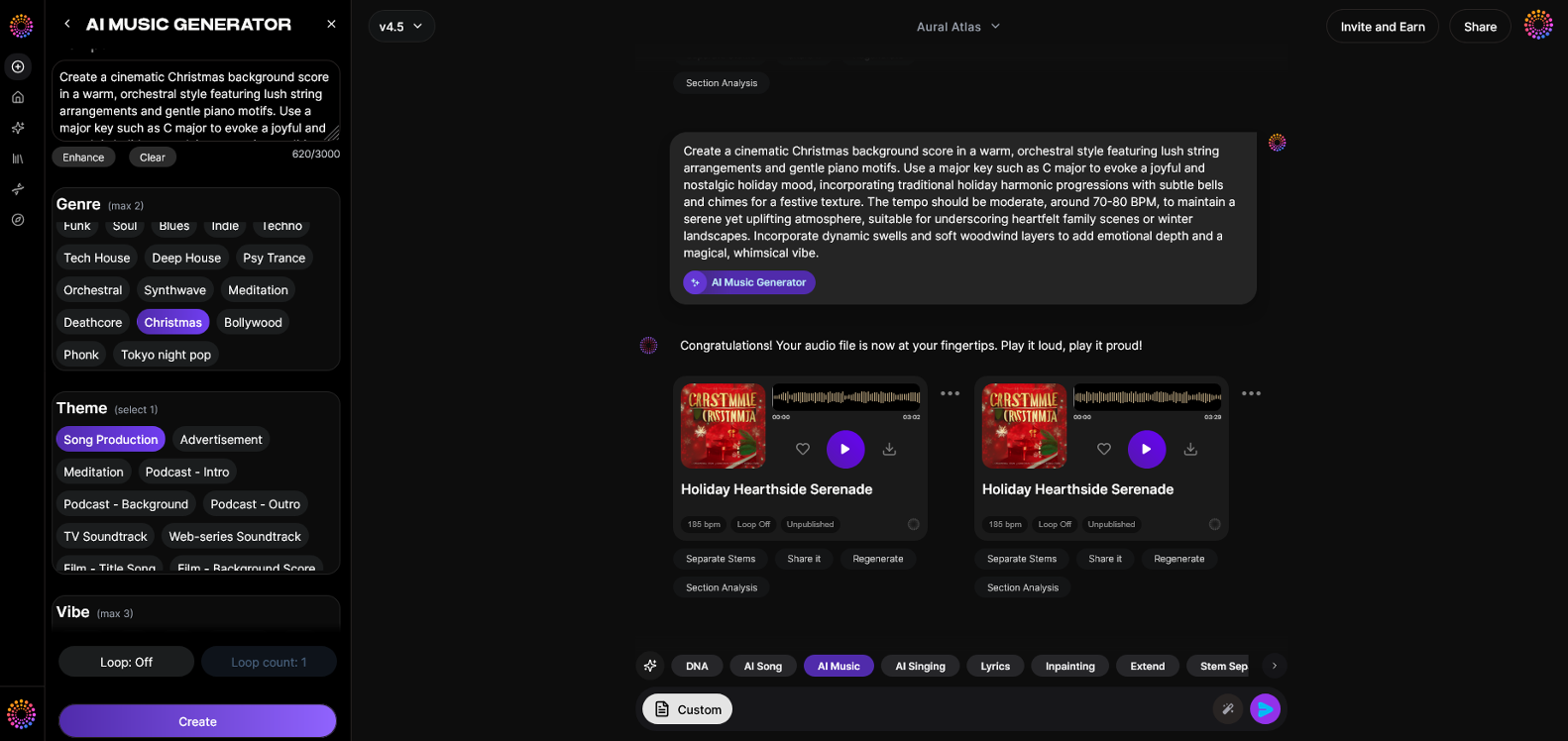
For artists and curators interested in crafting their own hybrid exhibitions, the Soundverse AI Music Generator provides an invaluable foundation. It allows creators to produce fully arranged instrumental music directly from text prompts, eliminating the barriers of traditional studio workflows.
Soundverse’s core capabilities include:
- Text-to-music generation across genres and moods.
- Loop Mode for seamless repetition, ideal for gallery environments where continuous playback is necessary.
- Detailed genre, mood, and instrument control for creative precision.
- V4 and V5 Model options that determine stylistic complexity and sound palette.
Primary use cases in gallery contexts:
- Background soundscapes supporting visual projections.
- Interactive installation loops that evolve continuously.
- Meditative sound environments for wellness-centered exhibitions.
- Commercial audio backdrops for branded pop-up spaces.
Because Soundverse generates instrumental (non-vocal) music, the resulting soundtracks integrate smoothly with ambient visuals and narrative spaces, avoiding lyrical distraction.
Artists can extend their soundscapes in Arrangement Studio, a collaborative environment for refining and restructuring generated tracks. Meanwhile, Soundverse DNA ensures that all AI-generated music remains ethically sourced and copyright-safe, a vital requirement for institutions exhibiting content publicly. The Section Analysis feature offers quick visualization of a track's structure (Intro, Verse, Chorus, etc.), providing editors with time-stamped control for syncing music to video or light cues.
For a deeper dive into use techniques, watch our tutorial on how to make music or the guide on creating Deep House music from the Soundverse Tutorial Series.
Why AI music generation aligns with the future of sound art
Artificial intelligence has liberated sound artists from repetitive production tasks, enabling them to focus entirely on conceptual and spatial exploration. By transforming abstract descriptions (e.g., “a reflective metallic sound reminiscent of rainfall inside a cathedral”) into complete musical forms, AI tools expand creative bandwidth.
Soundverse has been featured in numerous contemporary art projects — from ambient wellness exhibitions to generative architecture visualizations — due to its capacity to translate conceptual language into auditory form. For deeper examples, explore how AI-generated music is transforming the music industry or see applications in film and television composition.
These hybrid workflows redefine authorship and transformation, positioning AI as a collaborator rather than a replacement. The artist retains curatorial control while using the machine’s precision to render immersive patterns of sound.
How artists are using Soundverse to redefine gallery soundscapes
Many multimedia designers use Soundverse’s looping capabilities to synchronize sound with reactive lighting systems. Curators can quickly produce thematically synchronized tracks across multiple rooms — for example, pairing minimal electronic textures in one room with organic, acoustic soundscapes in another.
Moreover, the integration of DNA-trained sonic signatures allows for artists to monetize their style and license ethically produced gallery music. This approach nurtures a sustainable art economy where AI complements human creativity.
If you’re exploring evolving media environments or wish to develop music that evokes specific spaces, you may also find value in guides such as How to Create EDM with Soundverse AI or How to Create Healing Meditation Music.
Create Immersive Music and Visual Experiences with Soundverse
Bring your artistic vision to life by generating custom AI music and sounds that perfectly complement your visual media. Transform your gallery, video, or installation into a multisensory masterpiece today.
Related Articles
- The Role of AI Music in Film and Television — Discover how AI-generated music is reshaping sound design and storytelling across visual media industries.
- How an AI Music Generator Inspires Creative Fusion — Explore how AI-powered composition tools spark collaboration between sound and visual artists.
- AI Music Generator and Human Composers: A Future Together — Learn how AI complements human creativity to produce innovative soundscapes for modern art.
- The Benefits of Composing with AI Music Generator — Uncover the advantages of using AI tools to streamline your music creation process for multimedia projects.
Here's how to make AI Music with Soundverse
Video Guide

Here’s another long walkthrough of how to use Soundverse AI.
Text Guide
- To know more about AI Magic Tools, check here.
- To know more about Soundverse Assistant, check here.
- To know more about Arrangement Studio, check here.
Soundverse is an AI Assistant that allows content creators and music makers to create original content in a flash using Generative AI. With the help of Soundverse Assistant and AI Magic Tools, our users get an unfair advantage over other creators to create audio and music content quickly, easily and cheaply. Soundverse Assistant is your ultimate music companion. You simply speak to the assistant to get your stuff done. The more you speak to it, the more it starts understanding you and your goals. AI Magic Tools help convert your creative dreams into tangible music and audio. Use AI Magic Tools such as text to music, stem separation, or lyrics generation to realise your content dreams faster. Soundverse is here to take music production to the next level. We're not just a digital audio workstation (DAW) competing with Ableton or Logic, we're building a completely new paradigm of easy and conversational content creation.
TikTok: https://www.tiktok.com/@soundverse.ai
Twitter: https://twitter.com/soundverse_ai
Instagram: https://www.instagram.com/soundverse.ai
LinkedIn: https://www.linkedin.com/company/soundverseai
Youtube: https://www.youtube.com/@SoundverseAI
Facebook: https://www.facebook.com/profile.php?id=100095674445607
Join Soundverse for Free and make Viral AI Music

We are constantly building more product experiences. Keep checking our Blog to stay updated about them!