How Voice Cloning Works in Modern AI Music Platforms
Explore how voice cloning in AI music powers synthetic voices & creative production in 2026.
How Voice Cloning Works in Modern AI Music Platforms
Introduction
In 2026, voice cloning in AI music has become one of the most exciting frontiers in sound design and creative production. As AI voice technology advances, synthetic voices are not only indistinguishable from real human vocals but also capable of carrying the nuances, emotion, and expressiveness of any style or artist. From remix creators to vocal producers and AI developers, understanding how these systems work is crucial for harnessing their full potential in music creation with AI.
Unlike basic text-to-speech systems of the past, modern AI-powered vocal synthesis allows entire performances to be reimagined through deep learning in audio. These tools analyze timbre, phrasing, and expressive dynamics—then reconstruct a new performance that sounds authentic, emotional, and musically coherent. Let’s explore how it all works and see how Soundverse’s Voice Swap feature exemplifies the latest innovations.
What is Voice Cloning in AI Music?
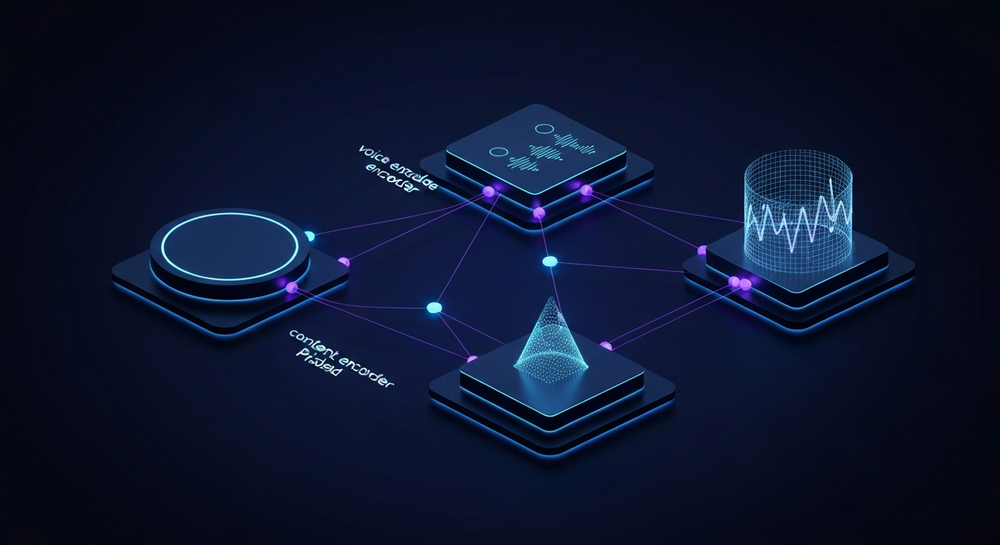
Voice cloning in AI music is the process of digitally replicating a singer’s voice characteristics using neural networks trained on audio data. The aim is to generate a synthetic version of a voice that can perform new material while retaining the tone and personality of the original. Modern systems rely on a combination of speech synthesis and vocal modeling technologies to achieve high fidelity.
In simple terms, the AI learns the unique sonic fingerprint of a voice—its timbre, resonance, vibrato, and articulation—and then uses this data to generate new singing or spoken performances. These synthetic voices can be applied to any song or instrumental piece, creating limitless possibilities for experimentation.
How Does Deep Learning in Audio Make Voice Cloning Possible?
Modern AI voice technology depends on deep learning models, specifically neural networks trained on vast datasets of recorded voices. The models identify patterns across frequency, pitch, and expression. Through encoder-decoder frameworks, the AI converts a vocal performance into a latent representation of human sound before reconstructing it in a target voice.
Typically, these systems integrate three primary components:
- Voice Encoder: Analyzes an input audio clip to extract unique voiceprint features.
- Content Encoder: Separates the vocal identity from linguistic and melodic content.
- Decoder or Vocoder: Reconstructs a new voice waveform matching the target vocal model.
This process allows AI developers to train multipurpose synthetic models that can expressively re-perform material without losing the original phrasing. In music production, this means a singer’s demo can be reimagined as another artist, or a songwriter can instantly test different vocal styles. For a practical demonstration, watch our Soundverse Tutorial Series - How to Make Music.
What Are the Key Applications of Voice Cloning in Music Creation with AI?
The potential of voice cloning extends across several creative and professional use cases:
- Demo and songwriting: Artists can create realistic guide vocals before hiring session singers.
- Character performance: Animation studios and game developers generate voices for characters without needing multiple actors.
- Genre adaptation: Producers test their music in different vocal styles, genders, or accents.
- Music remixes and parodies: Content creators generate alternative versions while keeping the emotional tone intact.
- Language localization: Songs can be rendered in multiple languages using consistent vocal identities.
These capabilities align closely with developments seen across platforms like Soundverse AI, where music creation has rapidly evolved into a collaborative process between humans and intelligent systems.
What Makes Modern Synthetic Voices so Realistic?
The realism of synthetic voices in 2026 arises from improvements in expressive modeling and timbre preservation. High-resolution spectrogram analysis allows the AI to capture micro-dynamics such as breathing, pitch slides, and subtle emotional shifts. Additionally, hybrid approaches now combine waveform synthesis with neural vocoding for high-fidelity output.
AI developers also emphasize the “contextual awareness” of the voice model—how it interprets rhythmic phrasing or vowel duration in different musical genres. For instance, a soul singer’s bending phrasing differs from a pop vocalist’s clean head tone. Modern AI captures these nuances effortlessly.
Another reason synthetic vocals are nearly indistinguishable today is that AI models are trained on licensed, ethically sourced data, ensuring both authenticity and legal safety—a core principle in platforms like Soundverse.
How to Make Voice Cloning Work in Real Music Workflows
In 2026, music producers and sound engineers integrate AI-powered vocal synthesis as naturally as they use auto-tune or sampler plug-ins. The standard workflow looks like this:
- Record or import a vocal performance. The source doesn’t need to be polished; even home recordings can be processed effectively.
- Apply a voice cloning model. Choose a synthetic or celebrity-style voice depending on creative requirements.
- Run the AI processing step. The model encodes, translates, and decodes the voice into the new identity.
- Mix & master. The cloned result is balanced with instrumentals, often indistinguishable from human performances.
The key is that the AI operates asynchronously—you upload or record first, then let the model generate results, avoiding any misconception about live microphone filtering. For a deeper dive into production, check out our guide on creating Deep House music.
How to Make Voice Cloning in AI Music with Soundverse Voice Swap
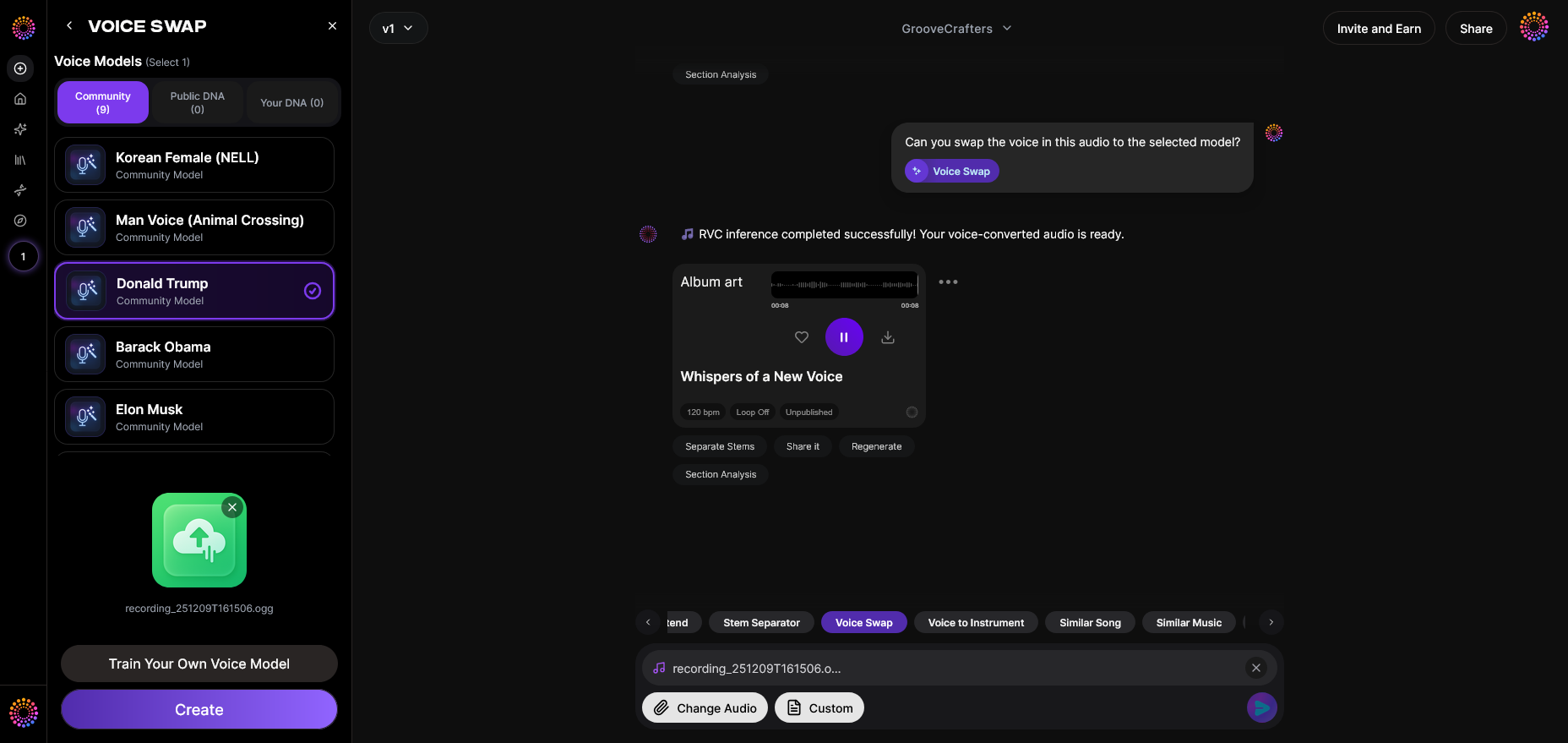
Soundverse’s Voice Swap is the flagship tool that brings professional-grade voice cloning to everyday creators. Instead of running complex neural scripts manually, Voice Swap automates the entire transformation while preserving natural phrasing and expressiveness.
Official Product Description: Voice Swap replaces the vocal identity in an audio track with a different voice model (Celebrity, Character, or Custom DNA) while preserving the original performance’s nuances, timing, and expression.
Core Capabilities:
- Community Voices: Choose from a growing collection of celebrity or character models.
- Public DNA & Personal DNA: Apply voice models built from licensed artist data or your own vocal DNA.
- Voice-to-Voice Conversion: Upload any recording and transform its vocal identity without losing performance quality.
Primary Use Cases:
- Create professional demo vocals.
- Generate character voices for media and games.
- Produce customized parody performances.
- Test multiple singing styles easily.
Built on the same ethical foundation as Soundverse DNA, Voice Swap ensures all output remains copyright-safe and aligned with legal AI training standards.
Why Is Soundverse Leading the AI Music Space in 2026?
By combining DNA-based modeling with synthetic vocal synthesis, Soundverse differentiates itself from other platforms such as Suno or Musicfy. Its generative system prioritizes artist collaboration and style monetization instead of unlicensed imitation.
Additionally, tools like the Similar Singing Generator and Similar Song Generator empower users to stay creative from idea to final master without stepping into copyright issues. It’s a holistic ecosystem designed for the modern musician.
For deeper exploration of AI-driven composition and arrangement, see how creators are already using Soundverse in areas like AI-generated song production or hybrid genre exploration discussed in AI Music Trends 2026.
Ethical Considerations and the Future of AI Voice Technology
While the technical sophistication of voice cloning in AI music is undeniable, ethical boundaries remain paramount. Responsible platforms, including Soundverse, address this with explicit consent protocols and licensing frameworks. Artists can register their vocal profiles, control usage rights, and earn royalties when others generate derivative material.
The future of AI voice technology will likely gravitate toward even finer emotional control—allowing producers to specify expressions like warmth, intensity, or melancholy directly in the generation prompt. As personalization expands, we can expect synthetic voices to merge seamlessly with holographic performances and immersive metaverse concerts.
Clone Voices. Create Magic with Soundverse AI.
Experience the future of customizable sound. Use AI-powered voice cloning to craft one-of-a-kind vocals, harmonies, and soundscapes that elevate your tracks instantly.
Start Creating with AI Voices
Related Articles
- Soundverse Introduces Stem Separation AI Magic Tool: Discover how Soundverse’s AI magic tool separates stems for more flexibility in remixing and production.
- Soundverse SAAR: AI Voice Assistant: Meet SAAR, the AI voice assistant helping creators produce professional-grade vocals without a studio.
- AI Music Generator and Human Composers: A Future Together: Explore how AI music generators complement human creativity for a harmonious music-making future.
- The Role of AI Music in Film and Television: Learn how AI-generated music is reshaping sound design and scoring across visual media projects.
Here's how to make AI Music with Soundverse
Video Guide

Here’s another long walkthrough of how to use Soundverse AI.
Text Guide
- To know more about AI Magic Tools, check here.
- To know more about Soundverse Assistant, check here.
- To know more about Arrangement Studio, check here.
Soundverse is an AI Assistant that allows content creators and music makers to create original content in a flash using Generative AI.
With the help of Soundverse Assistant and AI Magic Tools, our users get an unfair advantage over other creators to create audio and music content quickly, easily and cheaply.
Soundverse Assistant is your ultimate music companion. You simply speak to the assistant to get your stuff done. The more you speak to it, the more it starts understanding you and your goals.
AI Magic Tools help convert your creative dreams into tangible music and audio. Use AI Magic Tools such as text to music, stem separation, or lyrics generation to realise your content dreams faster.
Soundverse is here to take music production to the next level. We're not just a digital audio workstation (DAW) competing with Ableton or Logic, we're building a completely new paradigm of easy and conversational content creation.
TikTok: https://www.tiktok.com/@soundverse.ai
Twitter: https://twitter.com/soundverse_ai
Instagram: https://www.instagram.com/soundverse.ai
LinkedIn: https://www.linkedin.com/company/soundverseai
Youtube: https://www.youtube.com/@SoundverseAI
Facebook: https://www.facebook.com/profile.php?id=100095674445607
Join Soundverse for Free and make Viral AI Music

We are constantly building more product experiences. Keep checking our Blog to stay updated about them!