How Ethical AI Music Platforms Source Training Data in 2026
Discover how ethical AI music platforms ensure fair data sourcing and copyright-safe AI training.
How Ethical AI Music Platforms Source Training Data
In 2026, the conversation around ethical AI music platforms has shifted from simple compliance to deep structural integrity in data sourcing, transparency, and recurring compensation models. As generative audio technology matures, the question is no longer whether artificial intelligence can compose music—but whether it can do so responsibly. The stakes are clear: without ethical frameworks, the next generation of AI-driven creativity risks eroding artist rights and undermining copyright law.
Why Is Ethical Data Sourcing Critical for AI Music?
The foundation of every AI model lies in its training data. For AI music generation tools, that means vast libraries of songs, stems, and performance recordings. When developers train systems using unlicensed or scraped content, they expose themselves to infringement risks and ethical scrutiny. By contrast, ethical AI music platforms prioritize transparency in data sourcing and consent-driven participation.
Since 2025, major advancements in AI music generation have introduced new challenges concerning creator compensation, ownership, and attribution. As artists demand greater control over how their work informs machine learning models, the industry has begun to focus on responsibility, traceability, and fairness.

What Principles Guide Ethical AI Music Platforms?
- Consent: All training data must be sourced from artists or labels who have explicitly opted in.
- Attribution: The system should track creative lineage—identifying which artist’s input influenced which output.
- Compensation: When an AI’s output uses specific stylistic models derived from licensed data, the contributing artists must receive royalties.
- Transparency: Platforms must disclose how datasets are built, what rights are involved, and how usage is tracked over time.
- Auditability: Outputs should be verifiable through traceable metadata or watermarking.
These values underpin not only legal compliance but the larger mission of fostering trust between human creators and artificial intelligence systems.

How Do AI Platforms Obtain and Manage Training Data Responsibly?
Ethical AI music platforms follow rigorous workflows to ensure they only train on approved material. This often includes:
- Licensed Datasets: Instead of scraping songs from public sources, licenses are secured from rights-holders.
- Structured Metadata: Every song used for training is tagged with metadata identifying its author, label, and licensing terms.
- Data Partitioning: Models are segmented based on usage needs—commercial, creative, or educational—ensuring no unlicensed material slips through.
- Ongoing Compliance Audits: Continuous validation of usage terms ensures outputs remain compliant as regulation evolves.
This data hygiene approach prevents unauthorized use and strengthens the credibility of AI systems in the professional music ecosystem.
What Is Driving the Shift Toward Ethical AI in Music in 2026?
Artist unions and copyright regulators have accelerated standards development since 2024, leading to clearer frameworks for AI data governance. Several U.S. states and EU member countries now require AI platforms to disclose their training sources—creating a global push toward accountability.
Meanwhile, digital-native creators want to use AI safely. Independent musicians producing content for film, games, and social media increasingly demand models trained on ethical datasets. Articles such as How AI-Generated Music Is Transforming the Music Industry show how transparency influences creative adoption. In 2026, audiences now expect platforms to explain not just what AI can generate, but where its intelligence comes from.
For a deeper dive, watch our guide on creating Deep House music and our tutorial on making music with Soundverse.
What Ethical Challenges Still Exist?
Even in 2026, challenges persist:
- Representation Bias: Training data may overrepresent specific genres or regions, affecting stylistic diversity.
- Synthetic Attribution: Determining the boundary between influence and imitation remains complex.
- Data Provenance: Ensuring all content has verifiable origin metadata is still a technical hurdle.
- Artist Education: Many musicians remain unaware of the benefits of ethical data contribution programs.
These barriers signal the ongoing need for frameworks that go beyond compliance to create equitable creative ecosystems.
How to Make Ethical Data Sourcing Central to AI Development
Developers can adopt a multi-step approach:
- Conduct a data audit to identify current unlicensed datasets.
- Establish contracts with record labels or independent catalog managers.
- Use filtering mechanisms to detect and exclude unauthorized content.
- Deliver transparency reports accessible to rights-holders.
- Provide clear licensing options for artists who wish to opt-in to model training.
This alignment between business, legal, and technical teams forms the backbone of responsible AI deployment in music.
How to Make Ethical AI Music Platforms Sustainable
Long-term sustainability comes from blending commercial innovation with fair participation. Royalty models tied to watermark-based attribution have proven pivotal. Recurring revenue streams for artists encourage continued data licensing, while transparent attribution builds user trust. As music industry trends continue evolving, compliance systems are no longer just regulatory tools—they’re market differentiators.
How to Make Responsible AI in Music a Collaborative Effort
Building responsible AI in music depends on collaboration among multiple stakeholders:
- Artists & Labels: Provide licensed content and verify attribution.
- Developers: Uphold ethical data practices and transparency.
- Regulators: Enforce disclosure guidelines for training datasets.
- Users: Choose AI tools that respect creator rights.
This multi-stakeholder approach ensures AI becomes an ally to music creators rather than a competitor.
How to Make Ethical AI Music with Soundverse The Ethical AI Music Framework
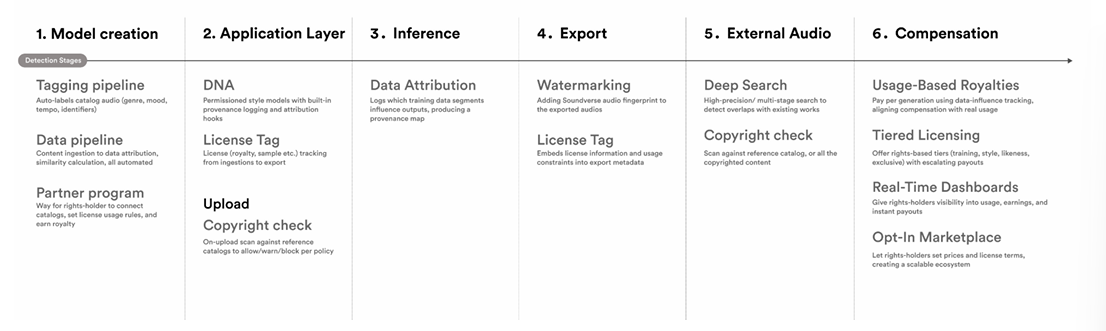
Soundverse’s Ethical AI Music Framework defines the current benchmark for ethical AI music platforms in 2026. It offers a six-stage transparent pipeline replacing the opaque, black-box systems that previously dominated the space.
The Six Stages of the Framework:
- Licensed Data Sourcing (No Scraping): All music data is obtained through verifiable partnerships rather than public scraping, ensuring every sound used in training is legally cleared.
- Permissioned Models (DNA): Each AI model is built only from consented, licensed data—forming the foundation of Soundverse DNA, which specializes in generating artist-specific yet copyright-safe music.
- Explainable Inference (Attribution): Outputs are tied to clear creator lineages, helping track which artists contributed stylistic DNA.
- Traceable Export (Watermarking): Every output carries invisible trace marks confirming authenticity and facilitating external attribution.
- Deep Search (External Scanning): The framework constantly checks outputs against external databases to ensure compliance with copyright standards.
- Recurring Compensation (Partner Program): Through the Content Partner Program, artists receive recurring usage-based royalties each time AI-generated outputs derived from their licensed data are used commercially.
This systematic approach bridges innovation and integrity—proving that sophisticated music generation can also respect ownership rights. It also complements other Soundverse tools such as Soundverse Trace, which reinforces attribution and rights protection, and the Soundverse Assistant, which simplifies ethical creative workflows.
For professionals exploring alternatives to non-transparent AI systems, Soundverse stands as a comprehensive framework for enterprises, developers, and ethical researchers alike.
Create Music Ethically with Soundverse
Experience the future of music generation built on transparency and creativity. Join thousands of artists using Soundverse to produce original tracks with ethically sourced AI tools.
Start Creating with Soundverse
Related Articles
- How AI-Generated Music Is Transforming the Music Industry: Discover how AI is reshaping production, distribution, and creativity across the music world.
- AI Music Generator and Human Composers: A Future Together: Explore how collaboration between AI tools and musicians is paving the way for innovative sound creation.
- Navigating the World of Royalty-Free and Copyright-Free Music Using Soundverse AI: Learn how to ethically source and use AI-generated music without copyright concerns.
- The Role of AI Music in Film and Television: Find out how ethical AI platforms are expanding soundscapes for modern visual storytelling.
Here's how to make AI Music with Soundverse
Video Guide
 Here’s another long walkthrough of how to use Soundverse AI.
Text Guide
- To know more about AI Magic Tools, check here.
- To know more about Soundverse Assistant, check here.
- To know more about Arrangement Studio, check here.
Soundverse is an AI Assistant that allows content creators and music makers to create original content in a flash using Generative AI. With the help of Soundverse Assistant and AI Magic Tools, our users get an unfair advantage over other creators to create audio and music content quickly, easily and cheaply. Soundverse Assistant is your ultimate music companion. You simply speak to the assistant to get your stuff done. The more you speak to it, the more it starts understanding you and your goals. AI Magic Tools help convert your creative dreams into tangible music and audio. Use AI Magic Tools such as text to music, stem separation, or lyrics generation to realise your content dreams faster. Soundverse is here to take music production to the next level. We're not just a digital audio workstation (DAW) competing with Ableton or Logic, we're building a completely new paradigm of easy and conversational content creation.
TikTok: https://www.tiktok.com/@soundverse.ai
Twitter: https://twitter.com/soundverse_ai
Instagram: https://www.instagram.com/soundverse.ai
LinkedIn: https://www.linkedin.com/company/soundverseai
Youtube: https://www.youtube.com/@SoundverseAI
Facebook: https://www.facebook.com/profile.php?id=100095674445607
Join Soundverse for Free and make Viral AI Music
 We are constantly building more product experiences. Keep checking our Blog to stay updated about them!