How AI Music Platforms Decide What You’re Allowed to Own
Discover how AI music platforms determine ownership, rights, and ethical AI music frameworks in 2026.
How AI Music Platforms Decide What You’re Allowed to Own
In 2026, the intersection between artificial intelligence and music creation has become one of the most debated topics in the music industry. As artists, producers, and tech innovators collaborate across digital environments, one question continually emerges: how do AI music platforms decide what you’re allowed to own?
The rise of AI-generated tracks has changed traditional music copyright frameworks. Ownership no longer only refers to the person who composed or recorded a song—it now involves the algorithm, the data used to train it, and the permissions attached to that data. Understanding AI music ownership is critical for any musician or creator using platforms like Soundverse or exploring alternatives such as Mubert and Soundraw.
What does AI music ownership mean in 2026?

In simple terms, AI music ownership refers to who holds rights to songs or compositions generated through artificial intelligence. It involves authorship, licensing, and the right to monetize or distribute works created by an algorithm. Since AI models generate music from large datasets, ownership can be complex. It may include the creator who inputs the prompt, the AI platform that processes it, and the rights-holders whose original works were used in training.
Back in 2024 and 2025, discussions about AI music rights were speculative. By 2026, regulatory bodies and legal precedents have started setting clearer standards. The focus has shifted from mere compliance to ethical transparency: users want to know not only that their tracks are legally safe but also how these models were trained.
Why do AI music platforms control ownership rights?
AI music platforms must define ownership boundaries to prevent legal conflicts and maintain ethical integrity. When creators generate music online, questions arise: Can they claim full ownership? Can they sell or license these tracks commercially? The answer depends on how transparently the platform manages data, attribution, and consent.
Several factors guide these decisions:
- Data Licensing and Permissions: Platforms must ensure all training data has been legally licensed. Using scraped content without consent can violate copyright laws.
- Transparency of Algorithms: Traditional AI systems often operate as black boxes. Without transparency, it’s difficult to prove ownership or ensure fair compensation.
- Attribution and Traceability: Tools should be able to identify which artists’ styles or datasets influenced a track.
- Distribution Control: Platforms regulate export rights, watermarking, and monetization routes to prevent misuse.
These principles shape how much control you actually have over AI-generated music.
What challenges arise with AI music rights?
Managing AI music rights involves balancing creative freedom and legal compliance. A single song may be influenced by thousands of licenses, metadata tags, and pattern recognitions embedded during model training. Thus, attributing ownership becomes a technical and ethical exercise.
Creators face three common challenges in 2026:
- Unclear Authorship: Who is the ‘author’ of an AI-generated song—the machine, the human input creator, or the dataset contributors?
- Commercial Restrictions: Many platforms limit how AI-generated tracks can be distributed or sold.
- Compensation Models: Artists whose sounds train the AI often lack recurring royalties.
Platforms like Soundverse emerged to solve these conflicts with a transparent architecture that centers artist integrity. For a deeper dive, watch our guide on creating Deep House music.
How legal frameworks evolved between 2024 and 2026
From 2024–2025, the debate about AI and copyright was dominated by lawsuits and experimental licensing schemes. But in 2026, most global music organizations adopted standardized AI music frameworks. The concept of ‘consent-driven data sourcing’ became mainstream.
Legal progress now relies on machine-auditable consent verification. Each dataset must trace back to a rights-holding entity, and generated outputs must contain embedded attribution metadata. This makes it possible to establish ownership lines even when multiple creators collaborate through AI interfaces.
How Soundverse helps clarify ownership in AI-generated music
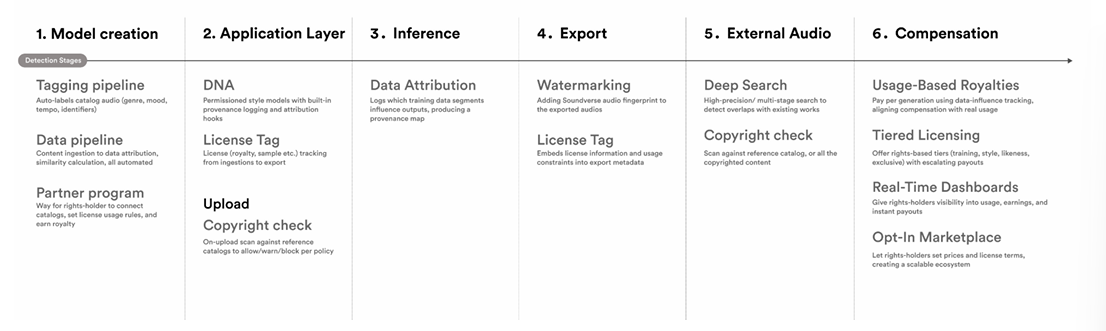
The industry’s most notable transparency model today is Soundverse’s Ethical AI Music Framework—a system designed specifically for ethical generation and ownership protection. It introduces a clear, six-stage pipeline that replaces opaque black-box models with traceable processes.
How to establish AI music ownership with Soundverse The Ethical AI Music Framework
Soundverse’s Ethical AI Music Framework is a comprehensive infrastructure that bridges the gap between innovation and artist integrity. It ensures that both the creator using AI and the rights-holders contributing source material remain protected.
Its six core stages build a transparent chain of trust:
- Stage 1: Licensed Data Sourcing (No scraping) – Every dataset used for AI model training originates from verified licenses within the Content Partner Program. No unauthorized scraping occurs.
- Stage 2: Permissioned Models (DNA) – Through Soundverse DNA, artists can license their stylistic data so users can generate music inspired by them legally and ethically.
- Stage 3: Explainable Inference (Attribution) – Every generation process includes attribution records embedded at inference. This guarantees that track origins are transparent.
- Stage 4: Traceable Export (Watermarking) – When creators export their songs, watermarks link the audio back to its training model chain, ensuring traceability.
- Stage 5: Deep Search (External Scanning) – Soundverse Trace scans the wider AI ecosystem to detect potential overlaps, helping prevent copyright violations.
- Stage 6: Recurring Compensation (Partner Program) – Rights-holders receive recurring royalties whenever their licensed sounds contribute to AI generations.
This system creates clarity around ownership in AI-generated music, ensuring creators own the outputs they produce while respecting data contributors.
What makes Soundverse unique compared to traditional AI platforms?
Conventional AI music platforms often leave users unaware of how data was sourced or whether their generated songs are copyright-safe. Soundverse changes that by prioritizing transparency and ethical responsibility.
It also connects creators to the Content Partner Program, where musicians can monetize their own catalog through opt-in licensing deals. Each time someone uses the AI to generate a track based on their ‘DNA,’ they receive equity-like royalties.
For professionals exploring diverse AI methods, you can compare Soundverse’s ethical framework to tools like Soundraw Alternative or Mubert Alternatives to understand how transparency impacts monetization.
How do rights transfer when using AI music platforms?
Ownership transfer depends on licensing type.
- Personal Use Licenses: You can use generated music for content creation (e.g., videos or podcasts), but may not resell it.
- Commercial Licenses: Platforms may grant full resale or publishing rights if you hold verified creator status.
- Collaborative Rights: Shared ownership models split revenue between prompt creators and data contributors.
In all cases, attribution is key. When using ethical frameworks, watermarking ensures you can prove that a track originated from legitimate data sources. This protects both creators and rights-holders.
For creators who regularly publish content across multiple platforms, exploring features like Soundverse Trace or Soundverse Assistant (see https://www.soundverse.ai/blog/article/soundverse-assistant-your-ai-music-co-producer) can simplify attribution management.
For another helpful visual summary, check out our Explore Tab walkthrough from the Soundverse YouTube channel.
How will AI music ownership evolve in the next few years?
By 2026, AI music rights are evolving toward long-term sustainability. Experts predict stronger global standards ensuring compensation, transparency, and verified authorship. Artist-led licensing programs will expand, allowing musicians to integrate their creative DNA directly into intelligent models.
The concept of ‘joint authorship’—where human prompts and AI algorithms co-own outputs—is expected to gain legal recognition soon. This balance of ethics and innovation ensures the future of music creation remains fair and collaborative.
Why understanding AI music ownership matters for creators
Musicians and producers now operate in hybrid creative spaces, mixing analog artistry with algorithmic intelligence. Owning your AI creations is not just a legal issue—it’s an identity and revenue issue. By learning how AI music platforms define ownership, creators can safeguard their work and maximize earning potential.
Platforms that follow transparent frameworks like Soundverse enable fair usage, verified compensation, and measurable attribution—a crucial combination for artists entering 2026’s digital economy.
Create Your Own AI Music—Own Every Note
Generate, edit, and claim your rights to original AI music effortlessly using Soundverse’s cutting-edge tools. Start building your sound library with complete creative freedom today.
Start Creating Music for Free
Related Articles
- How AI-Generated Music Is Transforming the Music Industry: Explore how AI is redefining music creation and distribution across genres and platforms.
- Copyright-Free vs. Royalty-Free Music: What Creators Should Know: Understand the differences between copyright-free and royalty-free tracks to protect your music rights.
- Navigating the World of Royalty-Free and Copyright-Free Music Using Soundverse AI: Learn how Soundverse’s AI technology helps you stay on top of music licensing rules while creating freely.
- AI Music Generator and Human Composers: A Future Together: Discover how collaboration between human creativity and AI composition leads to new musical frontiers.
Here's how to make AI Music with Soundverse
Video Guide

Here’s another long walkthrough of how to use Soundverse AI.
Text Guide
- To know more about AI Magic Tools, check here.
- To know more about Soundverse Assistant, check here.
- To know more about Arrangement Studio, check here.
Soundverse is an AI Assistant that allows content creators and music makers to create original content in a flash using Generative AI.
With the help of Soundverse Assistant and AI Magic Tools, our users get an unfair advantage over other creators to create audio and music content quickly, easily and cheaply.
Soundverse Assistant is your ultimate music companion. You simply speak to the assistant to get your stuff done. The more you speak to it, the more it starts understanding you and your goals.
AI Magic Tools help convert your creative dreams into tangible music and audio. Use AI Magic Tools such as text to music, stem separation, or lyrics generation to realise your content dreams faster.
Soundverse is here to take music production to the next level. We're not just a digital audio workstation (DAW) competing with Ableton or Logic, we're building a completely new paradigm of easy and conversational content creation.
TikTok: https://www.tiktok.com/@soundverse.ai
Twitter: https://twitter.com/soundverse_ai
Instagram: https://www.instagram.com/soundverse.ai
LinkedIn: https://www.linkedin.com/company/soundverseai
Youtube: https://www.youtube.com/@SoundverseAI
Facebook: https://www.facebook.com/profile.php?id=100095674445607
Join Soundverse for Free and make Viral AI Music

We are constantly building more product experiences. Keep checking our Blog to stay updated about them!