How AI Music Is Reviewed by Algorithms in 2026
Discover how AI music review algorithms shape the future of music evaluation and discovery in 2026.
How AI Music Is Reviewed by Algorithms
Artificial intelligence has transformed every corner of the modern music ecosystem, from composition to distribution, and now—evaluation. In 2026, AI music review algorithms play a decisive role in determining which AI-generated tracks get visibility on streaming platforms, playlist placements, and even licensing opportunities for creators. However, the underlying mechanisms driving these automated evaluations remain a complex blend of data science, psychoacoustics, and ethical considerations.
What are AI Music Review Algorithms?
AI music review algorithms are machine learning systems designed to evaluate musical compositions, both human-made and AI-generated. They assess audio characteristics such as structure, melody, rhythm, and emotional tone, while also considering external metadata like artist profiles, genre tags, and listener behavior. These engines don’t simply “listen” to a track—they analyze data representations of frequency, rhythm, and harmonic relationships to form judgments similar to a critic’s review.
By 2026, these algorithms perform automated quality control for millions of uploaded songs across digital platforms. They power music discovery systems that recommend new releases and categorize emerging styles. Unlike early iterations from 2024-2025 that focused primarily on acoustic or genre-based tagging, modern models in 2026 integrate deep learning to assess creativity, originality, and cultural context.

How Do Music Discovery Systems Use These Algorithms?
Music discovery systems rely heavily on AI review mechanisms to deliver better recommendations to listeners. Streaming services train their models with billions of listener interactions—skips, completions, likes, and playlist placements—to predict which songs resonate with specific audiences. For example, platforms like Spotify and YouTube use advanced pattern analysis to support their music recommendation algorithms, enabling artists to grow effectively.
In 2026, algorithmic curation has matured beyond basic matching. Instead of only analyzing BPM or genre, advanced systems use contextual embeddings to understand emotional intensity, lyrical sentiment, and instrumental balance. For example, an AI detector can assess whether an ambient composition fits a “mindfulness” playlist or a “soundtrack” category depending on its underlying sonic patterns. Moreover, social engagement and virality signals, such as those described in how social media traffic triggers music algorithms, further refine how discovery systems rank AI music.
Furthermore, AI in music evaluation is no longer limited to listener satisfaction metrics. Platforms implement automated music rating systems that consider technical precision, mix clarity, and mastering quality—allowing fairer competition between independent artists and AI models. This shift ensures that genuinely creative pieces, whether born from human imagination or machine collaboration, are recognized for their craftsmanship.

Why Are Automated Music Rating Systems Essential in 2026?
The sheer volume of music generated daily makes manual curation impractical. Automated music rating ensures scalable quality control and enhances trust in AI-driven catalogs. In previous years, platforms suffered from algorithmic bias and oversaturation of low-quality or derivative material. In 2026, AI-driven review systems address these issues by introducing transparent scoring models backed by verifiable metadata. See Platform Accountability in the Age of AI, Music Streaming, and Digital Media for further details on ongoing trust and transparency initiatives.
Machine learning and music now function symbiotically. Each new upload becomes a data source for training models that better understand style evolution, listener trends, and production standards. For example, a deep neural network can identify production flaws—like imbalanced loudness or spectral masking—while identifying creative originality through comparative pattern analysis.
Automated reviewers assign multi-dimensional scores, usually combining musicality, originality, and user appeal. These ratings influence playlist recommendations, contract opportunities, and even sync licensing decisions. The result is a more democratized evaluation pipeline where merit is recognized algorithmically rather than through subjective gatekeeping. Industry comparisons of current platforms can be found in Best New Music Recommendation Engines for 2026 Discovery.
What Ethical Challenges Do AI Music Review Algorithms Present?
While efficiency and consistency are benefits, the ethical risks are substantial. Algorithms lack intrinsic cultural understanding and can perpetuate genre or demographic bias if trained on unbalanced datasets. If a model learns mostly from Western pop structures, for instance, it might undervalue African polyrhythms or Indian raga traditions.
Therefore, in 2026, a growing push for transparent and explainable AI in music evaluation has emerged. Industry oversight now demands audit trails showing which training data influenced outcomes. Bias mitigation practices, multi-genre datasets, and traceable attribution layers have become best practices.
Legal and creative accountability are also intertwined with algorithmic reviews. If an AI system assigns a low originality score to a composer’s track due to “similarity” detection, the creator deserves to know whether the similarity stems from fair influence or dataset contamination. This is where solutions like Soundverse Trace play a crucial role.
How Does Machine Learning Analyze and Compare Music?
Modern machine learning models break music down into features including spectral centroids, chroma vectors, rhythmic onset patterns, and dynamic range compression. These parameters are fed into neural encoders that learn correlations between sonic elements and perceived quality metrics.
Generative models—those capable of creating music—also learn from the same property space, enabling them to both compose and evaluate their outputs. This dual role highlights a growing area of “self-assessment” AI in music, in which generative engines critique their compositions before human ears ever hear them.
Additionally, hierarchical transformers identify structural boundaries and thematic recurrence, similar to human musicological analysis. Technologies like Soundverse’s Section Analysis automate this task, labeling verses, choruses, and bridges for more precise algorithmic reviews. For a practical demonstration, watch our tutorial on making music inside Soundverse.
How to Make AI Music Review Algorithms More Transparent in 2026?
Transparency and traceability are top priorities in AI-driven music systems. Music industry professionals and developers are now establishing open standards for algorithmic audits, allowing creators to see how models arrived at a given rating or recommendation.
This movement grew after the 2025 debates on provenance in generative audio, which highlighted the need to verify how datasets influence composition and evaluation. Machine learning interpretability tools now display feature contributions—showing whether melody, tempo variation, or production style most affected a score. When combined with responsible frameworks like the Ethical AI Music Framework, such systems promote accountability across both sides of creation and critique.
How Soundverse Trace Reinforces Trust in AI Music Evaluation
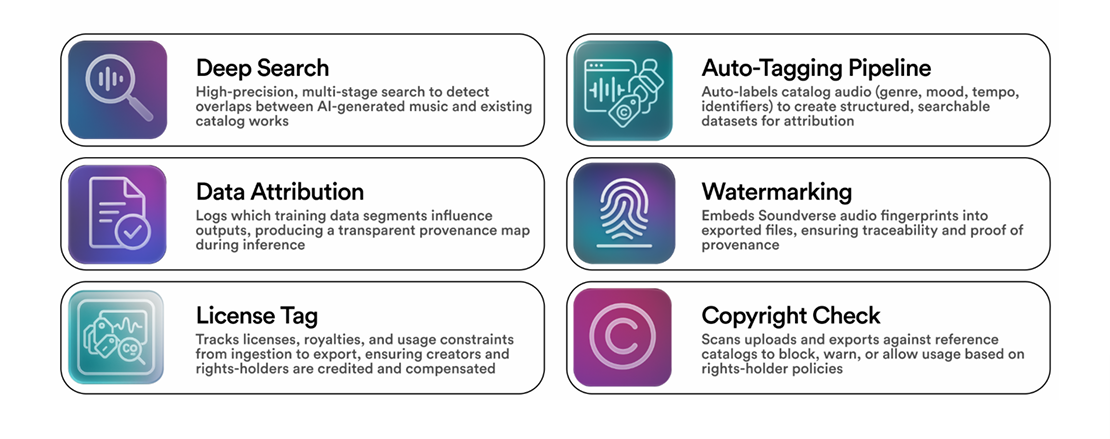
Soundverse Trace adds a new dimension of verification to the world of AI music review algorithms. Designed as a comprehensive trust layer for AI music, it provides deep metadata visibility from dataset creation to final export.
Soundverse Trace’s Deep Search capability conducts high-precision scanning (both 1:1 and 1:N) to detect overlaps or similarities among tracks. This ensures that evaluation engines can accurately differentiate between legitimate influence and potential plagiarism.
Through Data Attribution, Trace logs which training datasets influenced the final output, allowing transparent lineage tracking. Audio Watermarking embeds inaudible but robust fingerprints into each asset, maintaining accountability even as tracks circulate across platforms. Finally, License Tagging preserves rights metadata throughout the workflow—ensuring ethical compliance and accurate royalty tracking.
This system not only protects rights holders but also improves the reliability of automated music rating systems by providing contextual metadata. Developers integrating Soundverse Trace into their music discovery frameworks gain a powerful verification mechanism that enhances trust, transparency, and fairness.
To further ground AI innovations in ethical frameworks, Soundverse also offers the Ethical AI Music Framework, which ensures consent, attribution, and recurring compensation across generative and evaluative pipelines. Together, these technologies redefine authenticity in digital music ecosystems.
The Future of Algorithmic Curation and AI in Music Evaluation
Looking forward, algorithmic curation in 2026 is more human-aware than ever. While AI produces rapid assessments, human curators still play an essential oversight role—reviewing edge cases and training models for inclusivity. We’re witnessing the evolution of hybrid evaluation workflows where machine ranking supports, rather than replaces, human taste.
Music labels and streaming developers are merging algorithmic rating models with creative intelligence networks, forming “feedback loops” that improve both production and discovery quality. As a result, algorithms are no longer just gatekeepers—they are collaborators in shaping musical evolution.
For those exploring the broader AI music landscape, Soundverse’s guides on AI music generation and machine-learning-assisted creativity provide valuable context on how this technological symphony continues to unfold.
Experience the Future of AI Music Analysis
Discover how AI music review algorithms transform your compositions with intelligent insights and feedback. Join Soundverse to create, refine, and evolve your sound like never before.
Start Creating with Soundverse
Related Articles
- How AI-Generated Music Is Transforming the Music Industry: Explore how artificial intelligence is reshaping production, distribution, and creativity in the modern music landscape.
- AI Music Generator and Human Composers: A Future Together: Discover how AI tools complement human creativity and open new possibilities for composers and producers alike.
- Soundverse Assistant: Your AI Music Co-Producer: Learn how Soundverse Assistant helps you generate, arrange, and refine your tracks with seamless AI-powered collaboration.
- The Role of AI Music in Film and Television: Find out how AI-driven music generation enhances storytelling and production efficiency in film and TV.
Here's how to make AI Music with Soundverse
Video Guide

Here’s another long walkthrough of how to use Soundverse AI.
Text Guide
- To know more about AI Magic Tools, check here.
- To know more about Soundverse Assistant, check here.
- To know more about Arrangement Studio, check here.
Soundverse is an AI Assistant that allows content creators and music makers to create original content in a flash using Generative AI. With the help of Soundverse Assistant and AI Magic Tools, our users get an unfair advantage over other creators to create audio and music content quickly, easily and cheaply. Soundverse Assistant is your ultimate music companion. You simply speak to the assistant to get your stuff done. The more you speak to it, the more it starts understanding you and your goals. AI Magic Tools help convert your creative dreams into tangible music and audio. Use AI Magic Tools such as text to music, stem separation, or lyrics generation to realise your content dreams faster. Soundverse is here to take music production to the next level. We're not just a digital audio workstation (DAW) competing with Ableton or Logic, we're building a completely new paradigm of easy and conversational content creation.
TikTok: https://www.tiktok.com/@soundverse.ai
Twitter: https://twitter.com/soundverse_ai
Instagram: https://www.instagram.com/soundverse.ai
LinkedIn: https://www.linkedin.com/company/soundverseai
Youtube: https://www.youtube.com/@SoundverseAI
Facebook: https://www.facebook.com/profile.php?id=100095674445607
Join Soundverse for Free and make Viral AI Music

We are constantly building more product experiences. Keep checking our Blog to stay updated about them!
Image Steps: []