How AI Music Is Curated by Humans in 2026
Explore how AI music curation in 2026 blends human creativity with machine precision for ethical, transparent music generation.
How AI Music Is Curated by Humans
Artificial intelligence has revolutionized virtually every corner of the music world. Yet, even as algorithms compose melodies and neural networks replicate complex rhythmic patterns, one constant remains — the human touch. In 2026, AI music curation stands as a collaborative frontier where human expertise directs, filters, and perfects machine-generated creativity. The goal is not to replace human intuition but to enhance it through adaptive, ethical, and sustainable frameworks that ensure the integrity of both art and artist.
What does AI music curation mean in 2026?
AI music curation refers to the process of selecting, refining, and presenting AI-generated songs using human judgment and ethical oversight. Instead of leaving algorithmic generation to run unchecked, music producers, researchers, and curators actively guide the AI — deciding which datasets to train it on, determining stylistic influences, and evaluating output quality. According to Beatoven.ai, music curation is a specialized service in which a music creator crafts collections for unique experiences — an ethos continuing within human-guided AI models.
By 2026, the practice has matured into a core workflow for digital music platforms and professional creators. This shift is the result of growing awareness about consent, copyright, and the responsibility of technology companies to treat artists fairly. Thus, human-in-the-loop AI has become an industry-standard phrase, signifying a transparent cooperative process where humans set creative and ethical boundaries for machine learning in music.

Why can’t AI music curation be fully automated?
Despite monumental progress in machine learning, complete autonomy in music curation remains impractical and ethically risky. Algorithms can identify sound patterns and predict popular structures, but they lack emotional context. Human curators bring qualitative insights that AI cannot replicate — such as understanding lyrical nuance, cultural significance, and artistic emotion, as also explained in “What AI Means for the Music Industry in 2026” on YouTube.
This human oversight prevents algorithmic bias, ensures genre diversity, and safeguards artistic legacy. Without it, AI models might over-optimize for trends, overlooking unique musical expressions. The result could be a homogenized sonic landscape — precisely what curators seek to avoid.

How does human involvement shape AI-generated songs?
Human curators perform multiple roles in the AI music pipeline:
- Dataset supervision: Curators verify that training data come from licensed or consented sources, preventing the unethical scraping of copyrighted works.
- Aesthetic direction: They tweak prompts, adjust stylistic influences, and select generative architectures suited to specific moods or genres.
- Quality control: After generation, humans assess musical coherence, emotional impact, and structural flow.
- Cultural alignment: Curators consider the symbolic and social significance of songs — ensuring that AI outputs remain inclusive and context-sensitive.
Every one of these stages requires empathy and musical understanding, which no autonomous system can yet imitate.
What are the latest trends in AI music technology in 2026?
As music technology evolves, so too does the relationship between humans and AI systems. In the past two years, developers have focused on transparency and traceability — ensuring AI systems explain how compositions are formed. Machine learning in music now emphasizes accountability and identity over raw generative power.
Key 2026 trends include:
- Ethical data pipelines: Companies are investing in models trained on licensed catalogs through fair compensation programs.
- Generative explainability: Models now provide attribution trails showing which artists inspired an AI-generated style.
- Collaborative AI platforms: New systems allow shared human-AI composition sessions, where users can iterate on music generation interactively.
- Cross-platform traceability: Integration with streaming services enables tracking of AI compositions across remix culture and real-world reuse cases.
To explore how AI is redefining the music business landscape overall, readers can check out Music Industry Trends and the article on How AI-Generated Music is Transforming the Music Industry. For creators, Soundverse’s video tutorial on making music provides a hands-on introduction to AI-assisted workflows.
What challenges do human curators face in AI music generation?
AI curation introduces both creative opportunities and new ethical dilemmas. Some of the most discussed challenges in 2026 include:
- Attribution complexity: Determining which artist’s data influenced a generated track can be difficult, especially when models combine thousands of licensed sources.
- Fair compensation: Ensuring recurring royalties for contributors remains a logistical hurdle across distributed AI systems.
- Cultural representation: AI training datasets risk marginalizing underrepresented music traditions if curators do not deliberately include global diversity.
- Audience trust: Musicians and listeners increasingly demand transparency — wanting to know how their favorite AI-assisted songs were made.
These issues reinforce the vital need for human presence as ethical and creative stewards.
How to make ethical AI music curation possible with Soundverse The Ethical AI Music Framework
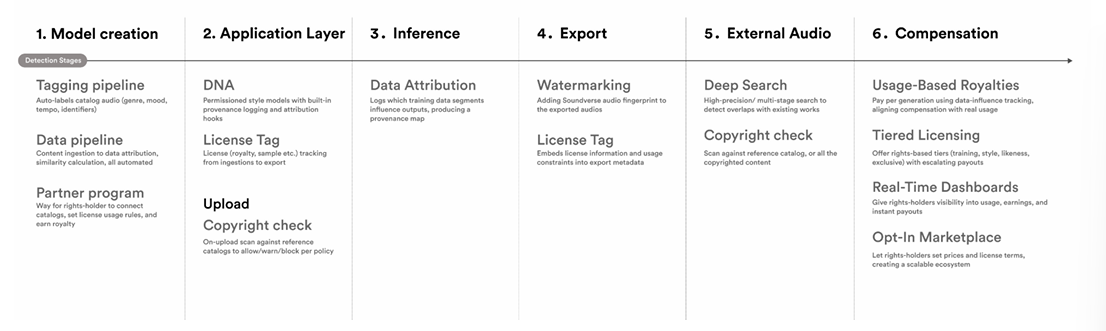
Soundverse’s Ethical AI Music Framework defines what responsible AI music curation looks like in practice. This end-to-end infrastructure replaces opaque systems with a six-stage process that upholds creative integrity and artist rights.
1. Licensed Data Sourcing (No Scraping)
Soundverse ensures data legality from the start. All training material is sourced through explicit licenses or the company’s Content Partner Program — an opt-in model that rewards contributors with usage-based royalties.
2. Permissioned Models (DNA)
Using Soundverse DNA, AI models are trained on authorized artist catalogs. Each model carries a transparent identity signature reflecting the artist’s sonic DNA, allowing creators to generate new compositions while preserving integrity.
3. Explainable Inference (Attribution)
Every AI-generated track comes with a detailed attribution log showing which influences contributed to its style. This explainability helps curators and listeners understand implicit creative lineage.
4. Traceable Export (Watermarking)
When tracks are exported, digital watermarks ensure they remain traceable across the web. This helps labels, curators, and artists track usage and prevent misuse.
5. Deep Search (External Scanning)
The system continuously scans external platforms for copies or remixes based on copyrighted datasets. This feature maintains ongoing compliance.
6. Recurring Compensation (Partner Program)
Artists receive recurring compensation whenever their training data influences an AI output, closing the gap between artistic contribution and algorithmic benefit.
Together, these six stages form the foundation of ethical AI music curation. They align perfectly with human-in-the-loop methodologies — placing people, not machines, at the center of digital creativity.
To see how Soundverse applies these principles to specific generative workflows, explore Generate AI Music with Soundverse Text-to-Music or understand more about Soundverse Assistant, your AI Music Co-Producer. For genre inspiration, check out the Deep House creation guide on our YouTube channel.
Why is transparency the future of AI music?
Transparency builds trust between creators, listeners, and AI developers. In an age when content authenticity is under scrutiny, traceable and explainable systems reassure both artists and audiences that the technology operates ethically. The combination of watermarking, explainability, and licensed training ensures that AI-generated songs are legally sound and artistically respectful.
Platforms like Soundverse’s Ethical AI Music Framework set the precedent for trust-centered collaboration, ensuring that music technology advances in tandem with artistic values.
What’s next for human-guided AI music creation in 2026 and beyond?
As AI models become more context-aware, human curators will transition from gatekeepers to creative directors. This means their role will focus less on correcting algorithmic mistakes and more on guiding AI systems toward sophisticated creative objectives — blending emotional storytelling with computational precision.
AI’s role in music production is already reshaping workflows for content creators and label executives. This synergy will only deepen, guided by frameworks that operationalize ethical collaboration. For creators exploring genre-specific applications, blogs like How to Create Country Music with Soundverse AI and How to Create Jazz Music with Soundverse AI explore how generative tools respect human expression.
Start Curating AI Music Your Way Today
Unleash your creativity by blending human insight with Soundverse’s cutting-edge AI music generation tools. Discover how effortless curation can lead to unique, professional-grade soundtracks.
Try Soundverse Free ›
Related Articles
- AI Music Generator and Human Composers: A Future Together — Explore how human artistry and AI-powered composition create harmony in the future of music production.
- How AI-Generated Music Is Transforming the Music Industry — Learn how AI is reshaping the soundscape of modern music—from production to personalization.
- Soundverse AI: Revolutionizing Music Creation for New-Age Content Creators — Discover why Soundverse stands out as the ultimate platform for creators seeking innovative AI-driven composition tools.
- The Role of AI Music in Film and Television — Find out how AI-generated music is shaping modern storytelling across films and streaming media.
Here's how to make AI Music with Soundverse
Video Guide

Here’s another long walkthrough of how to use Soundverse AI.
Text Guide
- To know more about AI Magic Tools, check here.
- To know more about Soundverse Assistant, check here.
- To know more about Arrangement Studio, check here.
Soundverse is an AI Assistant that allows content creators and music makers to create original content in a flash using Generative AI. With the help of Soundverse Assistant and AI Magic Tools, our users get an unfair advantage over other creators to create audio and music content quickly, easily and cheaply. Soundverse Assistant is your ultimate music companion. You simply speak to the assistant to get your stuff done. The more you speak to it, the more it starts understanding you and your goals. AI Magic Tools help convert your creative dreams into tangible music and audio. Use AI Magic Tools such as text to music, stem separation, or lyrics generation to realise your content dreams faster. Soundverse is here to take music production to the next level. We're not just a digital audio workstation (DAW) competing with Ableton or Logic, we're building a completely new paradigm of easy and conversational content creation.
TikTok: https://www.tiktok.com/@soundverse.ai
Twitter: https://twitter.com/soundverse_ai
Instagram: https://www.instagram.com/soundverse.ai
LinkedIn: https://www.linkedin.com/company/soundverseai
Youtube: https://www.youtube.com/@SoundverseAI
Facebook: https://www.facebook.com/profile.php?id=100095674445607
Join Soundverse for Free and make Viral AI Music
 We are constantly building more product experiences. Keep checking our Blog to stay updated about them!