How AI Music Is Changing the Economics of Background Music
Explore how AI music is redefining background music economics, licensing, and production in 2026.
How AI Music Is Changing the Economics of Background Music
In 2026, the economics of background music are being rewritten by artificial intelligence. The rise of AI music generation has upended long-standing paradigms—changing how production studios, content creators, and brands acquire and license their sonic identities. While stock music once dominated the background music economy, AI-generated background music has now emerged as the defining model for flexibility, cost-efficiency, and scalability.
Why is background music economics changing in 2026?
Background music has always played a crucial role in shaping experiences—whether in retail stores, YouTube videos, meditation apps, or games. Traditionally, the cost of licensing stock music or commissioning custom tracks created a financial and logistical barrier. However, beginning around 2024 and accelerating through 2025, AI music tools began to transform this landscape. In 2026, these systems have matured into professional-grade production resources.

With AI-driven composition, tracks can be generated instantly with no session musicians, recording studios, or complex licensing negotiations required. Businesses can now create unlimited variations of a mood or genre for a fraction of traditional costs. This democratization of access is what’s reshaping the entire background music economy.
According to recent music industry trend reports, corporate background music spending is shifting from library subscriptions to adaptive, on-demand AI music generation. This evolution has introduced not just lower costs but also higher relevance—soundtracks tailored to specific branding needs or audience psychographics.
What is driving the stock music disruption?
The traditional stock music market relied on vast pre-recorded libraries. Users could license music for use in advertising, marketing videos, and podcasts. However, AI music tools are challenging this model in two fundamental ways:

- Dynamic adaptability: AI music generators create tracks tailored to exact moods, tempos, or sentiments in seconds. Instead of browsing through thousands of near-matches, creators input a short text prompt and receive a track that fits perfectly.
- Cost efficiency: Whereas premium libraries or custom scoring once cost hundreds of dollars per project, AI models generate an unlimited catalog at subscription-level prices. For small agencies, game developers, and independent content creators, this equates to exponential savings.
- Legal clarity: A major contributor to this shift is the rise of transparent frameworks like Soundverse’s Ethical AI Music Framework, ensuring proper attribution and compensation. This not only reassures businesses but stabilizes the creative economy behind these tools.
The stock music disruption, therefore, is not merely technical—it’s economic and ethical. Traditional providers are forced to compete on customization and transparency, while AI music platforms continue to refine licensing precision.
How are music licensing trends evolving with AI-generated background music?
Music licensing has always been one of the most complex areas for creators and businesses. Rights management, territorial restrictions, and royalty structures added confusion and compliance risks. However, the emergence of AI-generated background music in 2026 has reshaped these processes.
AI composition eliminates many hurdles by producing royalty-free content from scratch. That means fewer copyright claims, smoother publishing, and simpler media distribution workflows. Yet it’s also introducing a new class of hybrid licensing models. For example, Soundverse’s Content Partner Program allows rights-holders to opt in and receive algorithmically calculated usage-based royalties derived from AI training or playback data.
This kind of transparent royalty attribution is creating new income streams for musicians while empowering corporations to maintain ethical compliance. In effect, AI technology is decentralizing and rebalancing the power dynamics of licensing.
If we compare this to older marketplaces, the benefits are obvious: flexible usage terms, precise attribution, and legal consistency across global campaigns. Businesses no longer worry about take-down notices or mismatched license tiers; every generated track is unique, rights-cleared, and customizable in length and mood.
For context, Soundverse explained in a previous article how adaptive text-to-music creation has become foundational for modern media production workflows. This has fueled the broader shift toward AI-first music economies.
How is artificial intelligence in music production reducing business costs?
Before AI, producing background music required collaboration with composers, sound engineers, and licensing agencies. Each step came with time costs and middleman fees. Now, artificial intelligence in music production automates many of these processes—saving both time and money.
AI systems trained to interpret genre-specific prompts can output industry-grade instrumental tracks ready for immediate use. For small creators producing short-form video content, this transformation is especially impactful. Instead of spending hours searching royalty-free catalogs, creators can simply describe their desired mood—such as “chill acoustic background for coffee shop scenes”—and generate results within minutes.
This is particularly beneficial to digital marketing firms, retail environments, and developers producing mobile games, where constant rotation of background loops is essential to maintaining user engagement.
As discussed in this insight, AI composition systems are not replacing musicians but extending creative capacity. Studios can now produce larger volumes of work faster, improving margins while maintaining quality. For a deeper dive, watch our guide on creating Deep House music or check out the tutorial on how to make music from Soundverse’s YouTube series.
What risks or challenges remain for the royalty-free music market?
The modern royalty-free music market in 2026 faces both opportunities and challenges. On one hand, AI generation tools continue to expand accessibility; on the other, they must address questions around ethics, consent, and data origin.
Without transparency, creators risk unintentionally using material trained on unlicensed datasets. That’s where frameworks like the Ethical AI Music Framework provide governance—ensuring that training data comes from opt-in rights-holders and that all outputs remain free from infringement risk.
For end users, this provides assurance that their background soundtracks are cleanly rights-cleared. In a corporate or agency context, such compliance is not a luxury—it’s a regulatory necessity.
Another challenge involves maintaining musical diversity. AI systems must balance efficiency with creativity to prevent homogenization. Ongoing updates, model tuning (like Soundverse’s V4 and V5 Model options), and diversified dataset curation are central to achieving that balance.
How to make AI music work for your brand or platform
For business owners, the key is strategic use. Understanding when to deploy AI-generated background music and when to commission human composers allows for scalable brand sound design. Common applications include:
- Retail Environments: Continuous ambiance loops that adjust by time of day.
- Podcasts & YouTube: Episode intros, outros, or transition beds.
- Gaming: Procedural adaptive loops that react to gameplay.
- Wellness & Meditation Apps: Seamless, evolving textures supporting calm or focus.
In these cases, looped AI-generated soundscapes reduce both recurring licensing costs and creative turnaround time.
For hands-on examples, explore our “Explore” Tab walkthrough on the Soundverse YouTube channel.
How to make AI-generated background music with Soundverse AI Music Generator
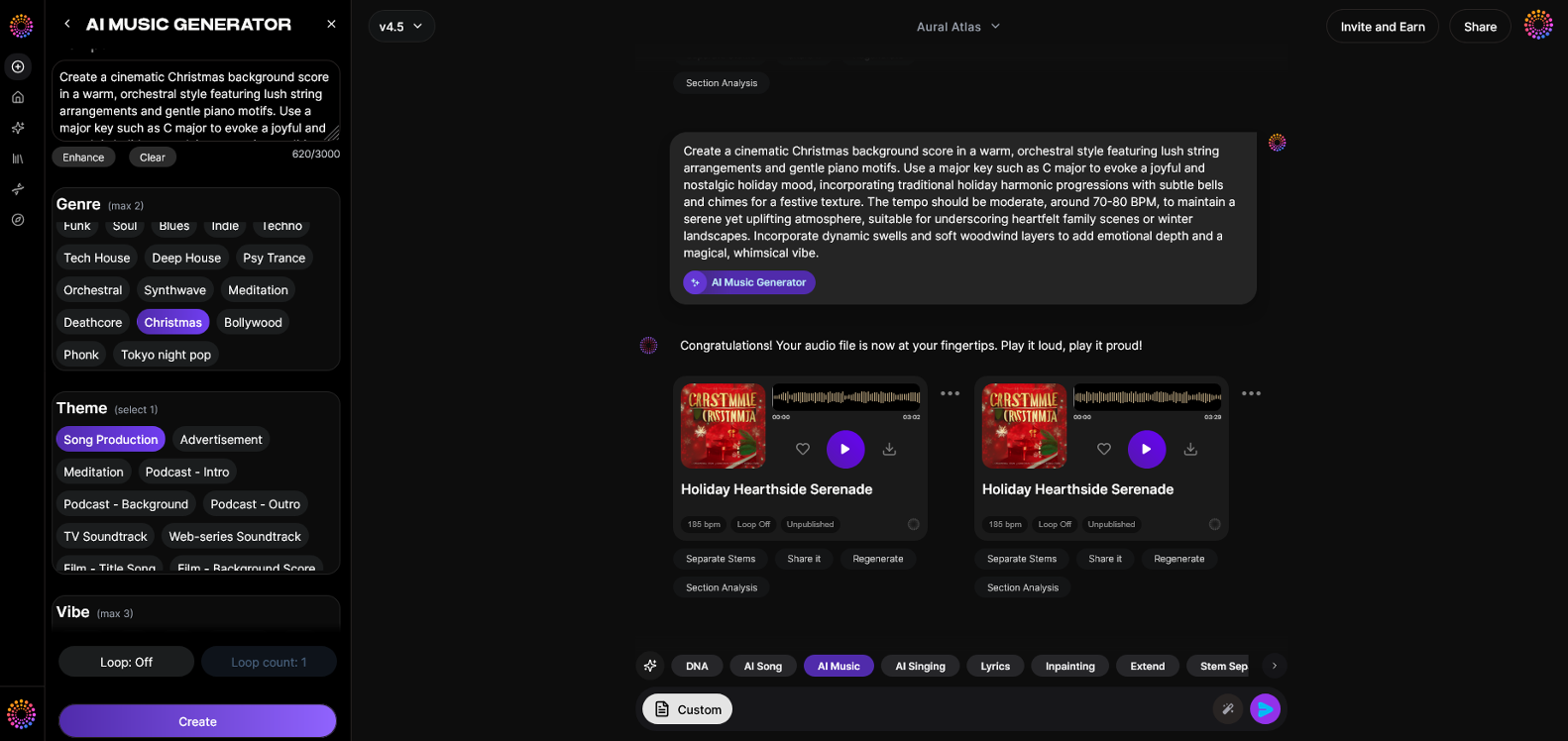
The AI Music Generator from Soundverse is purpose-built for the new era of adaptive and affordable background scoring. Designed to generate fully produced instrumental music from simple text prompts, it allows creators to craft everything from cinematic soundscapes to corporate themes without complex production knowledge.
Core capabilities include:
- Text-to-music: Describe your desired sound and the AI produces it.
- Loop Mode: Create seamless loops ideal for video and game contexts.
- Genre, Mood, and Instrument Control: Fine-tune the sonic details to your precise needs.
- V4 and V5 Models: Advanced model options that yield realistic and stylistically refined instrumentations.
Use cases: Video background music, game soundtrack loops, advertising and product scoring, and wellness or meditation tracks.
Soundverse ensures all compositions are ethically generated under its Ethical AI Music Framework, giving businesses legal certainty and creators peace of mind. Furthermore, through the Content Partner Program, rights-holders can share data for AI training in exchange for recurring royalties, creating a sustainable ecosystem.
To explore more about functional creative workflows, visit resources like Generate AI Music with Soundverse Text-to-Music or Soundverse AI Revolutionizing Music Creation for New Age Content Creators.
Start Creating Your Own AI-Generated Soundtracks Today
Transform the way you produce, license, and monetize background music with Soundverse’s cutting-edge AI tools. Generate high-quality tracks in minutes without worrying about copyright or cost barriers.
Generate Music with Soundverse
Related Articles
- How AI-Generated Music Is Transforming the Music Industry — Discover how artificial intelligence is reinventing the traditional music industry model from composition to commercialization.
- The Role of AI Music in Film and Television — Explore how AI music tools are powering soundtracks in the film and TV industries while cutting production time and costs.
- Enhancing YouTube Content with Royalty-Free and Copyright-Free Music Using Soundverse AI — Learn how creators leverage AI music to produce copyright-safe audio for YouTube videos and digital content.
- The Benefits of Composing with an AI Music Generator — Understand how AI-driven tools simplify music composition and open new possibilities for creators of all skill levels.
Here's how to make AI Music with Soundverse
Video Guide

Here’s another long walkthrough of how to use Soundverse AI.
Text Guide
- To know more about AI Magic Tools, check here.
- To know more about Soundverse Assistant, check here.
- To know more about Arrangement Studio, check here.
Soundverse is an AI Assistant that allows content creators and music makers to create original content in a flash using Generative AI.
With the help of Soundverse Assistant and AI Magic Tools, our users get an unfair advantage over other creators to create audio and music content quickly, easily and cheaply.
Soundverse Assistant is your ultimate music companion. You simply speak to the assistant to get your stuff done. The more you speak to it, the more it starts understanding you and your goals.
AI Magic Tools help convert your creative dreams into tangible music and audio. Use AI Magic Tools such as text to music, stem separation, or lyrics generation to realise your content dreams faster.
Soundverse is here to take music production to the next level. We're not just a digital audio workstation (DAW) competing with Ableton or Logic, we're building a completely new paradigm of easy and conversational content creation.
TikTok: https://www.tiktok.com/@soundverse.ai
Twitter: https://twitter.com/soundverse_ai
Instagram: https://www.instagram.com/soundverse.ai
LinkedIn: https://www.linkedin.com/company/soundverseai
Youtube: https://www.youtube.com/@SoundverseAI
Facebook: https://www.facebook.com/profile.php?id=100095674445607
Join Soundverse for Free and make Viral AI Music

We are constantly building more product experiences. Keep checking our Blog to stay updated about them!