How AI Detects and Adapts to Environmental Cues in Music
Explore how AI detects and adapts to environmental cues to create context aware music in 2026.
How AI Detects and Adapts to Environmental Cues in Music
Artificial intelligence has rapidly evolved from merely generating melodies to understanding the world around music creation. By 2026, AI-powered adaptive music systems are capable of sensing environmental cues—such as location, time of day, ambient noise, and even human emotion—to tailor music that aligns perfectly with context. Whether it’s adapting ambient scores for smart homes or customizing playlists based on movement, AI adaptation transforms listening from a passive activity into a dynamic interaction. This revolution shapes how composers, sound designers, and engineers approach AI as both a creative collaborator and a sensory partner.
What is AI-powered adaptive music?
AI-powered adaptive music refers to compositions or soundscapes that evolve based on contextual or environmental data. These systems analyze multiple variables—temperature, brightness, crowd density, or user activity—to craft audio responses that match real-world conditions. Unlike static playlists, adaptive systems dynamically select tonal characteristics, rhythm, and instrumentation in response to external cues.
The rise of context-aware music in 2026 is a culmination of advancements in neural audio synthesis, emotion detection models, and environment sensing in sound. Smart music systems such as those integrated into vehicles, gaming engines, and wellness apps now use AI adaptation to create seamless transitions between moods and scenarios.

How does AI detect environmental cues in music creation?
Detecting environmental cues requires translating sensory data into musical parameters. Modern AI algorithms achieve this through multimodal data synthesis—combining inputs from sensors, GPS, microphones, and even computer vision.
- Location Awareness (Geospatial Data): Geographic coordinates and local acoustic profiles guide AI to select culturally or atmospherically relevant instruments. For instance, AI might create location music with tropical textures when you’re near the beach and cooler digital tones in metropolitan settings.
- Temporal Sensitivity (Time-Based Adaptation): The time of day influences tonality and tempo. Morning sessions might prompt lighter, upbeat compositions compared to ambient nighttime soundscapes.
- Environmental Sensing in Sound: Machine learning models process background audio—identifying crowd chatter or wind—to blend harmonically compatible textures.
- Human Interaction Patterns: Wearable devices or phones supply movement and affective data, letting AI adjust rhythmic intensity or melodic phrasing to users’ physical state.
These cues allow an adaptive engine to respond intelligently. The result: music that feels intuitively alive, synchronized with human and environmental rhythms. Related research such as Sony AI's Contributions at AAAI 2026 highlights the role of continual learning in refining this responsiveness.

What technologies make smart music systems possible in 2026?
Smart music systems rely on deep learning architectures tailored for sequence understanding and environmental reasoning. Recent developments from 2024–2025 have been refined to operate locally in wearables, vehicles, and immersive installations.
- Sensor Fusion Engines: Combine multiple sources of data—biometric, spatial, and acoustic—to establish context.
- Neural Audio Modulation: Adjusts waveform output in real time according to detected stimuli.
- Edge AI Processing: Enables adaptive behavior without cloud latency, crucial for spatial sound deployment.
- Generative Sound Networks: Use transformer-based models similar to text-to-music engines described in Soundverse’s AI music generation walkthrough.
These components make AI adaptation achievable across industries—from gaming to virtual production. Similar systems are being seen in hardware design, as Headphone Technology In 2026: Immersive Sound And AI Integration illustrates real-time sound personalization.
Why does context aware music matter for creators and audiences?
Context aware music delivers relevance: compositions that resonate with moments, spaces, and emotions. For creators, environmental intelligence reduces the guesswork involved in syncing audio to scene dynamics. For audiences, it feels transformative—a soundtrack that acknowledges presence.
In film and television, directors now utilize adaptive scores to respond to scene brightness or motion, creating a flexible sonic track instead of static cues (also discussed in The Role of AI Music in Film and Television). Sound designers use it to automate ambient layering for interactive experiences, freeing time for high-level creative judgment. For creators getting started, watch our tutorial on how to make music or explore Deep House creation to learn how adaptive flow can synchronize with creative form.
Challenges facing adaptive AI music
Despite achievements, the pathway toward reliable adaptive sound isn’t trivial. Major challenges include:
- Data Privacy: Collecting biometric or locational data must comply with ethical frameworks.
- Latency and Consistency: Synchronizing sensory changes with sound modulation requires near-immediate transitions.
- Musical Coherence: Ensuring shifts preserve compositional integrity—especially in genre-specific patterns.
- Licensing Boundaries: AI adaptation must respect licensed content frameworks—something Soundverse DNA solves with artist-permission datasets.
Overcoming these ensures smart music systems stay aligned with creative and legal standards.
How to make AI-powered adaptive music with Soundverse Section Analysis
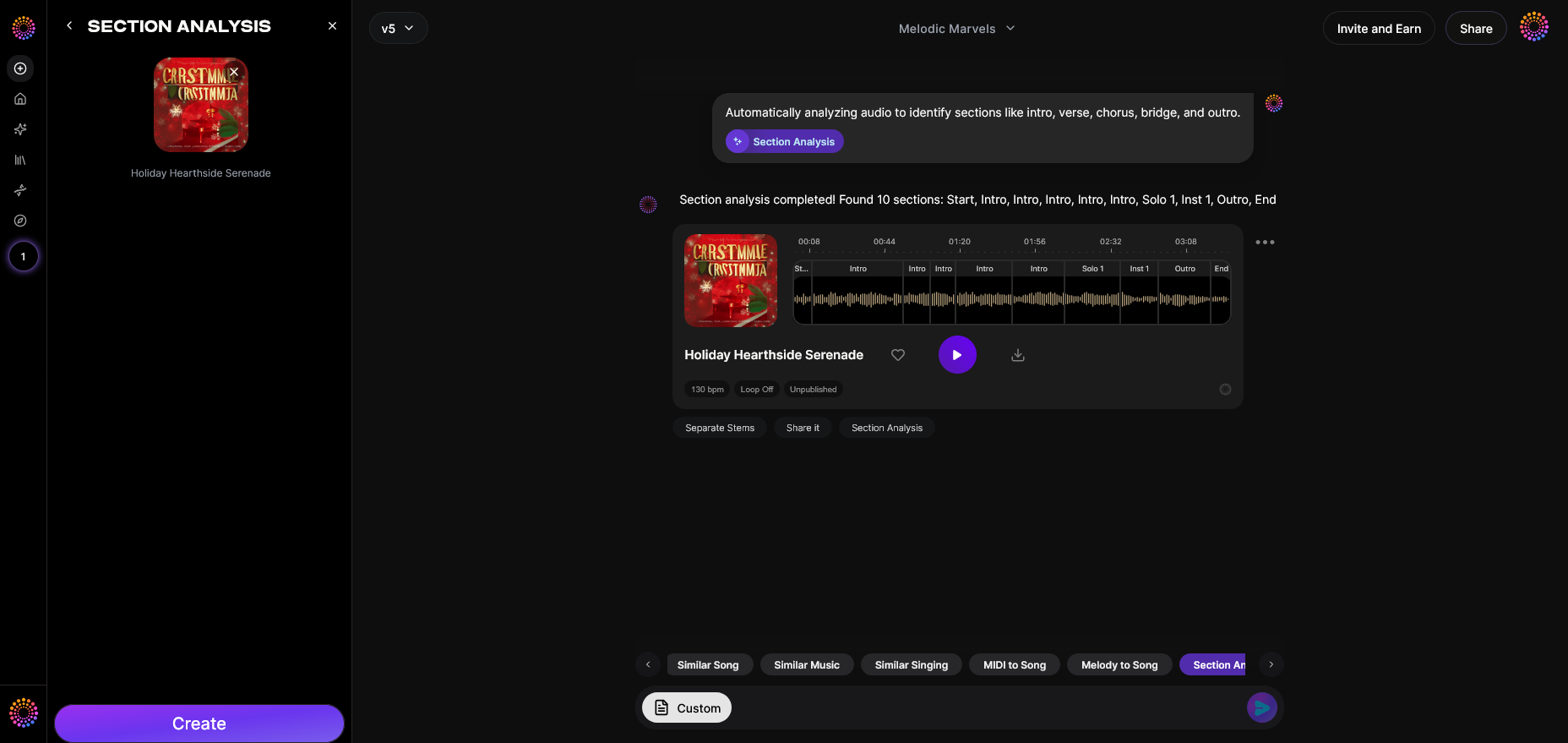
Soundverse’s Section Analysis feature brings structured intelligence to adaptive composition workflows. It automatically detects and labels song structure sections—Intro, Verse, Chorus, Bridge, Outro—providing precise timestamps and a visual roadmap for editing or remixing.
Core Capabilities:
- Automated structure detection: AI examines uploaded tracks to identify logical divisions based on spectral variance and composition flow.
- Visual roadmap generation: Allows creators to see where music should evolve when adapting to contexts—such as shifting tone during environmental changes.
- Timestamp export: Enables quick synchronization with external adaptive engines and sensors.
Primary Use Cases:
- Inpainting Edits: Perfect for filling blank spaces during ambient transitions.
- Learning Song Structure for Covers: Musicians studying adaptive performances can visualize form precision.
- Remixing and DJ Cue Point Setting: Sync dynamic mixes that match crowd intensity.
- Sync Licensing Assessment: Quickly verify suitability of sections for adaptive deployment.
When integrated into an adaptive music workflow, Section Analysis simplifies structural mapping—ensuring that AI-powered environmental reactions respect musical storytelling. It’s especially effective for integrating data-driven transitions within compositions built using the Soundverse AI Music Generator or Soundverse DNA systems.
How Soundverse complements adaptive AI music creation
Beyond structure detection, Soundverse offers synergistic tools:
- Similar Music Generator: Creates original background compositions matching a desired vibe, ideal for directors using adaptive temp scores.
- AI Music Generator: Converts text prompts into instrumental loops, supporting environmental sound design scenarios.
- Soundverse DNA: Ensures ethical AI music creation through licensed artist training—critical for adaptive music’s commercial use.
These combine to provide end-to-end support for creators aiming to explore the interplay between audio intelligence and environmental responsiveness.
What’s next for AI adaptation and environment sensing in sound?
By 2026, integration between physical environments and generative audio has become the frontier for experiential design. Smart cities employ adaptive music in public installations to adjust atmospheres automatically. Mobile platforms personalize sound therapy sessions based on biosignal feedback. As algorithms progress, the subtlety of adaptation will expand toward predictive capabilities—anticipating changes rather than reacting to them.
Researchers foresee cross-modal AI blending vision, touch, and ambient acoustics for full-sensory simulation environments. For digital artists and sound designers, this evolution signifies a creative paradigm shift: instead of crafting static scores, they orchestrate living systems.
Create Adaptive Music with AI Today
Experience how Soundverse’s AI-powered tools generate music that evolves with environmental cues and emotional context — perfect for creators seeking dynamic soundscapes.
Related Articles
- How AI-Generated Music Is Transforming the Music Industry: Discover how AI composition tools are redefining creativity, production speed, and accessibility in modern music.
- The Role of AI Music in Film and Television: Learn how AI-powered scores and adaptive soundscapes are revolutionizing how filmmakers craft emotional impact.
- AI Music Generator and Human Composers: A Future Together: Explore how AI tools complement human creativity and open new possibilities for collaborative music production.
- Soundverse AI Revolutionizing Music Creation for New-Age Content Creators: Find out how Soundverse empowers creators to craft AI-driven, responsive music for every creative scenario.
Here's how to make AI Music with Soundverse
Video Guide

Here’s another long walkthrough of how to use Soundverse AI.
Text Guide
- To know more about AI Magic Tools, check here.
- To know more about Soundverse Assistant, check here.
- To know more about Arrangement Studio, check here.
Soundverse is an AI Assistant that allows content creators and music makers to create original content in a flash using Generative AI.
With the help of Soundverse Assistant and AI Magic Tools, our users get an unfair advantage over other creators to create audio and music content quickly, easily and cheaply.
Soundverse Assistant is your ultimate music companion. You simply speak to the assistant to get your stuff done. The more you speak to it, the more it starts understanding you and your goals.
AI Magic Tools help convert your creative dreams into tangible music and audio. Use AI Magic Tools such as text to music, stem separation, or lyrics generation to realise your content dreams faster.
Soundverse is here to take music production to the next level. We're not just a digital audio workstation (DAW) competing with Ableton or Logic, we're building a completely new paradigm of easy and conversational content creation.
TikTok: https://www.tiktok.com/@soundverse.ai
Twitter: https://twitter.com/soundverse_ai
Instagram: https://www.instagram.com/soundverse.ai
LinkedIn: https://www.linkedin.com/company/soundverseai
Youtube: https://www.youtube.com/@SoundverseAI
Facebook: https://www.facebook.com/profile.php?id=100095674445607
Join Soundverse for Free and make Viral AI Music

We are constantly building more product experiences. Keep checking our Blog to stay updated about them!