Grammy Categories Explained: Choosing the Right One for Your Song
Learn how to choose the right Grammy category for your song in 2026.
Grammy Categories Explained: Choosing the Right One for Your Song
The Grammy Awards remain one of the most prestigious honors in music, symbolizing excellence, innovation, and artistic integrity. For independent musicians and producers in 2026, understanding Grammy categories is crucial—it can shape not only how you submit your song, but also how you position your brand within the music industry.
What are Grammy categories and why do they matter in 2026?
Grammy categories represent distinct areas of achievement across the vast landscape of music—from performance and production to composition and engineering. In 2026, as genre boundaries continue to blur thanks to AI-assisted creativity and global collaboration, choosing the right category has never been more strategic. Submitting a song under the correct music award category affects eligibility, competition level, and even the likelihood of nomination.
The Recording Academy organizes these categories to ensure fair recognition among diverse music styles. There are general fields such as Album of the Year, Record of the Year, Song of the Year, and Best New Artist, along with genre-based awards like Best Pop Solo Performance or Best Rap Song. For creators harnessing AI tools like Soundverse, understanding where your work fits demonstrates professionalism and awareness of industry standards. Explore the full list of official Grammy divisions through List of Grammy Award categories.

How does the Grammy nomination process work?
Each year, members of The Recording Academy submit eligible recordings released during the defined eligibility period. Following submission, members vote within their areas of expertise to determine the nominees. The process includes three stages: submission, screening, and voting.
- Submission: Artists, record labels, and independent creators register their works. This phase emphasizes accurate category selection—a misclassified entry could disqualify your submission or reduce its chances.
- Screening: Committees review each submission for eligibility and appropriate categorization. This ensures fairness and consistency.
- Voting: Academy members vote in their respective genres, followed by final rounds determining winners.
Understanding this Grammy nomination process helps creators meet eligibility requirements while strategically presenting their music. Check out 2026 GRAMMY Awards®: Winners, Nominations & Music Awards for an in-depth look at how categories are structured.
For independent musicians, knowing where your song stands matters. If your track blends electronic synths with jazz-inspired arrangements, should you enter it under Best Dance Recording or Best Contemporary Instrumental Album? Decisions like these influence recognition and exposure.

What are the main music award categories musicians should know?
While there are dozens of Grammy categories, creators should focus on major divisions that align with their artistry:
- General Field Awards: These cover all genres—Album of the Year, Record of the Year, Song of the Year, and Best New Artist.
- Genre-Specific Awards: Designed for styles such as Pop, Rock, Country, Hip-Hop, R&B, Jazz, Classical, and Electronic/Dance. Each includes subcategories like Best Pop Duo/Group Performance or Best Rap Performance.
- Production and Technical Awards: Recognize excellence in mixing, mastering, and engineering (Best Engineered Album, Producer of the Year).
- Composition and Arrangement: Honor songwriters and arrangers through categories like Best Instrumental Composition.
- Visual Media and Soundtrack Awards: Celebrate music created for film, television, or games.
- Global and Emerging Categories: Reflect international outreach, including Best Global Music Album and new experimental categories introduced to embrace evolving styles.
In 2026, the Grammys have expanded recognition for cross-genre blends and AI-assisted composition, signaling a progressive shift towards technology-integrated music creation. The 68th Annual Grammy Awards highlights how these categories have evolved in recent years.
How can independent artists prepare a successful song submission for Grammys?
To submit your music for Grammy consideration, focus on three pillars—originality, rights compliance, and proper metadata. Submissions must be published within the eligibility year and meet technical standards of recording quality.
Key preparation steps include:
- Ensure all collaborators are credited.
- Register work through official Grammy portals before the deadline.
- Maintain accurate metadata: song title, contributing artists, genre classification.
- Verify licensing and copyright ownership—a critical aspect, especially in AI-generated content.
When AI models are involved in songwriting or production, the Academy expects clear documentation proving creative contribution. This reinforces transparency and protects both artists and rights-holders.
For further insights, watch our Soundverse Tutorial Series - 9. How to Make Music for detailed steps on preparing AI-created compositions for professional recognition.
What are the most popular music genre awards in 2026?
Music trends in 2026 reflect fluid genre boundaries influenced by digital production. According to current music industry trends, hybrid genres like Electro-Soul, Ambient Pop, and Virtual Jazz dominate streaming platforms. Consequently, Grammy categories have adjusted to recognize innovative sounds and AI collaboration.
Popular genre awards now include:
- Best AI-Assisted Composition (a recently added category acknowledging computational creativity)
- Best Electronic/Dance Performance
- Best Global Fusion Album
- Best Independent Artist Recording
These honor evolving artistry across diverse soundscapes, appealing particularly to independent creators leveraging AI for unique productions. See the full updated listing via 2026 GRAMMYS Nominations: Watch Live Here.
Why is selecting the right Grammy category important for exposure and recognition?
Choosing the right Grammy category affects not only nomination chances but also how industry peers perceive your expertise. When your submission aligns with an appropriate genre, it signals authenticity and mastery of craft. Misalignment—like placing an acoustic folk track under Electronic—can lead to confusion among voters and dilute your impact.
Artists aiming for industry recognition must consider their musical structure, influences, and intended audience when deciding the category. This analytical approach ensures accurate representation and maximizes the visibility your work receives during judging.
Proper category placement has also proven beneficial for long-term branding. For instance, gaining a nomination under Best Jazz Performance solidifies your reputation within the jazz community far beyond awards season.
How to make your Grammy submission future-ready with Soundverse Trace
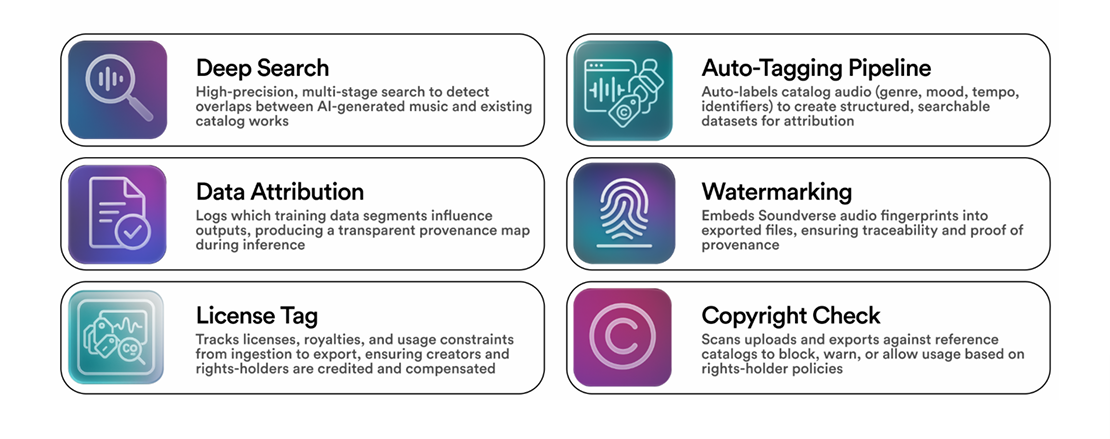
As AI technologies shape creative workflows in 2026, transparent attribution becomes essential for trust and compliance during the Grammy submission process. Enter Soundverse Trace, a comprehensive trust layer for AI music that embeds attribution, deep search, and rights protection from dataset creation to final export.
Soundverse Trace offers four core capabilities:
- Deep Search: Performs high-precision scans (1:1 and 1:N) to detect overlaps and ensure originality before submission.
- Data Attribution: Logs which training data influenced outputs, providing traceability for AI-generated sections.
- Audio Watermarking: Embeds robust, inaudible fingerprints that verify song provenance.
- License Tagging: Preserves rights metadata from ingestion to export, critical for proving creative ownership.
For artists preparing a song submission for Grammys, these features streamline documentation and compliance. With Soundverse Trace, you can verify provenance, prevent infringement, and secure rightful royalties—all necessary to meet the ethical standards of modern music awards.
Using Soundverse also connects you to a broader network of ethical AI development via the Content Partner Program, where rights-holders earn usage-based royalties, and the Ethical AI Music Framework, ensuring consent and attribution.
Creators can explore complementary tools in other related resources such as generate AI music with Soundverse text-to-music, Soundverse Assistant: your AI music co-producer, and AI music revolution articles.
How Soundverse Trace supports ethical music industry recognition
Soundverse Trace bridges AI innovation with artistic integrity. By embedding rights metadata and attribution markers, it empowers musicians to confidently submit songs that comply with Grammy eligibility requirements. This transparency resonates deeply with the industry’s focus in 2026—authenticity, originality, and ethics.
Adoption of AI trust tools has become a standard expectation among professional creators. When you present your music for Grammy consideration, accompanying it with verifiable attribution elevates your credibility and safeguards artistic honor.
Start Creating Award-Worthy Music with AI
Unleash your creativity with Soundverse’s AI-powered music tools. From stem separation to text-to-music generation, you can compose polished tracks ready for any Grammy category.
Get Started Free
Related Articles
- How AI-Generated Music Is Transforming the Music Industry: Discover how AI is reshaping the music world and influencing award-worthy production techniques.
- The Role of AI Music in Film and Television: Learn how AI-driven music creation is expanding the creative possibilities within visual media.
- AI Music Generator and Human Composers: A Future Together: Explore how AI tools complement human artistry to produce music that resonates across genres.
- Most Popular Music Genres: Get insights into trending genres and how they influence modern music recognition and award categories.
Here's how to make AI Music with Soundverse
Video Guide

Here’s another long walkthrough of how to use Soundverse AI.
Text Guide
- To know more about AI Magic Tools, check here.
- To know more about Soundverse Assistant, check here.
- To know more about Arrangement Studio, check here.
Soundverse is an AI Assistant that allows content creators and music makers to create original content in a flash using Generative AI. With the help of Soundverse Assistant and AI Magic Tools, our users get an unfair advantage over other creators to create audio and music content quickly, easily and cheaply. Soundverse Assistant is your ultimate music companion. You simply speak to the assistant to get your stuff done. The more you speak to it, the more it starts understanding you and your goals. AI Magic Tools help convert your creative dreams into tangible music and audio. Use AI Magic Tools such as text to music, stem separation, or lyrics generation to realise your content dreams faster. Soundverse is here to take music production to the next level. We're not just a digital audio workstation (DAW) competing with Ableton or Logic, we're building a completely new paradigm of easy and conversational content creation.
TikTok: https://www.tiktok.com/@soundverse.ai
Twitter: https://twitter.com/soundverse_ai
Instagram: https://www.instagram.com/soundverse.ai
LinkedIn: https://www.linkedin.com/company/soundverseai
Youtube: https://www.youtube.com/@SoundverseAI
Facebook: https://www.facebook.com/profile.php?id=100095674445607
Join Soundverse for Free and make Viral AI Music

We are constantly building more product experiences. Keep checking our Blog to stay updated about them!
Image Steps: []