Ethical AI Music Generation: Building a Responsible and Transparent Future for Artists and Technology in 2026
Discover how ethical AI music generation protects artist rights and promotes responsible innovation in 2026.
Ethical AI Music Generation
What is ethical AI music generation?
Ethical AI music generation refers to the creation of artificial intelligence tools and models that produce music in ways that respect artist rights, avoid copyright infringement, and maintain transparency throughout the process. As AI-driven creativity matured through 2024 and 2025, the music industry entered 2026 with clearer guidelines and ethical standards. The focus has shifted from allowing AI to replicate styles freely to ensuring that human creators remain acknowledged, rewarded, and protected.
In the most basic sense, ethical AI music generation is about responsibility. It rejects scraping unlicensed data or exploiting artists' work without consent. Instead, it embraces licensed sourcing, attribution systems, and technologies that make the origin of each generated note traceable. For music producers, AI developers, digital rights managers, and academic researchers, this means designing and deploying models that align with music technology ethics while enabling creative freedom.
Why is ethical AI music generation important in 2026?
By 2026, AI has become a cornerstone of global music production — used by independent creators, labels, and streaming platforms alike. However, rapid growth introduced intellectual property risks. AI systems trained on copyrighted datasets without permission led to lawsuits and halted collaborations between tech companies and artists. Ethical AI music generation solves this problem by ensuring that creative output is both legally compatible and morally fair.
Key reasons why it matters now include:
- Artist consent and control: Musicians deserve the ability to approve how their art is used in training sets. As highlighted in Harmonizing Humanity and AI: A Proposed Ethical Framework for the Music Industry, artist consent and control are non-negotiable in responsible AI systems.
- Copyright compliance: Ethical frameworks prevent disputes, ensuring enterprises and individuals produce copyright-safe AI music — echoing principles discussed in Independent music publishers propose ethical guidelines to AI developers.
- Transparency and trust: Artists and listeners can trace how AI music is made, building public confidence in generative models.
- Sustainable collaboration: Ethical solutions make long-term AI–artist partnerships viable, generating recurring royalties.
- Cultural integrity: Music generated ethically preserves the identity and intention behind artistic work.

What are the main challenges in AI-generated music ethics?
AI-generated music ethics involves navigating the tension between innovation and ownership. Some common challenges include:
- Data sourcing: The absence of clear licensing protocols created ambiguity about whether training data violated copyrights.
- Attribution: Without explainable inference frameworks, generated music might incorporate style elements without credit.
- Compensation: Traditional models pay royalties for distribution, not generation, leaving gaps in monetization systems.
- Regulation: Many countries updated AI and IP laws in 2025 but enforcement remains uneven in 2026.
AI developers must integrate ethical principles directly into model architecture, ensuring responsible music AI from start to finish.
For a deeper dive into how creators navigate this complexity, watch Soundverse Tutorial Series - 9. How to Make Music or Soundverse Tutorial Series - 10. Make Deep House Music from the Soundverse Channel.
How can creators ensure copyright-safe AI music?
Creators aiming to produce copyright-safe AI music should follow several best practices:
- Use licensed or permissioned data sources: Train only on approved catalogs where artist participation is verified.
- Verify transparency features: Choose systems with explainable inference and watermarking tools to track attribution.
- Audit AI outputs: Regularly check generated audio against known databases to ensure originality.
- Participate in royalty programs: Opt-in frameworks compensate artists each time their data contributes to a generation.
- Collaborate with trusted platforms: Work with providers that maintain strong ethical compliance standards.
For example, Soundverse offers multiple tools that simplify this process, including Soundverse Trace and Soundverse DNA. Both solutions integrate ethical sound creation principles across the full AI lifecycle, supporting fairness and transparency. To learn how composition workflows function in practice, check out AI Music Creation 2026: Hybrid Workflows for Composers.
What role does technology play in ethical sound creation?
Technological innovation is critical to advancing ethical sound creation. The modern generation of frameworks uses traceability and explainability to ensure each composition is legitimate. Cutting-edge components like watermarking, attribution layers, and deep search mechanisms allow automated rights verification.
Key technology elements enhancing ethical music generation in 2026 include:
- Transparent pipelines: Replacing black-box AI with identifiable generation steps.
- Digital DNA labeling: Associating each AI model with licensed artist identities.
- Smart attribution systems: Mapping generated sequences back to their data source.
- External scanning algorithms: Detecting potential overlaps with existing copyrighted material.
- Automated royalty distribution: Facilitating recurring compensation through blockchain or verified databases.
Technologists have transitioned from building creative tools to engineering ethical ecosystems — systems where artists, creators, and AI coexist productively.
Explore how related discussions continue within Ethics in AI Music Creation - Soundstripe and Saving Country Music's New Policy on AI Music for 2026.
What frameworks define music technology ethics today?
Music technology ethics in 2026 are governed by transparency, accountability, and equitable access. Ethical AI music generation aligns with three pillars:
- Transparency: Users understand how AI arrives at outputs and which sources it learned from.
- Consent: Rights-holders explicitly permit use of their works for training or referencing.
- Accountability: Developers and enterprises remain liable for unlicensed use or failure to provide attribution.
These principles guide industry standards that organizations, like Soundverse, incorporate through structured frameworks such as the Ethical AI Music Framework.
How to make ethical AI music generation with Soundverse The Ethical AI Music Framework
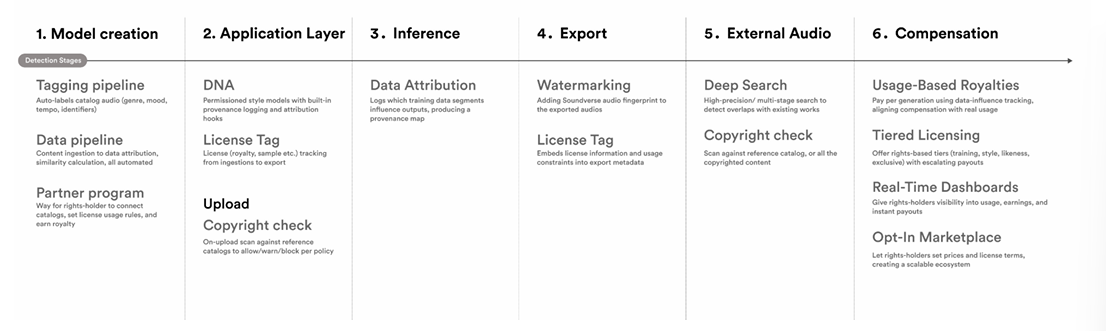
Now that you understand the fundamentals of ethical AI music generation, here is how to create it instantly using Soundverse. The Ethical AI Music Framework is a comprehensive end-to-end infrastructure that bridges innovation and artist integrity. Instead of relying on opaque generative systems, it introduces a transparent six-stage pipeline to ensure consent, attribution, and recurring compensation.
Six Stages of the Ethical AI Music Framework:
- Stage 1: Licensed Data Sourcing (No scraping) — Every dataset is obtained legally and with artist approval, setting a foundation for copyright-safe AI music.
- Stage 2: Permissioned Models (DNA) — Built on Soundverse DNA technology, these models encode artist styles ethically, creating signature sound identities that users can generate with.
- Stage 3: Explainable Inference (Attribution) — Generation processes remain explainable, ensuring proper attribution for each training source.
- Stage 4: Traceable Export (Watermarking) — Every output includes watermarking that identifies its AI origin, empowering digital rights managers.
- Stage 5: Deep Search (External Scanning) — Before release, tracks undergo deep search verification to confirm they are free from copyright conflicts.
- Stage 6: Recurring Compensation (Partner Program) — Through the Content Partner Program, artists earn usage-based royalties whenever their licensed data contributes to audio generation.
With these layers, enterprises and independent creators can generate music responsibly, aligning innovation with ethics. The framework supports transparency, protects artist rights, and builds sustainable monetization pathways.
Soundverse complements this framework with other ecosystem tools. Soundverse Trace provides attribution and rights protection across the entire project lifecycle, while Soundverse DNA offers artist-trained AI that produces copyright-safe sound consistent with licensed identity models. Users can explore comprehensive workflows through related resources such as generating AI music with Soundverse, AI music transforming the industry, and sound creation ethics across media.
For professionals exploring trends, Soundverse AI Magic Tools showcase how responsible systems align creative and commercial objectives. Ethical AI music generation is no longer a theoretical goal — it is a live standard shaping the music technology ethics landscape of 2026.
Start Creating Ethical AI Music Today
Unlock your potential with Soundverse’s advanced AI music tools designed for creators who value originality, ethics, and artistic control. Generate tracks, stems, and soundscapes safely and responsibly.
- How AI-Generated Music Is Transforming the Music Industry — Explore the ways AI is reshaping creative workflows and introducing new opportunities for artists and producers.
- AI Music Generator and Human Composers: A Future Together — Discover how collaboration between human musicians and AI systems can create new ethical and artistic possibilities.
- Navigating the World of Royalty-Free and Copyright-Free Music Using Soundverse AI — Learn how to find and generate music that respects copyright laws while enhancing your creative projects.
- The Role of AI Music in Film and Television — Understand how ethical AI music generation is influencing the soundtrack creation process for media professionals.
Here's how to make AI Music with Soundverse
Video Guide
Here’s another long walkthrough of how to use Soundverse AI.
Text Guide
- To know more about AI Magic Tools, check here.
- To know more about Soundverse Assistant, check here.
- To know more about Arrangement Studio, check here.
Soundverse is an AI Assistant that allows content creators and music makers to create original content in a flash using Generative AI.
With the help of Soundverse Assistant and AI Magic Tools, our users get an unfair advantage over other creators to create audio and music content quickly, easily and cheaply.
Soundverse Assistant is your ultimate music companion. You simply speak to the assistant to get your stuff done. The more you speak to it, the more it starts understanding you and your goals.
AI Magic Tools help convert your creative dreams into tangible music and audio. Use AI Magic Tools such as text to music, stem separation, or lyrics generation to realise your content dreams faster.
Soundverse is here to take music production to the next level. We're not just a digital audio workstation (DAW) competing with Ableton or Logic, we're building a completely new paradigm of easy and conversational content creation.
TikTok: https://www.tiktok.com/@soundverse.ai
Twitter: https://twitter.com/soundverse_ai
Instagram: https://www.instagram.com/soundverse.ai
LinkedIn: https://www.linkedin.com/company/soundverseai
Youtube: https://www.youtube.com/@SoundverseAI
Facebook: https://www.facebook.com/profile.php?id=100095674445607
Join Soundverse for Free and make Viral AI Music

We are constantly building more product experiences. Keep checking our Blog to stay updated about them!