Can AI Music Be Used Commercially in 2026?
Learn how AI music can be used commercially in 2026 legally and ethically.
Can AI Music Be Used Commercially?
Introduction
As 2026 unfolds, the conversation around AI music commercial use is no longer confined to experimental labs or startups. Brands, film studios, game developers, and digital marketers are turning to generative AI tools to produce everything from background soundtracks to jingles and cinematic scores. However, the central question remains: Can AI music be used commercially without breaching copyright laws or ethical boundaries?
This article explores how AI-generated music fits into the commercial landscape of 2026 — covering copyright laws, ethical considerations, and how frameworks like Soundverse’s Ethical AI Music Framework ensure compliance and sustainable monetization for both creators and businesses.
What Does “Commercial Use” of AI Music Mean?
In simple terms, commercial use refers to using a piece of music for profit-oriented applications — such as advertising, retail soundscapes, streaming, video production, or merchandise branding. For human-created music, commercial licensing is straightforward: rights must be cleared through agreements with labels, publishers, or performing rights organizations. In contrast, AI-generated music licensing introduces new questions about ownership, consent, and compensation.
Since AI-generated compositions are crafted by models rather than traditional composers, the matter of who holds the copyright — the developer, the user, or the machine — becomes complex. In 2026, multiple jurisdictions have issued guidance clarifying that AI music may be used commercially only if it adheres to transparent licensing and data sourcing standards.

How Does AI-Generated Music Licensing Work in 2026?
Licensing for AI-generated tracks depends on how the dataset was created. Tools that scrape copyrighted materials without consent can create major legal exposure for users. To ensure lawful commercial use, companies must verify that the underlying AI systems rely on licensed or properly attributed datasets.
Three primary models have emerged:
- Licensed Dataset Models – AI platforms trained on legally sourced music under commercial agreements. Tracks generated from such datasets are safe for commercial release.
- Royalty-Free AI Output Models – Systems offering users perpetual commercial rights to the generated outputs, often through subscription plans.
- Hybrid Licensing Models – Frameworks that track attribution and distribute recurring royalties, aligning AI-generated creations with human rights holders — a principle championed by Soundverse’s Content Partner Program.
To see how such hybrid systems benefit creators, you can explore related insights in AI-generated music licensing and attribution trends.
Who Owns the Copyright of AI Music?
Copyright law worldwide still evolves around human authorship. As of 2026, most jurisdictions recognize that AI itself cannot own copyright — but the person or organization directing the AI’s creative process can, provided that substantial human input exists.
However, if a user simply types a short text prompt like “create an ambient chill track” and receives a finished piece from an opaque model, legal ambiguities may arise. The safest route for commercial entities is to work with AI platforms that clearly document attribution, consent, and data provenance.
This is why the concept of AI music copyright now revolves less around who wrote the melody and more around whether data transparency can be proven. Transparent frameworks such as Soundverse Trace offer a new level of confidence by embedding digital watermarks that verify origin and artistic DNA. The U.S. Copyright Office’s guidance reinforces that works lacking sufficient human control cannot claim copyright protection.
Why Ethical AI Matters in the Music Business
Brands in 2026 have learned that ethical lapses in AI use can swiftly backfire. A commercial soundtrack found to have been derived from unlicensed or derivative material can lead to lawsuits or public backlash. The AI in music business landscape has matured towards transparency and auditability.
Ethical AI practices include:
- Using permissioned models trained with explicitly licensed datasets.
- Ensuring fair attribution for contributing artists.
- Adopting track-level traceability for accountability.
- Sharing profits with rights-holders when their works influence AI outputs.
Such practices not only support compliance but also build consumer trust — an essential element for global brands utilizing AI music for campaigns. To further understand how creative AI tools complement ethical use, explore the AI Magic Tools in Soundverse.
How Are Brands Using AI Music Commercially in 2026?
AI-generated compositions are now integral to campaigns across media formats. Some practical examples include:
- Advertising: Brands use AI engines to instantly generate music aligning with brand emotion and demographics. Licensing confidence ensures the tracks can appear in global media.
- Video Production: Content creators on YouTube and TikTok are accessing royalty-cleared AI music to monetize their videos without copyright strikes. Learn more from this guide on enhancing YouTube content with copyright-free music.
- Gaming Industries: Game developers use adaptive AI background scores that shape mood dynamically, ensuring immersive user experiences.
- Retail Environments: AI-generated soundscapes crafted to reinforce ambient customer emotions and brand perception.
For a deeper dive, watch our guide on creating Deep House music and AI composition workflow tutorial on the Soundverse YouTube channel.
By 2026, using AI music for brands is no longer a novelty — it’s a scalable way to maintain sonic identity while cutting production costs.
Common Legal Risks When Using AI Music Commercially
Businesses adopting AI-generated music must guard against several risk zones:
- Unlicensed Training Data: When the AI model uses copyrighted music without consent, its outputs may be considered derivative works.
- Lack of Attribution Transparency: Users must verify whether the AI music engine discloses the origin of the underlying data.
- Cross-Border IP Complexity: Music used commercially in multiple markets may face differing copyright rules.
Addressing these issues requires frameworks that clearly document the chain of custody for every generated track. That’s where ethical and transparent design becomes essential.
How to Make AI Music Commercially Safe with Soundverse’s Ethical Framework
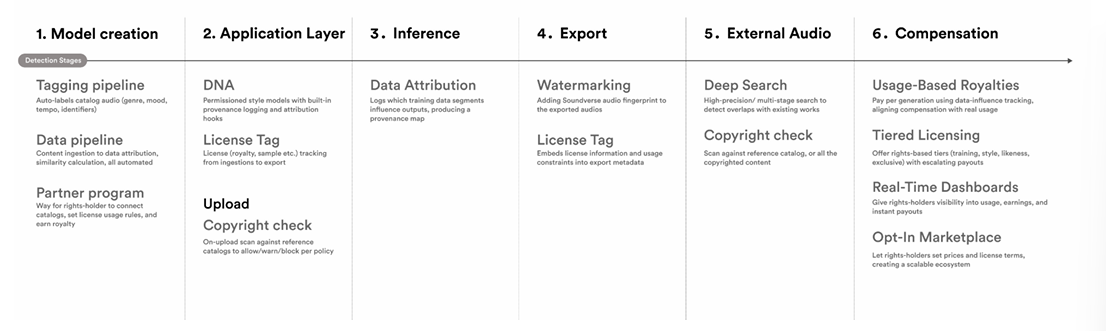
Soundverse’s Ethical AI Music Framework is a transparent infrastructure specifically designed to enable lawful AI music commercial use. Instead of relying on opaque generative systems, it offers an end-to-end model rooted in consent and traceability.
The Six-Stage Infrastructure:
- Stage 1: Licensed Data Sourcing (No Scraping) – Every dataset used for training is legally cleared and consent-based, ensuring users can later deploy their outputs commercially without risk.
- Stage 2: Permissioned Models (DNA) – Only rights-verified and labeled data feed into training pipelines.
- Stage 3: Explainable Inference (Attribution) – Each generated output can be traced back to its source influences, maintaining transparency.
- Stage 4: Traceable Export (Watermarking) – AI-generated tracks contain watermark metadata identifying legal lineage.
- Stage 5: Deep Search (External Scanning) – Outputs are automatically compared across public catalogs to confirm non-infringement.
- Stage 6: Recurring Compensation (Partner Program) – Artists whose works contribute to training receive automated royalty payouts, ensuring fairness and sustainability.
This framework bridges innovation and artist integrity, directly aligning AI-generated music with human creative ecosystems. Enterprises adopting the framework can safely release AI-generated compositions on streaming platforms, in films, or in branded content without fear of infringement.
For comparison, Soundverse’s approach represents an evolution beyond basic AI music generators such as Mubert or Soundraw, offering complete auditability and ethical assurance.
How Soundverse Empowers AI Music Monetization
With legal clarity established through the Ethical Framework, Soundverse supports multiple modes of AI music monetization:
- Brand Sync Licensing: AI-generated tracks can be monetized directly through advertising or film placements.
- Streaming Distribution: Artists can publish AI-assisted compositions with watermarked verification, building trust on streaming platforms.
- Creator Marketplaces: Businesses can generate and sell white-labeled background tracks under commercial rights.
- Recurring Royalties: Through the Content Partner Program, human contributors receive ongoing compensation as AI outputs incorporating their data generate commercial value.
This transparent model ensures that using AI in music production benefits all parties — creators, brands, and audiences alike.
Unlock Royalty-Free AI Music for Your Next Project
Discover how Soundverse lets you generate high-quality, commercially usable music in seconds. Empower your content with tracks that are legal, customizable, and always unique.
Related Articles
- Navigating the World of Royalty-Free and Copyright-Free Music Using Soundverse AI — Learn how to ensure your AI-generated music is both royalty-free and safe for commercial projects.
- Enhancing YouTube Content with Royalty-Free and Copyright-Free Music Using Soundverse AI — Find out how you can legally use AI music in YouTube videos without worrying about copyright strikes.
- Copyright-Free vs. Royalty-Free Music: What Creators Should Know — Understand the crucial difference between copyright-free and royalty-free music before using AI tracks commercially.
- The Role of AI Music in Film and Television — Explore how filmmakers and media producers are integrating AI-generated music into their visual storytelling.
Here's how to make AI Music with Soundverse
Video Guide
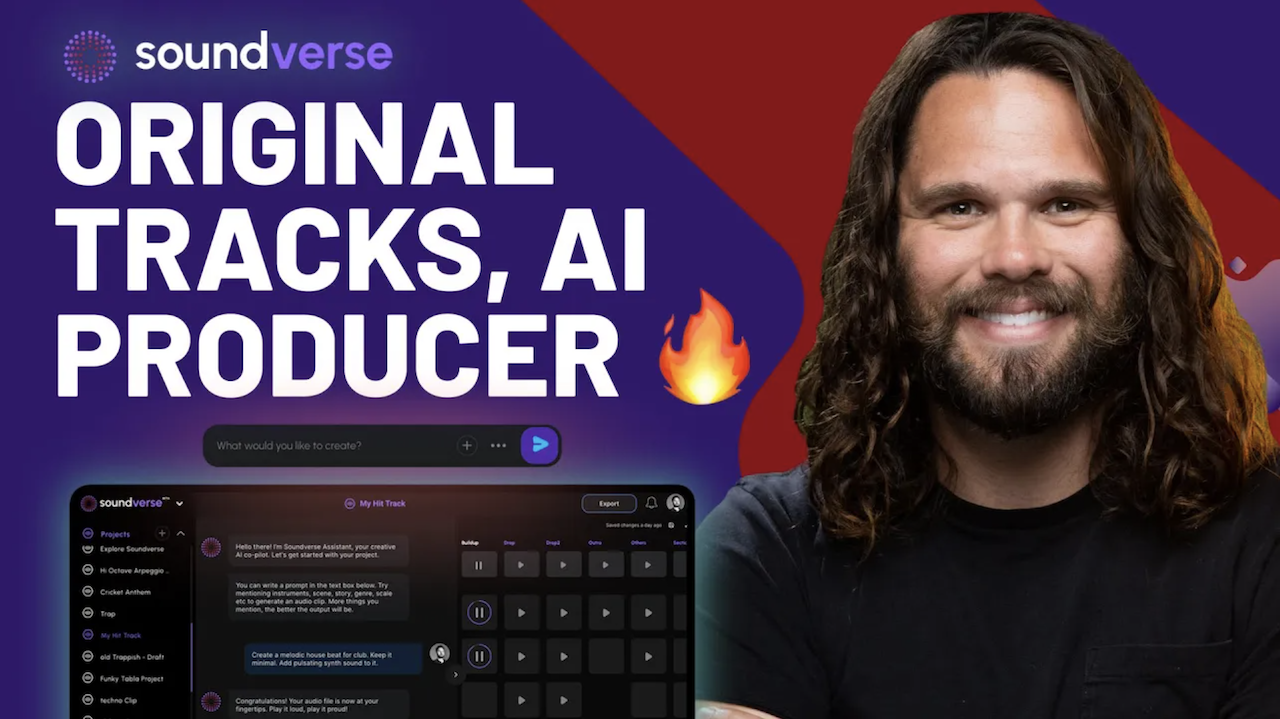
Here’s another long walkthrough of how to use Soundverse AI.
Text Guide
- To know more about AI Magic Tools, check here.
- To know more about Soundverse Assistant, check here.
- To know more about Arrangement Studio, check here.
Soundverse is an AI Assistant that allows content creators and music makers to create original content in a flash using Generative AI. With the help of Soundverse Assistant and AI Magic Tools, our users get an unfair advantage over other creators to create audio and music content quickly, easily and cheaply. Soundverse Assistant is your ultimate music companion. You simply speak to the assistant to get your stuff done. The more you speak to it, the more it starts understanding you and your goals. AI Magic Tools help convert your creative dreams into tangible music and audio. Use AI Magic Tools such as text to music, stem separation, or lyrics generation to realise your content dreams faster. Soundverse is here to take music production to the next level. We're not just a digital audio workstation (DAW) competing with Ableton or Logic, we're building a completely new paradigm of easy and conversational content creation.
TikTok: https://www.tiktok.com/@soundverse.ai
Twitter: https://twitter.com/soundverse_ai
Instagram: https://www.instagram.com/soundverse.ai
LinkedIn: https://www.linkedin.com/company/soundverseai
Youtube: https://www.youtube.com/@SoundverseAI
Facebook: https://www.facebook.com/profile.php?id=100095674445607
Join Soundverse for Free and make Viral AI Music
 We are constantly building more product experiences. Keep checking our Blog to stay updated about them!