Can AI-Generated Songs Win a Grammy? What You Need to Know
Explore Grammy rules for AI-generated songs, eligibility updates, and how frameworks like Soundverse empower ethical AI in music.
Can AI-Generated Songs Win a Grammy? What You Need to Know
Introduction
Artificial intelligence has transformed nearly every creative industry, but perhaps none as dramatically as music. From generating melodies with text prompts to full-fledged albums co-created by algorithms, AI's role in composition is now undeniable. In 2026, the question dominating headlines and studio boardrooms alike is: Can AI-generated songs win a Grammy? This question isn't just about trophies—it's about redefining authorship, creativity, and recognition in an era of machine collaboration.
Understanding AI-generated songs Grammy eligibility requires unpacking both the changing Grammy rules and the growing sophistication of artificial intelligence in music. Musicians, producers, and rights-holders are wondering where the line lies between technological assistance and creative authorship.
What Are AI-Generated Songs?
AI-generated songs are musical compositions produced with the help of artificial intelligence—using machine learning models trained on vast collections of audio and metadata. These models analyze patterns in pitch, rhythm, and timbre to generate original compositions, melodies, or even lyrics. Platforms like Soundverse, Udio, and Suno have popularized this technology, making AI composition accessible to individual creators and global labels alike.
In recent years, AI-generated music has expanded from simple loops to intricate arrangements and emotive storytelling. Some artists use AI tools to create instrumental beds, while others generate entire productions, fine-tuned for cinematic or streaming-ready releases.
While this technology has unlocked new creative possibilities, it has also forced institutions like the Recording Academy (which organizes the Grammys) to reconsider how they define a "songwriter" or "artist" in the digital age.
What Are the Grammy Rules for AI in Music?
As of 2026, the Recording Academy has refined its stance on the use of AI in submissions. The ruling adopted in 2023 stated that only human creators are eligible for Grammy awards. In 2025, additional clauses clarified the boundaries:
- AI-generated material can be part of a song, but not the only creative contributor.
- Only the human creators who meaningfully shape or guide the AI output are eligible for award consideration.
- AI cannot receive a Grammy; it cannot be credited as an artist or songwriter.
This framework doesn't reject technology but ensures that artistic intent and human judgment remain at the center of Grammy recognition. The Recording Academy CEO Harvey Mason Jr. noted that music made with AI is eligible “as long as the human authorship component is meaningful.” Similarly, Stereogum reported that AI-assisted performances can still be nominated if human effort anchors the submission.
Where Does AI Fit Into the Creative Process?
Many musicians now use AI to assist with melody generation, arrangement, and sound design. For instance, text-to-music platforms allow creators to describe a mood—like "cinematic orchestral tension" or "1970s funk groove"—and receive an original track based on that input. AI then acts as a creative collaborator, providing novel starting points or variations.
But Grammy eligibility hinges on human input at key stages: songwriting, performance, and production. If an AI model autonomously generates music with minimal human orchestration, it falls outside the scope of Grammy recognition.
Nevertheless, as seen in recent collaborations, when a human writes lyrics, curates the output, and defines artistic direction, those contributions qualify for award consideration—even if they integrate AI assistance. For a hands-on example of creative collaboration, watch our Soundverse Tutorial Series - How to Make Music.
AI and Music Copyright: A Continuing Challenge
A major barrier to AI music's legitimization is copyright: who owns a song when part of it is created by an algorithm trained on existing works? The issue of AI and music copyright sits at the heart of ongoing legal debate.
In 2024 and 2025, multiple tech companies faced lawsuits for training models on copyrighted recordings without consent or compensation. These cases shaped the current environment, where transparency in data usage is no longer optional—it's essential.
As a result, ethical frameworks and traceable attribution systems like Soundverse have emerged to ensure that AI-generated compositions respect rights and rewards for human creators.
For a deeper exploration of how this legal evolution intersects with music production, check out AI Music in the USA and AI-Generated Music is Transforming the Music Industry.
Could an AI Song Ever Truly Win a Grammy?
Technically, yes—but only if a human collaborator plays a substantive role. If, for instance, a producer uses an AI tool to generate a song’s instrumental and then records human vocals, arranges the track, and oversees production decisions, those human contributions can qualify for awards like Best Record or Song of the Year. The AI itself would not receive the prize, but its assistance wouldn’t disqualify the work either.
The Academy’s current model mirrors how tools like synthesizers and samplers were integrated into music decades ago: at first controversial, eventually ubiquitous. Today, AI is at a similar inflection point.
In Music Industry Trends, AI’s co-creative role is predicted to deepen, with artists increasingly acting as directors rather than traditional performers—curating outputs generated by intelligent systems.
The Ethical Debate: Creativity or Co-Creation?
Purists argue that AI lacks consciousness and thus cannot create “art.” Others contend that art has always been shaped by tools, from the invention of the electric guitar to the launch of DAWs. The difference now lies in authorship. When an AI system produces an original melody derived from learned data, is that melody new or derivative?
In practice, musicians increasingly adopt a stance of co-authorship: the AI assists, but the human defines the direction. This aligns with Grammy principles emphasizing meaningful human authorship.
Still, the conversation around AI songwriters continues. Should models trained on specific artist styles receive shared credit? Can ethical datasets ensure fair attribution and compensation? This brings us to the role of Soundverse.
How to Make AI-Generated Songs Grammy Eligible with Soundverse’s Ethical AI Music Framework
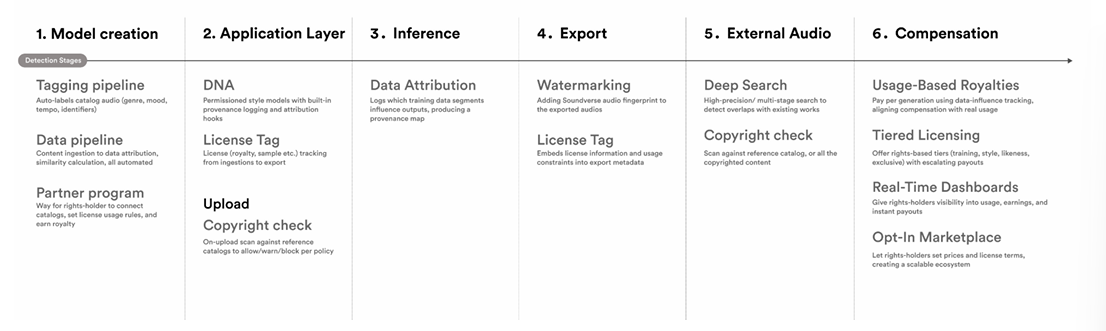
The Ethical AI Music Framework from Soundverse was designed precisely to resolve the challenges discussed above—balancing innovation with integrity. It is a comprehensive end-to-end infrastructure that connects creators, rights-holders, and AI developers through transparent governance.
Unlike black-box systems, Soundverse’s framework operates through six auditable stages:
- Licensed Data Sourcing: Every AI model is trained on legally licensed audio, eliminating unauthorized scraping and protecting rights-holders.
- Permissioned Models (DNA): Artists can contribute their sonic identity to Soundverse DNA—an opt-in program allowing others to generate music in their style while earning royalties.
- Explainable Inference: The system transparently attributes every AI output, documenting source lineage for ethical compliance.
- Traceable Export (Watermarking): Each exported track carries a digital watermark for ownership tracking.
- Deep Search (External Scanning): Soundverse Trace scans the internet and streaming catalogs for AI-generated works to prevent infringement.
- Recurring Compensation (Partner Program): Artists and labels receive continuous payments tied to verified usage via attribution metadata.
This framework ensures that AI-assisted songs conform to Grammy rules for AI by maintaining clear human authorship, explicit consent, and verifiable data lineage. It bridges artistic innovation and compliance—crucial for producers and composers aiming for award recognition without legal or ethical compromise. For creators eager to explore AI ethically, Soundverse’s tools like Soundverse Trace and Soundverse Assistant extend this transparency across collaboration and editing.
The Future of AI Music Awards: 2026 and Beyond
By 2026, multiple music awards, festivals, and digital platforms have created separate categories for AI music. For example, specialized AI Music Awards now recognize excellence in algorithmic composition and technical innovation. These categories complement rather than compete with the Grammys—acknowledging distinct artistic processes.
If Grammy history is any indicator, acceptance evolves with culture. Just as the introduction of sampling once sparked controversy but later became an art form, AI collaboration is now following that trajectory. Expect future Grammys to introduce expanded guidelines for hybrid human-AI works.
Start Creating Award-Ready Music with AI
Unlock the full potential of AI-generated composition with Soundverse and craft songs that rival Grammy-quality tracks. Experience smart tools that blend creativity, technology, and artistry seamlessly.
Create with Soundverse AI
Related Articles
- How AI-Generated Music Is Transforming the Music Industry: Discover how artificial intelligence is reshaping everything from production styles to artist recognition and awards.
- AI Music Generator and Human Composers: A Future Together: Explore how AI tools and human creativity are collaborating to produce groundbreaking new sounds.
- AI Music in the USA: Learn why the United States is becoming a hub for AI-generated music innovation and awards eligibility.
- The Role of AI Music in Film and Television: Find out how AI compositions are entering mainstream entertainment and shaping the future of screen soundtracks.
Here's how to make AI Music with Soundverse
Video Guide

Here’s another long walkthrough of how to use Soundverse AI.
Text Guide
- To know more about AI Magic Tools, check here.
- To know more about Soundverse Assistant, check here.
- To know more about Arrangement Studio, check here.
Soundverse is an AI Assistant that allows content creators and music makers to create original content in a flash using Generative AI. With the help of Soundverse Assistant and AI Magic Tools, our users get an unfair advantage over other creators to create audio and music content quickly, easily and cheaply. Soundverse Assistant is your ultimate music companion. You simply speak to the assistant to get your stuff done. The more you speak to it, the more it starts understanding you and your goals. AI Magic Tools help convert your creative dreams into tangible music and audio. Use AI Magic Tools such as text to music, stem separation, or lyrics generation to realise your content dreams faster. Soundverse is here to take music production to the next level. We're not just a digital audio workstation (DAW) competing with Ableton or Logic, we're building a completely new paradigm of easy and conversational content creation.
TikTok: https://www.tiktok.com/@soundverse.ai
Twitter: https://twitter.com/soundverse_ai
Instagram: https://www.instagram.com/soundverse.ai
LinkedIn: https://www.linkedin.com/company/soundverseai
Youtube: https://www.youtube.com/@SoundverseAI
Facebook: https://www.facebook.com/profile.php?id=100095674445607
Join Soundverse for Free and make Viral AI Music

We are constantly building more product experiences. Keep checking our Blog to stay updated about them!