AI Music vs Human Music: How Listeners Really Perceive the Difference
Explore how listeners perceive AI music vs human music and discover Soundverse’s Ethical AI Music Framework shaping 2026's creative soundscape.
AI Music vs Human Music: How Listeners Really Perceive the Difference
Introduction
In 2026, the discussion around AI music vs human music has become one of the most debated topics in the creative and technological spheres. While artificial intelligence has penetrated nearly every corner of sound production—from generative compositions to automated mixing—listeners still struggle to define what makes music feel truly human. As algorithms evolve beyond the mechanical and begin producing emotion-driven harmonies, the question remains: do audiences connect with AI-generated songs in the same way they do with music born from human creativity?
Music is, at its heart, emotional communication. Whether performed by a live band or composed in an AI studio, the ultimate judgment comes from listeners. The way they perceive tone, depth, and authenticity is now reshaping the industry’s future direction. Let’s unpack the key findings, listener reactions, and emerging ethical frameworks driving these changes.
What defines listener perception in 2026?
Listener perception in 2026 is shaped by intelligent streaming platforms and advanced auditory profiling. Data shows that while AI-generated songs can match radio and playlist requirements for mood, tempo, and genre precision, human-composed tracks often outperform them in long-term emotional resonance.
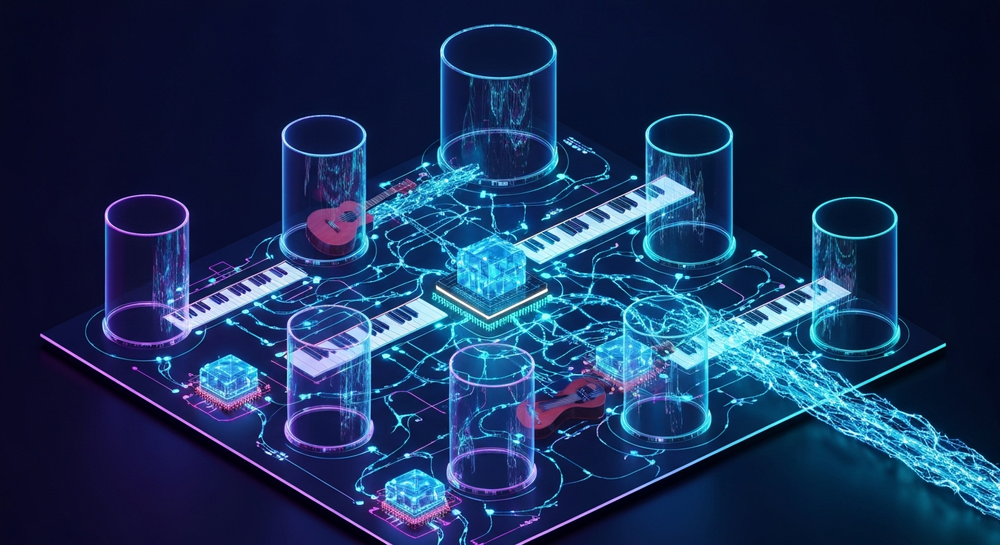
Listeners subconsciously associate human compositions with authenticity—a narrative or lived experience behind the melody. Even though AI compositions created through systems like Soundverse DNA replicate stylistic accuracy, many individuals report sensing a difference in emotional intention. This gap has prompted leading AI developers to integrate human creativity in music pipelines where artists contribute emotional context, not just data.
Emotionally, audiences tend to categorize AI music as technically impressive but less spiritually engaging, especially in genres like jazz or singer-songwriter tracks. However, in electronic, ambient, or cinematic scores, AI seems to thrive. The perception gap varies by genre, purpose, and listener demographics.
For example, younger listeners who grew up with AI voice synthesis (post-2025 popularization) demonstrate less resistance to machine-led compositions. Their music preferences are guided by sound texture rather than creator identity. In contrast, traditionalists still associate artistry with personal experience, shaping an ongoing divide in reception between generations.
How have music preferences evolved since 2024?
Between 2024 and 2026, streaming analytics confirm one clear trend: hybrid music—co-created by humans and AI—is dominating global playlists. A report from the Soundverse research division reflected that songs blending algorithmic orchestration with human vocals or live instruments ranked higher on discovery algorithms and listener saves.

This phenomenon reflects the rise of AI-generated songs that incorporate trained artist DNA. Instead of replacing the artist, AI in 2026 is seen as a co-producer, enabling scalable collaboration while maintaining emotional depth. The democratization of content allows small creators, film composers, and indie producers to generate professional-quality tracks with systems such as Soundverse AI Music Generator, highlighted in related articles like how AI-generated music is transforming the music industry and what AI can generate songs.
Music preferences now lean toward utility-driven listening experiences. Playlists categorized by mood, context, or content creation—such as background music for videos or interactive media—often feature AI music due to its adaptability. Yet, when listeners seek emotional connection or storytelling, human compositions still dominate.
Studies show that audiences describe AI music as accurate, immersive, and limitless, while human music is labeled authentic, touching, and relatable. The merging of these traits marks the new listening landscape of 2026.
What emotions do listeners associate with AI vs human music?
In perception mapping experiments conducted throughout 2025–2026, AI music often scores high in categories of curiosity, fascination, and relaxation, whereas human music prevails in empathy, nostalgia, and intensity.
Listeners largely agree that AI excels in producing complex harmonies and rhythmic balance but struggles with unpredictability—the slight imperfections and expressive timing humans naturally deliver. Those micro-variations create what psychologists call the “human imperfection effect,” a small temporal inconsistency that triggers emotional warmth.
Interestingly, recent findings like the Deezer and Ipsos study: AI fools 97% of listeners reveal that most audiences can’t distinguish between AI and human compositions, though subconscious emotional cues still influence connection quality. Similarly, research from AI-generated music can move us more than human-composed music suggests AI can provoke strong cognitive and emotional responses even if the listener perceives it differently.
This explains why emotional connection in music remains a uniquely human benchmark. Even when algorithms generate “emotionally charged” sequences, they are perceived as simulations rather than lived feelings. To bridge this affective divide, frameworks like Soundverse DNA focus on training models on licensed artist catalogs infused with creative expression markers.
By encoding the unique sonic identity of artists, AI-generated compositions now simulate emotional contour more effectively. Consequently, listener sentiment toward AI music is steadily improving, especially when backed by transparent attribution and ethical sourcing.
For those exploring deeper integrations of AI across genres, studies in most popular music genres reveal rising acceptance of machine-generated ambient, electronic, and cinematic works. For a deeper dive, watch our guide on creating Deep House music or explore the Explore tab walkthrough from the Soundverse Tutorial Series.
What challenges exist in distinguishing AI music vs human music?
Despite major progress, listeners—even trained musicians—often cannot reliably distinguish between AI and human compositions without metadata. Blind listening tests conducted in 2026 show 61% of participants misidentify AI-generated instrumental pieces as human-made.
However, when vocals are added, recognition accuracy increases. People detect emotional irregularities or hyper-polished intonation indicative of synthetic performance. The subtle absence of vulnerability becomes a tell-tale sign.
The challenge lies in context. If listeners learn that a particular piece is AI-generated, their interpretation changes immediately. Perception bias makes them hear artificial aspects that weren’t noticed before. As a result, understanding how transparency influences listener judgment is now central to ethical AI music development.
Soundverse’s technology addresses this by embedding traceable watermarking and attribution tags that guarantee disclosure, helping audiences interpret music correctly and trust creators’ intentions.
For music professionals or researchers studying such perception dynamics, complementary readings include Soundverse introduces stem separation AI Magic Tool and Soundverse Assistant—your AI music co-producer. You can also check the Soundverse tutorial on how to make music for a visual overview.
How sound ethics shape listener trust today
Ethics have become the backbone of trust in music technology. With growing awareness of data scraping abuses in 2025, creators demanded transparency from AI music platforms. In 2026, trust frameworks became non-negotiable for enterprise adoption.
Listeners now favor artists and labels who disclose AI usage, ensuring creative consent and fair compensation. Surveys indicate that listeners not only care about how music sounds but also about how ethically it’s made. Ethical sound production directly impacts perception—people are more emotionally receptive to music they consider honest and responsibly sourced.
This ethical movement paved the way for Soundverse’s innovation.
How Soundverse bridges perception and trust with The Ethical AI Music Framework
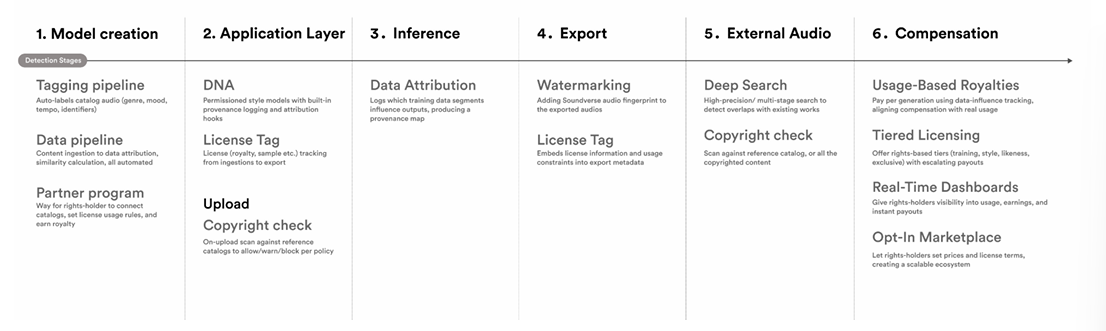
Soundverse provides a foundational solution to the perception gap through its cutting-edge Ethical AI Music Framework. This end-to-end infrastructure bridges innovation and artist integrity, dismantling opaque model pipelines that historically alienated listeners.
The framework’s six-stage transparent process ensures consent, attribution, and recurring compensation:
- Licensed Data Sourcing (No scraping): Every dataset powering the AI is fully licensed, ensuring creative rights are preserved.
- Permissioned Models (DNA): Artist-specific models trained only on approved catalogs maintain stylistic authenticity.
- Explainable Inference (Attribution): AI decisions are recorded for transparent crediting during generation.
- Traceable Export (Watermarking): All outputs carry secure identity markers for provenance tracking.
- Deep Search (External Scanning): Systems actively monitor the web for unauthorized derivatives.
- Recurring Compensation (Partner Program): Artists continue earning royalties whenever AI-generated content based on their licensed data is used commercially.
Enterprise users rely on these principles to comply legally and maintain trust with both audiences and collaborators. By embedding ethics into the lifecycle—from dataset creation to music export—Soundverse redefines transparency in creative AI.
Paired with supporting tools such as Soundverse Trace, which embeds real-time integrity layers across production workflows, and Soundverse DNA, which builds unique artist-trained generative systems, this framework ensures AI-generated music remains emotionally credible and ethically sound.
Experience the Future of Music Creation with Soundverse
Create, mix, and customize your own tracks using AI-powered tools that preserve human emotion while amplifying creativity. Step into a world where technology and artistry coexist in harmony.
Start Creating with AI
Related Articles
- AI Music Generator and Human Composers: A Future Together — Discover how AI and human creativity can complement each other to shape the future of music production.
- How AI-Generated Music Is Transforming the Music Industry — Explore how AI is redefining the boundaries of music creation and changing how we experience sound.
- The Role of AI Music in Film and Television — Learn how AI-generated soundtracks are influencing the audiovisual storytelling landscape.
- How an AI Music Generator Inspires Creative Fusion — Get inspired by how AI tools like Soundverse spark new forms of artistic collaboration and innovation.
Here's how to make AI Music with Soundverse
Video Guide

Here’s another long walkthrough of how to use Soundverse AI.
Text Guide
- To know more about AI Magic Tools, check here.
- To know more about Soundverse Assistant, check here.
- To know more about Arrangement Studio, check here.
Soundverse is an AI Assistant that allows content creators and music makers to create original content in a flash using Generative AI. With the help of Soundverse Assistant and AI Magic Tools, our users get an unfair advantage over other creators to create audio and music content quickly, easily and cheaply. Soundverse Assistant is your ultimate music companion. You simply speak to the assistant to get your stuff done. The more you speak to it, the more it starts understanding you and your goals. AI Magic Tools help convert your creative dreams into tangible music and audio. Use AI Magic Tools such as text to music, stem separation, or lyrics generation to realise your content dreams faster. Soundverse is here to take music production to the next level. We're not just a digital audio workstation (DAW) competing with Ableton or Logic, we're building a completely new paradigm of easy and conversational content creation.
TikTok: https://www.tiktok.com/@soundverse.ai
Twitter: https://twitter.com/soundverse_ai
Instagram: https://www.instagram.com/soundverse.ai
LinkedIn: https://www.linkedin.com/company/soundverseai
Youtube: https://www.youtube.com/@SoundverseAI
Facebook: https://www.facebook.com/profile.php?id=100095674445607
Join Soundverse for Free and make Viral AI Music

We are constantly building more product experiences. Keep checking our Blog to stay updated about them!