AI Music Licensing: What Creators Need to Know Before Publishing in 2026
Learn key facts about AI music licensing, ownership, and publishing rules in 2026.
AI Music Licensing: What Creators Need to Know Before Publishing
Introduction
The rise of AI-generated soundtracks, vocals, and fully composed pieces has forever transformed how music is made and shared online. As of 2026, AI music licensing has become a must-know area for any musician or content creator using artificial intelligence to produce or distribute songs. The industry’s shift toward transparency, accurate attribution, and ethical dataset sourcing means that creators who want to publish AI-generated music must now navigate a complex web of ownership rules, publishing laws, and usage rights.
While the opportunities are vast—allowing artists to generate intricate arrangements using AI tools like those discussed in this article on how AI-generated music is transforming the music industry—the legal and ethical aspects are equally significant. This guide breaks down what you need to know before publishing AI-generated works in 2026, and how Soundverse helps creators maintain compliance, creativity, and confidence.
Why is AI Music Licensing So Important in 2026?

Since 2024, the global music landscape has shifted toward hybrid authorship, where human creativity is amplified by machine intelligence. With millions of new tracks generated each week using AI models, regulators and streaming platforms have increased scrutiny over ownership claims and copyright metadata.
AI music licensing ensures that:
- Rights holders are compensated fairly. If AI models use copyrighted material for training, licensing helps track and distribute royalties.
- Artists can claim proper authorship. Attribution technology identifies what influence or dataset contributed to an AI-generated song.
- Distributors and publishers can verify music origins. Provenance verification prevents the spread of plagiarized or unlicensed audio.
For creators, this means that ignorance is no longer an excuse. Understanding licensing is now part of the publishing workflow.
What Rights Exist in AI-Generated Music?
When publishing AI music, creators must separate three distinct layers of rights:
- Dataset Rights: Who owns the data that trained the AI model? Models can only use datasets lawfully obtained under consent or license.
- Output Rights: The generated music may carry its own copyright status depending on human input versus machine autonomy.
- Derivative Rights: If the music resembles or overlaps with existing works, licensing arrangements or takedown mechanisms apply.
In most jurisdictions—including the EU, UK, and US—AI-generated works without meaningful human contribution may not receive full copyright protection. However, when the human creator curates prompts, orchestrates arrangements, and mixes the final product, that person typically holds adjacent rights to the output.
How Do AI Music Ownership and Attribution Work Today?
As of 2026, AI music ownership has evolved through several legal milestones. Bodies like the World Intellectual Property Organization (WIPO) and major streaming partners have endorsed hybrid copyright models that divide credit between human contributors and algorithmic influences.
Creators now typically submit metadata about how the AI contributed—such as model name, dataset source, and user inputs—when registering new works. Labels and publishers demand traceable attribution before accepting submissions. Systems like Soundverse Trace give creators the proof they need to establish authorship records and avoid disputes.
For a deeper dive, watch our guide on creating Deep House music or how to make music from the Soundverse Tutorial Series on YouTube.
What Are the Current AI Music Publishing Regulations?
The regulatory environment in 2026 emphasizes transparency and permissioned training. Emerging frameworks across Europe, Asia, and North America have adopted the following standards for AI music publishing regulations:
- Mandatory training disclosure: AI developers must disclose dataset compositions used in model creation.
- Watermarking compliance: Published AI-generated music must include audio fingerprints confirming provenance.
- Royalty routing and redistribution: Systems automatically allocate royalties to dataset contributors where applicable.
- Dataset consent verification: If you use an external AI platform, ensure that it adheres to explicit usage agreements under ethical AI frameworks.
For independent musicians, compliance begins long before distribution—it starts the moment you generate an AI-based composition.
To explore broader technology shifts, check out music industry trends for 2026 and how they affect emerging creators.
How to Avoid Copyright Issues When Publishing AI Music
Creators must treat AI composition not as a one-click solution but as a co-authored creative process. Here are essential steps to keep your releases legally safe:
- Use licensed datasets only: Verify that your chosen AI platform obtains sound libraries or sample data ethically.
- Check for musical similarity: Tools like Soundverse Trace use deep search to detect 1:1 or 1:N overlaps against existing songs, identifying potential infringement before publishing.
- Keep attribution logs: Record which model and dataset version were used when generating each project.
- Embed license metadata in exports: Never share or sell music files that lack visible ownership or release rights.
- Stay up to date on regional laws: AI publishing rules differ by territory—ensure your distribution covers compliant metadata fields.
For creators seeking new markets or collaborations, visit how AI-generated music is transforming the industry to understand how distribution models now adapt for AI-first content.
How to Make AI Music Licensing Work for You
Independent composers can treat licensing not as a restriction but as a competitive advantage. Proper licensing frameworks help:
- Guarantee fair credit across co-producers.
- Prevent takedowns or copyright claims.
- Build trust with audiences and platforms.
If you plan to use AI regularly in your production workflow, partner with platforms that provide transparent traceability and metadata support instead of opaque AI systems that store no provenance details.
How Soundverse Trace Protects AI Music Licensing and Ownership
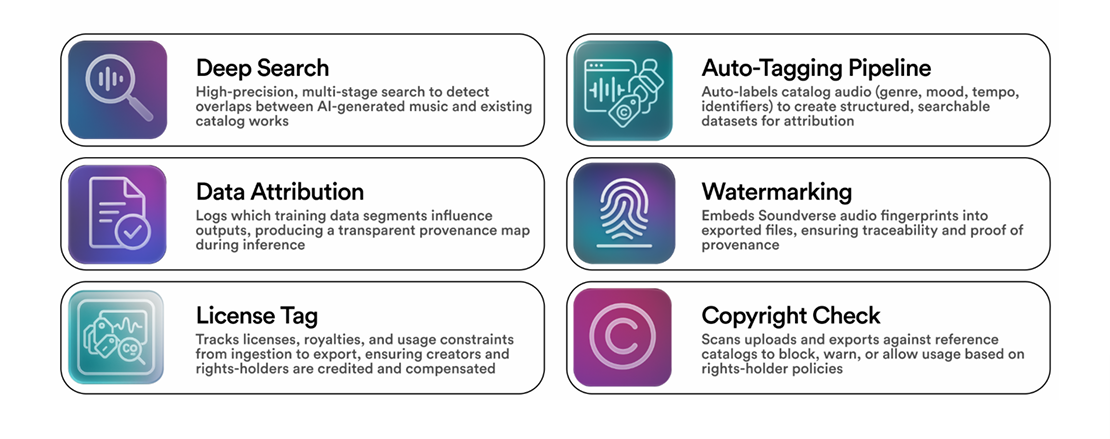
Soundverse Trace is Soundverse’s comprehensive trust layer for AI music. It ensures that each stage of the creative cycle—dataset, generation, export, and distribution—retains attribution, deep search capability, and rights protection.
Key Core Capabilities Include:
- Deep Search: Precision scanning (1:1 and 1:N) to detect any overlaps with existing audio catalogues before release.
- Data Attribution: Logs which specific training data influenced your generated tracks, creating a verifiable creative footprint.
- Audio Watermarking: Inserts inaudible yet robust fingerprints that authenticate provenance on every exported file.
- License Tagging: Maintains metadata tags preserving rights information from dataset ingestion to final master.
Using Soundverse Trace, creators can:
- Verify whether their generated content is original or influenced by existing datasets.
- Track catalog usage for transparent royalty reporting.
- Automate payouts or takedowns when overlapping material is detected.
Soundverse Trace integrates naturally with the Content Partner Program, allowing rights-holders to submit sound data for AI training while earning per-use royalties. Combined with The Ethical AI Music Framework, Soundverse provides a transparent pipeline where consent and compensation are built-in rather than afterthoughts.
See how creators leverage Soundverse tools for production by visiting helpful guides such as generate AI music with Soundverse text-to-music or explore how features like stem separation support legal remix workflows.
The Future of AI Music Licensing
By the second half of 2026, AI licensing is expected to become integrated into nearly every distribution network. Streaming platforms may soon require provenance certification before listing AI-generated albums, while labels prioritize datasets registered under the Ethical AI frameworks.
The adoption of traceable licensing technology enables collaborations where human artistry meets algorithmic innovation safely. Whether you compose cinematic instrumentals, pop choruses, or ambient soundscapes, your mastery of licensing frameworks ensures that creativity flourishes sustainably.
Start Creating Copyright-Safe AI Music Today
Unlock your creative flow with Soundverse’s AI-powered tools. Generate original, royalty-free music designed to keep your projects safe and publish-ready.
Create with Soundverse
Related Articles
- Copyright-Free vs. Royalty-Free Music: What Creators Should Know — Understand the difference between copyright-free and royalty-free tracks before distributing your music online.
- Navigating the World of Royalty-Free and Copyright-Free Music Using Soundverse AI — Learn how Soundverse AI helps creators find music that’s both safe and suitable for commercial use.
- How AI-Generated Music Is Transforming the Music Industry — Explore how AI composition is reshaping music production, licensing, and creative collaborations globally.
- The Role of AI Music in Film and Television — Discover how AI-generated soundtracks are changing content creation and IP management for filmmakers and studios.
Here's how to make AI Music with Soundverse
Video Guide

Here’s another long walkthrough of how to use Soundverse AI.
Text Guide
- To know more about AI Magic Tools, check here.
- To know more about Soundverse Assistant, check here.
- To know more about Arrangement Studio, check here.
Soundverse is an AI Assistant that allows content creators and music makers to create original content in a flash using Generative AI. With the help of Soundverse Assistant and AI Magic Tools, our users get an unfair advantage over other creators to create audio and music content quickly, easily and cheaply. Soundverse Assistant is your ultimate music companion. You simply speak to the assistant to get your stuff done. The more you speak to it, the more it starts understanding you and your goals. AI Magic Tools help convert your creative dreams into tangible music and audio. Use AI Magic Tools such as text to music, stem separation, or lyrics generation to realise your content dreams faster. Soundverse is here to take music production to the next level. We're not just a digital audio workstation (DAW) competing with Ableton or Logic, we're building a completely new paradigm of easy and conversational content creation.
TikTok: https://www.tiktok.com/@soundverse.ai
Twitter: https://twitter.com/soundverse_ai
Instagram: https://www.instagram.com/soundverse.ai
LinkedIn: https://www.linkedin.com/company/soundverseai
Youtube: https://www.youtube.com/@SoundverseAI
Facebook: https://www.facebook.com/profile.php?id=100095674445607
Join Soundverse for Free and make Viral AI Music

We are constantly building more product experiences. Keep checking our Blog to stay updated about them!