AI Music in Film: What Works and What Doesn’t in 2026
Explore what works and fails in AI music in film scoring, from synthetic soundtracks to AI composers shaping cinema in 2026.
AI Music in Film: What Works and What Doesn’t
Artificial intelligence has taken an increasingly prominent role in the creative industries, and few sectors showcase its potential and challenges more vividly than film scoring. As directors and producers seek faster, cost-effective solutions for mood-driven storytelling, the phenomenon of AI music in film has emerged as both a blessing and a cautionary tale. In 2026, AI-driven tools are no longer futuristic novelties—they’re mainstream instruments in the cinematic toolbox. But as with any technological leap, the question remains: what works and what doesn’t?
What is AI Music in Film?
AI music in film refers to the use of artificial intelligence to compose, arrange, or generate soundtracks tailored for cinematic experiences. Unlike traditional scoring, which relies on human composers, AI systems analyze reference tracks, tempos, emotions, and narrative arcs to produce instrumental compositions automatically. These developments connect deeply with AI film scoring, synthetic soundtracks, and automated soundtrack creation, providing scalable ways to align music with visual storytelling.
AI film music isn’t new. Experiments date back to algorithmic composition projects in the early 2000s. Yet, the growth of neural networks and machine learning between 2023 and 2026 has propelled the industry into new territory. AI-generated soundtracks are now capable of emulating the stylistic flair of Hollywood epics, indie art films, or even noir-inspired thrillers. Platforms like Soundverse, Amper, and Mubert compete to refine this delicate balance between automation and artistry.
Why Are Filmmakers Using AI Film Scoring Tools in 2026?
For producers, music supervisors, and independent creators, time and budget constraints often dictate creative decisions. Traditional scoring processes—including orchestral sessions, revisions, and licensing—can be expensive and slow. In contrast, AI film scoring offers the following advantages:
- Speed and Efficiency: What once took weeks can now be done within hours. Directors can test different moods before finalizing a scene’s tone.
- Cost Reduction: Independent filmmakers gain access to professional-grade compositions without hiring a full scoring team.
- Customization: AI tools learn from a film’s emotional pacing, providing adaptive background scores that complement narrative tension.
- Creative Exploration: Composers use AI to prototype ideas, then refine them manually, bridging technology and artistic intuition.
In many cases, AI acts not as a replacement for human composers but as a creative partner. By generating ‘temp-like’ scores, it helps filmmakers refine direction before live orchestration.

What Works Well with AI Composers and Synthetic Soundtracks?
While skeptics worry that AI homogenizes film music, many projects demonstrate that, when used strategically, AI enhances storytelling:
- Background Atmospheres: AI excels at crafting ambient textures for documentaries, sci-fi, or psychological dramas.
- Thematic Consistency: Using dataset-based learning, tools can maintain musical cohesion across sequels or series.
- Reference Matching: Technologies like style transfer ensure that music aligns with cinematic aesthetics approved by directors.
- Interactive Adaptation: Particularly relevant for immersive cinema and gaming crossovers, AI music reacts to on-screen evolution.
The result is not only sonic efficiency but also narrative depth. When used ethically and transparently, AI becomes a storytelling ally rather than an artistic threat. Articles such as How AI-Generated Music Is Transforming the Music Industry and AI Music Generator and Human Composers: A Future Together further explore this synergy. For context, similar experiments are happening beyond film—AI films that evolve in real time demonstrate how adaptive music enhances live cinematic experiences.
For a deeper dive, watch our guide on creating Deep House music and our Soundverse Tutorial Series - How to Make Music. These tutorials showcase similar AI composition workflows used in cinematic sound design.
When Doesn’t AI Film Scoring Work?
Despite its remarkable progress, AI music in film still faces notable challenges.
- Emotional Authenticity: Machines can emulate patterns but often struggle with genuine emotional nuance.
- Oversaturation of Similar Sounds: Many synthetic soundtracks rely on the same datasets, causing stylistic repetition.
- Ethical and Legal Ambiguities: If training data isn’t properly licensed, questions of consent and ownership arise.
- Director-Composer Communication: Collaboration is more complex when the ‘composer’ is an algorithm with no intuitive emotional intelligence.
Filmmakers often find that AI works best as a collaborator for early drafts rather than the final production score, particularly in emotionally driven genres like romance or historical drama.
How Ethical and Transparent Is AI Music Technology in Cinema?
Ethical concerns have pushed the industry toward systems that prioritize consent and attribution. This shift led to frameworks such as the Ethical AI Music Framework and technologies like Soundverse Trace, which embed metadata for authorship, rights, and origin tracking. Such innovations protect composers’ integrity while allowing producers to integrate AI outputs responsibly.
Systems like Soundverse DNA also redefine what it means to train AI models on licensed catalogs. Instead of exploiting existing works, these platforms build sustainable ecosystems where artists receive recurring compensation for their contributions—a step toward fairness in the age of synthetic creativity.
To gain a wider perspective on industry trends, check out Music Industry Trends and explore how ethical innovation drives technology adoption.
How to Make AI Film Scoring Work for Creative Teams
Practical integration is key. For production houses in 2026, combining AI efficiency with human expertise ensures results that resonate with audiences. Here’s how the process typically unfolds:
- Pre-Visualization: Directors upload temp tracks or mood references into an AI film scoring tool.
- AI Drafting: The system analyzes tempo, key, and emotion to produce similar compositions.
- Human Refinement: A composer adjusts phrasing, dynamics, and orchestration to align with the narrative.
- Legal Review: Music supervisors ensure licensing frameworks comply with international standards.
By blending human artistry with automated soundtrack creation, production teams gain flexibility without sacrificing quality.
How to Make AI Music in Film with Soundverse Similar Music Generator
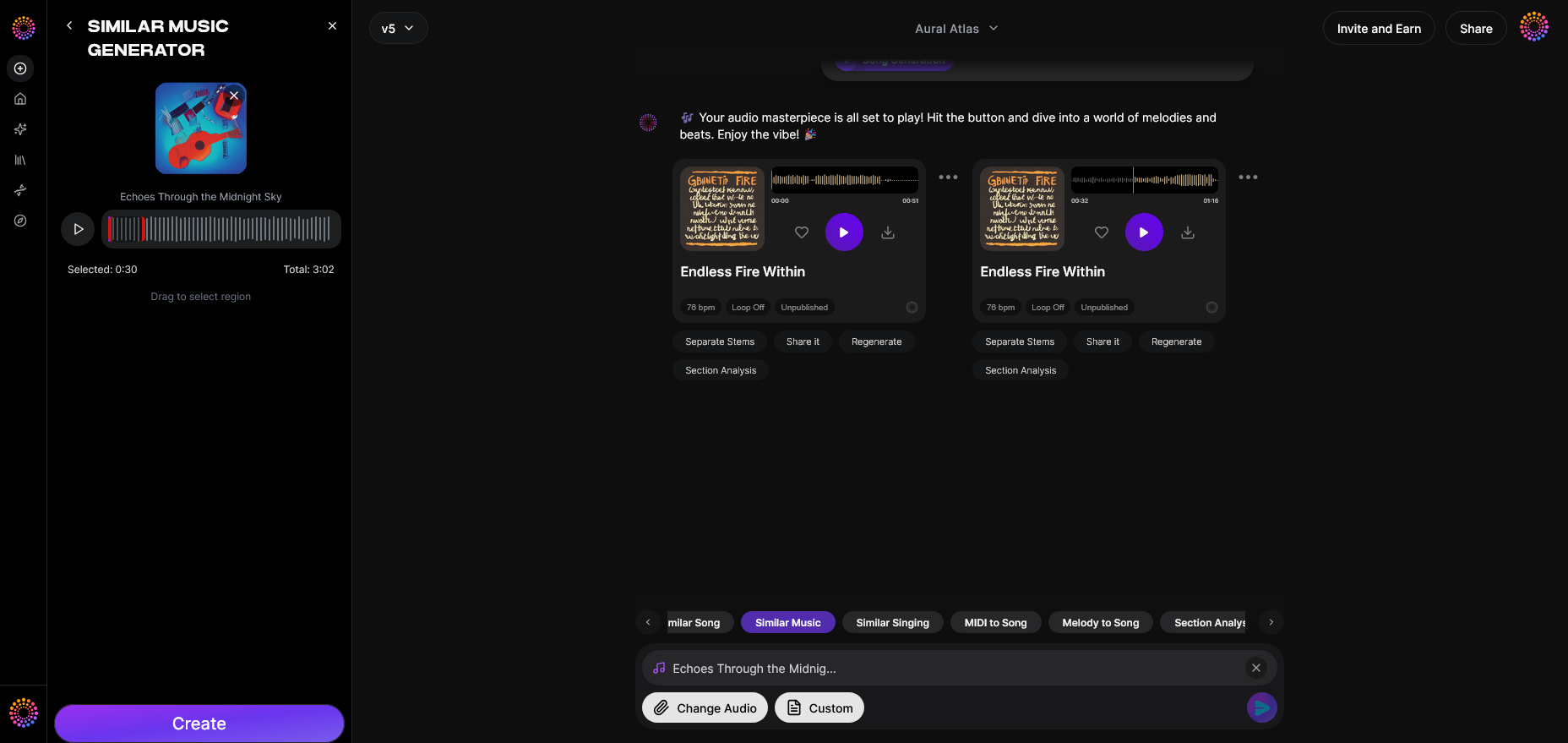
At the center of this conversation stands Soundverse’s Similar Music Generator, a robust tool purpose-built for film scoring applications. It’s engineered to help creators produce original instrumental compositions inspired by a reference track, acting as a creative bridge between director-approved temp music and polished cinematic sound.
What the Similar Music Generator Does:
- Instrumental Style Transfer: It analyzes a reference track’s melodic, rhythmic, and harmonic DNA, then reinterprets it into an original composition.
- Detailed Musical Analysis: The AI identifies tempo, key, and mood nuances, ensuring fidelity to the emotional tone of the reference.
- Reference-Based Loop Creation: Ideal for background loops and atmospheres that evolve seamlessly throughout a film.
Where It Excels:
For film producers, Soundverse eliminates the common bottleneck between idea and execution. Need a track that matches the intensity of a suspenseful chase sequence without infringing on copyrights? Upload the reference, and the system returns an original score tailored to your need.
Soundverse also integrates seamlessly with the Ethical AI Music Framework, meaning every composition is generated within an environment that ensures transparency, consent, and compensation. Alongside complementary tools like Soundverse Trace and Soundverse DNA, studios can safely scale AI-driven music production.
For readers exploring broader functionality, see Soundverse Introduces Stem Separation AI Magic Tool and Soundverse Assistant: Your AI Music Co-Producer to understand how these systems unify modern music creation pipelines.
The Future of AI Composers in Cinema
By 2026, AI composers have earned a seat at the creative table. They influence everything from indie projects to streaming series, empowering filmmakers to experiment with synthetic and hybrid soundtracks. Yet, the ultimate success of AI music in film depends on thoughtful implementation. As AI continues to evolve, success stories will come from teams that know what to automate and what to preserve for human expertise.
Looking forward, expect to see further integration between adaptive scoring systems and real-time post-production workflows. The cinematic landscape of 2026 signals that automation isn’t about replacing human emotion—it’s about amplifying it.
Create Your Own AI Film Score Today
Transform your storytelling with AI-generated music that adapts to the tone and emotion of your film scenes. Save time, reduce production costs, and bring cinematic sound to life effortlessly.
Start Composing with Soundverse
Related Articles
- The Role of AI Music in Film and Television: Explore how AI-generated scores are shaping modern film and TV production, from background ambiance to emotional orchestration.
- How AI-Generated Music is Transforming the Music Industry: Discover the technologies revolutionizing music creation and how artists and filmmakers alike are leveraging them for creative advantage.
- AI Music Generator and Human Composers: A Future Together: Learn how AI tools complement human creativity to form a new era of collaboration in composition and sound design.
- Navigating the World of Royalty-Free and Copyright-Free Music Using Soundverse AI: Understand how filmmakers can ethically and efficiently use AI music without the legal hurdles of licensing or copyright claims.
Here's how to make AI Music with Soundverse
Video Guide

Here’s another long walkthrough of how to use Soundverse AI.
Text Guide
- To know more about AI Magic Tools, check here.
- To know more about Soundverse Assistant, check here.
- To know more about Arrangement Studio, check here.
Soundverse is an AI Assistant that allows content creators and music makers to create original content in a flash using Generative AI.
With the help of Soundverse Assistant and AI Magic Tools, our users get an unfair advantage over other creators to create audio and music content quickly, easily and cheaply.
Soundverse Assistant is your ultimate music companion. You simply speak to the assistant to get your stuff done. The more you speak to it, the more it starts understanding you and your goals.
AI Magic Tools help convert your creative dreams into tangible music and audio. Use AI Magic Tools such as text to music, stem separation, or lyrics generation to realise your content dreams faster.
Soundverse is here to take music production to the next level. We're not just a digital audio workstation (DAW) competing with Ableton or Logic, we're building a completely new paradigm of easy and conversational content creation.
TikTok: https://www.tiktok.com/@soundverse.ai Twitter: https://twitter.com/soundverse_ai Instagram: https://www.instagram.com/soundverse.ai LinkedIn: https://www.linkedin.com/company/soundverseai Youtube: https://www.youtube.com/@SoundverseAI Facebook: https://www.facebook.com/profile.php?id=100095674445607
Join Soundverse for Free and make Viral AI Music

We are constantly building more product experiences. Keep checking our Blog to stay updated about them!