AI Music for Short-Form Ads: How Intelligent Sound Drives Advertising in 2026
Explore how AI music transforms short-form ads with personalized soundtracks and audio hooks in 2026.
AI Music for Short-Form Ads
In 2026, short-form advertising is no longer just about striking visuals and quick edits—it’s about sound. As social platforms continue to reward video engagement through attention-grabbing and emotionally resonant content, marketers are turning to AI music for advertising to stand out. The fusion of artificial intelligence and audio creation is giving rise to dynamic, data-driven soundtracks that are custom-built to move audiences in mere seconds.
Why is music crucial in short-form advertising?
Sound has always played a psychological role in marketing. A memorable jingle or background score can trigger brand recall far better than a visual logo alone. In short-form formats like TikTok, Instagram Reels, and YouTube Shorts, viewers engage most when the audio carries rhythm, mood, and message cohesively. Research across 2024 and 2025 indicated that ads with tailored audio hooks achieved up to 35% higher retention rates—and by 2026, this number is improving thanks to AI-driven music personalization.
AI-generated soundtracks can instantly reflect brand identity. They ensure the tone—whether playful, emotional, or luxurious—matches the narrative without relying on generic stock tracks. This level of precision gives creative directors a new toolset for storytelling within the 15-30 second format that dominates digital promotion.
What makes AI music ideal for creating branded audio content?
Short-form ads thrive on consistency and differentiation. AI music for advertising achieves both by producing unique, copyright-safe instrumentals that can loop perfectly underneath brand visuals. Modern AI tools let advertisers generate sound that captures desired moods—e.g., upbeat pop for fitness brands or calm ambient tones for wellness products.

Branded audio content is evolving beyond static jingles. In 2026, personalization is key: music can be adapted by demographic or region to match listener preferences. Imagine an algorithm that adjusts rhythm for urban youth audiences versus a slower tempo for older consumers—AI models now make such micro-personalization feasible.
The power of audio hooks in short-form ads
Audio hooks hold the same value as visual transitions or slogans. They create memory anchors—brief, distinctive moments that make viewers pause. For example, a plucky synth riff or rhythmic percussion drop can define the brand’s sonic fingerprint. AI systems trained on genre and emotional data generate these cues efficiently.
Brands integrating strong audio hooks report measurable impact on click-through rates and recognition in non-view contexts (like hearing the same melody elsewhere). With Soundverse and similar AI music platforms, the hook isn’t guessed—it’s generated based on trend data, genre insights, and prompt-specific descriptors. For a deeper dive, watch our Soundverse Tutorial Series - 9. How to Make Music, which demonstrates how creators can develop distinct sonic patterns. Also see Soundverse Tutorial Series - 8. "Explore" Tab for discovering genre-based inspiration.
For in-depth techniques on creating memorable AI tones, explore articles like How an AI Music Generator Inspires Creative Fusion and The Role of AI Music in Film and Television, which discuss how soundscapes can emotionally align with narrative structure.
How has AI music generation evolved by 2026?
Between 2024 and 2025, the industry saw early adoption of text-to-music models. By 2026, these tools have matured through improved dataset diversity, instrument modeling, and composition algorithms. They can now output higher production fidelity suitable for commercial use—without post-processing.
Advertisers have shifted away from licensing expensive stock tracks toward custom AI music solutions. With these, brands can:
- Maintain sonic originality in recurring campaigns.
- Adjust compositions instantly based on performance analytics.
- Ensure royalty-free usage, avoiding copyright complications.
According to iMusician’s 2026 industry report, platforms were already processing tens of thousands of AI tracks daily by late 2025, solidifying custom generation as standard practice. Spotify’s forecast likewise anticipates AI will become a foundational force in shaping audio trends for advertising in 2026.
The rise of AI sound has paralleled broader creative tech trends in the music industry. Soundverse has written extensively on this progression in Music Industry Trends and How AI-Generated Music is Transforming the Music Industry.
How to make AI Music for Advertising with Soundverse AI Music Generator
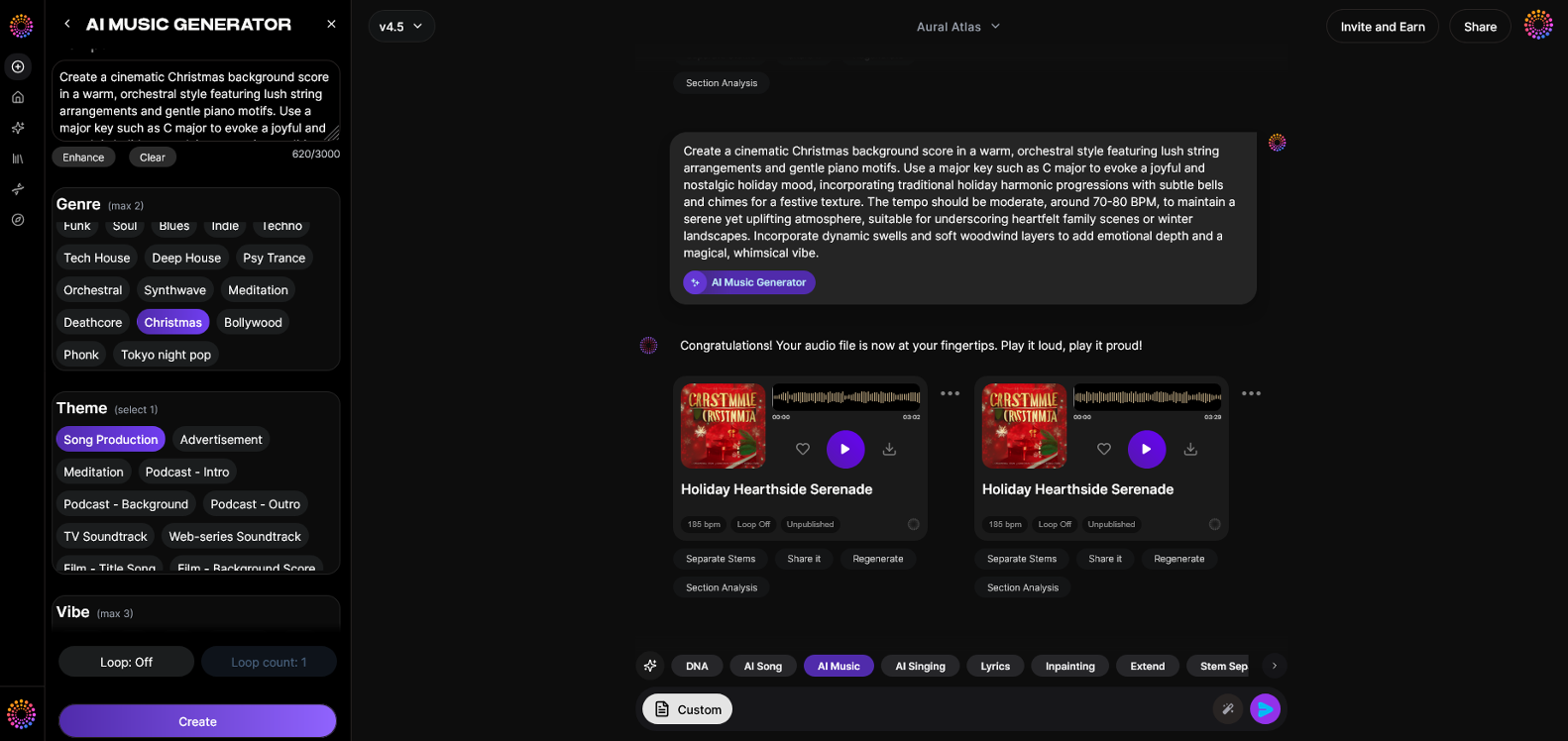
Soundverse’s AI Music Generator redefines background music creation for advertisers by transforming plain text prompts into fully arranged instrumentals. It specializes in tracks without vocals, perfect for underscores and brand jingles.
Key Capabilities:
- Text-to-music creation: Simply describe the desired mood, genre, or energy level.
- Loop Mode: Allows seamless repetition for short ads or rotative social videos.
- Detailed control: Adjust genre, instrument palette, and emotional tone.
- Model options: Choose between V4 and V5, each optimized for genre clarity and mix depth.
Primary Use Cases:
- Video background scores
- Commercial and advertising soundscapes
- Branded content themes
- Game and interactive media loops
Why Soundverse is ideal for advertisers
Short-form video creators need flexibility and creative speed. Soundverse delivers this through a streamlined workflow—users type their creative intent, let the AI process asynchronously, and receive export-ready music within minutes.
Advertisers can further extend generated tracks using Extend Music, another Soundverse tool that continues existing instrumentals while keeping key and tempo intact. For brand consistency across campaigns, Soundverse Trace ensures rights tracking and attribution, embedding ethical transparency into every file.
If you want to explore how Soundverse compares to other tools, check out Soundraw Alternative and Best AI Music Generator: Top Picks and Review. Both discuss how Soundverse distinguishes itself through genre precision and non-vocal production specialization. For detailed generation tutorials, watch our Soundverse Tutorial Series - 10. Make Deep House Music.
How does AI music improve ad performance metrics?
Marketers increasingly rely on data analytics to optimize campaigns. AI music supports this performance-oriented mindset by allowing real-time adjustment in future content iterations. When an ad with a faster tempo performs better, the AI model can generate similar patterns for subsequent campaigns, a concept outlined in How AI Analytics Optimize Music Marketing Campaigns in 2026.
Personalization also drives engagement. Viewers subconsciously align with music that fits their cultural or emotional context. This connection amplifies message retention, making each short-form ad not just watchable but memorable. Creative directors in 2026 see this as an evolution: sound isn’t decoration—it’s identity.
AI music as a storytelling catalyst
Music provides non-verbal storytelling cues. For instance, cinematic percussion builds anticipation for product reveals, while minimalist electronic backgrounds suit modern tech brands. AI-generated music enhances this storytelling flow by giving creators instant variations to test audiences’ emotional response.
Through platforms like Soundverse, advertisers can create multiple soundtrack versions and A/B test emotional resonance before picking the best-performing audio. Since Soundverse’s generation is copyright-safe, this experimentation is cost-efficient and risk-free.
What are best practices for integrating AI soundtracks in short-form ads?
- Start with emotion mapping: Define the core emotion your ad should evoke—joy, curiosity, or trust—and use that as your prompt foundation.
- Optimize for pacing: Ensure your AI-generated soundtrack aligns with the edit rhythm. Quick-cut ads need sharp beats; storytelling formats require smooth transitions.
- Apply looping where needed: Loop Mode in Soundverse helps deliver endless background ambiences ideal for carousel-style campaigns.
- Combine data and creativity: Use analytics insights from previous campaigns to refine prompts for future music generations.
- Ensure attribution and rights protection: Soundverse Trace embeds transparency layers, maintaining ethical standards across production.
The future of AI music in advertising
By 2026, AI-powered sound creation isn’t a novelty—it’s the standard. As brands compete for milliseconds of attention, AI music for advertising bridges the gap between digital efficiency and emotional artistry. The next frontier will integrate adaptive audio: music that dynamically shifts based on viewer behavior, powered by contextual AI learning.
Marketers who adapt now secure an edge in brand memorability and consumer connection. With intelligent sound design, even a fifteen-second clip can evolve into an unforgettable experience.
Create Impactful Ad Music in Minutes with Soundverse AI
Transform your short-form ads with custom AI-generated tracks that capture attention and drive engagement. No musical expertise required – just creativity and our intuitive tools.
Start Creating AI Music
Related Articles
- Enhancing YouTube Content with Royalty-Free and Copyright-Free Music Using Soundverse AI: Discover how to make your YouTube videos shine with original, copyright-safe music generated by Soundverse AI.
- The Role of AI Music in Film and Television: Explore how AI-generated compositions are reshaping sound design for film, TV, and branded entertainment.
- How AI-Generated Music Is Transforming the Music Industry: Unpack the ways AI is revolutionizing creative processes and redefining modern music production.
- Soundverse AI Revolutionizing Music Creation for New-Age Content Creators: Learn how Soundverse empowers today’s creators to produce studio-quality music faster with innovative AI features.
Here's how to make AI Music with Soundverse
Video Guide

Here’s another long walkthrough of how to use Soundverse AI.
Text Guide
- To know more about AI Magic Tools, check here.
- To know more about Soundverse Assistant, check here.
- To know more about Arrangement Studio, check here.
Soundverse is an AI Assistant that allows content creators and music makers to create original content in a flash using Generative AI. With the help of Soundverse Assistant and AI Magic Tools, our users get an unfair advantage over other creators to create audio and music content quickly, easily and cheaply. Soundverse Assistant is your ultimate music companion. You simply speak to the assistant to get your stuff done. The more you speak to it, the more it starts understanding you and your goals. AI Magic Tools help convert your creative dreams into tangible music and audio. Use AI Magic Tools such as text to music, stem separation, or lyrics generation to realise your content dreams faster. Soundverse is here to take music production to the next level. We're not just a digital audio workstation (DAW) competing with Ableton or Logic, we're building a completely new paradigm of easy and conversational content creation.
TikTok: https://www.tiktok.com/@soundverse.ai
Twitter: https://twitter.com/soundverse_ai
Instagram: https://www.instagram.com/soundverse.ai
LinkedIn: https://www.linkedin.com/company/soundverseai
Youtube: https://www.youtube.com/@SoundverseAI
Facebook: https://www.facebook.com/profile.php?id=100095674445607
Join Soundverse for Free and make Viral AI Music

We are constantly building more product experiences. Keep checking our Blog to stay updated about them!