AI Music Copyright Myths Explained: Clearing Up AI Copyright Confusion in 2026
Discover the truth behind AI music copyright myths in 2026 and learn how Soundverse Trace ensures fairness and rights attribution in AI-generated music.
AI Music Copyright Myths Explained
Introduction
By 2026, the lines between human creativity and machine-generated art have become more intricate than ever. AI music composition tools have transformed how artists, producers, and content creators generate audio content for streaming, social media, film, and even personal branding. However, as innovation flourishes, confusion surrounding AI music copyright continues to stir debates across the global music industry.
With the rise of text-to-music engines and AI generation tools, many creators struggle to understand where ownership begins and ends. Does the person who prompts an AI to create a melody own the rights? What if the AI used copyrighted works in its training data? These are legitimate concerns that have fueled what many call AI copyright confusion.
In this article, we’ll unpack the most persistent myths about AI-generated music, demystify the legal landscape, explore the evolution of music AI law, and end by explaining how Soundverse Trace provides a reliable framework for copyright transparency and attribution.
What is AI music copyright, and why is it important in 2026?

The term AI music copyright refers to the question of who holds the legal rights to music created with artificial intelligence. It intersects three complex domains: intellectual property law, machine learning ethics, and creative authorship.
By 2026, the conversation has matured well beyond early speculation seen in 2024 and 2025. Regulatory bodies in the U.S., E.U., and Asia have each proposed frameworks that attempt to distinguish between “human-assisted” and “machine-generated” compositions. The importance of AI music copyright lies in ensuring creators are compensated fairly, that training data is ethically sourced, and that ownership can be transparently verified.
Without clear attribution, disputes over datasets, reused material, and ownership stakes could swamp the industry in legal battles. Musicians and producers now rely on tools such as Soundverse Trace to verify authorship lineage and metadata, reducing conflicts before they even arise.
What are the most common myths about AI music copyright?

Misunderstandings about AI-generated music laws have given rise to several dangerous myths. Let’s break down the most widespread ones:
Myth 1: “AI-generated songs can’t be copyrighted.”
This is partially true—but context matters. Most jurisdictions currently state that a purely machine-generated work cannot be copyrighted unless there is substantial human input guiding the creative output, as detailed in AI Music Copyright 2026: Complete Legal Guide for Creators. That means if you use an AI generator to produce a song through deliberate prompt engineering, arrangement decisions, or post-production editing, your contributions may qualify for partial or full authorship rights.
The confusion stems from past rulings (like those from 2024) where courts denied copyright protection for AI-generated works without human involvement. In 2026, hybrid ownership—shared between AI tools and human input—is recognized as a viable legal pathway, following an update by the U.S. Copyright Office.
Myth 2: “All AI music is automatically plagiarism.”
Many artists assume that AI tools inherently copy existing copyrighted content. In truth, responsible AI systems are designed to use patterns and features from training data rather than directly copying material, as confirmed in Music Copyright in the Gen AI Age. Modern frameworks emphasize data attribution and ethical dataset curation.
Solutions like Soundverse Trace ensure transparency by logging which datasets influence each generated track. This allows musicians and entertainment lawyers to trace patterns without compromising the confidentiality of the original dataset.
Myth 3: “AI cannot produce original compositions.”
Early AI experiments often produced derivative or overfamiliar sounds, but advances in generative architectures have changed that narrative. By 2026, human-guided machine composition is capable of generating entirely fresh arrangements that blend macro-level style learning with micro-level improvisation.
AI originality today depends not on total independence, but on the creative synergy between humans and algorithms. The evolving music AI law now accounts for the human’s intent, prompts, and selection process.
For creative inspiration, watch our Soundverse tutorial on how to make music or the Deep House creation guide for workflow insights.
Myth 4: “Once you use AI, you lose rights to your music.”
Another major misconception is that using an AI system automatically transfers ownership to the platform. Reputable AI music services, such as Soundverse, operate under clear licensing frameworks—users retain copyright for the portions they create or direct. This principle has been covered by Artlist.
In contrast, free or unverified AI websites may hide broad commercial rights in their terms of service. Always verify platform licenses before releasing music commercially.
Myth 5: “AI copyright confusion will disappear with new laws.”
While governments are actively modernizing statutes, no single universal solution exists yet. AI technology evolves faster than legislation. The best way to manage uncertainty is through attribution transparency and verifiable metadata. That’s precisely where Soundverse Trace adds value: it bridges ethical practice and technological accountability.
How is music AI law evolving in 2026?
Since 2024, policymakers have shifted from banning or restricting AI music tools to regulating their accountability. Key developments include:
- Attribution-first compliance: New “creative traceability” laws in the U.S. and U.K. require any AI-generated music used commercially to include metadata identifying the training source and generation method, per the TRAIN Act.
- Royalty frameworks: Platforms participating in licensing programs, such as Soundverse’s Content Partner Program, distribute recurring royalties to rights-holders whose works contributed to training datasets.
- Ethical training guidelines: The Ethical AI Music Framework encourages model creators to ensure fair consent, dataset transparency, and artist compensation.
Entertainment lawyers in 2026 emphasize that compliance depends not only on contracts but also on technical infrastructure. Without traceable data lineage, even legitimate creators may be unable to defend their rights during disputes.
How does AI copyright confusion affect musicians and producers?
For working artists and content creators, AI’s legal grey zones can raise serious business concerns:
- Monetization barriers: Music distributors and DSPs (Digital Streaming Platforms) now require proof of training data provenance when registering AI-assisted works.
- Collaboration uncertainty: Producers worry about royalty-sharing when AI contributes significant arrangements or performances.
- Legal exposure: Without trace logs, creators risk unintentional overlap with copyrighted works, inviting takedown notices or demonetization.
Navigating these pitfalls requires authoritative verification tools—and that’s where platforms like Soundverse Trace bring structure to the chaos.
How to manage AI music copyright safely with Soundverse Trace
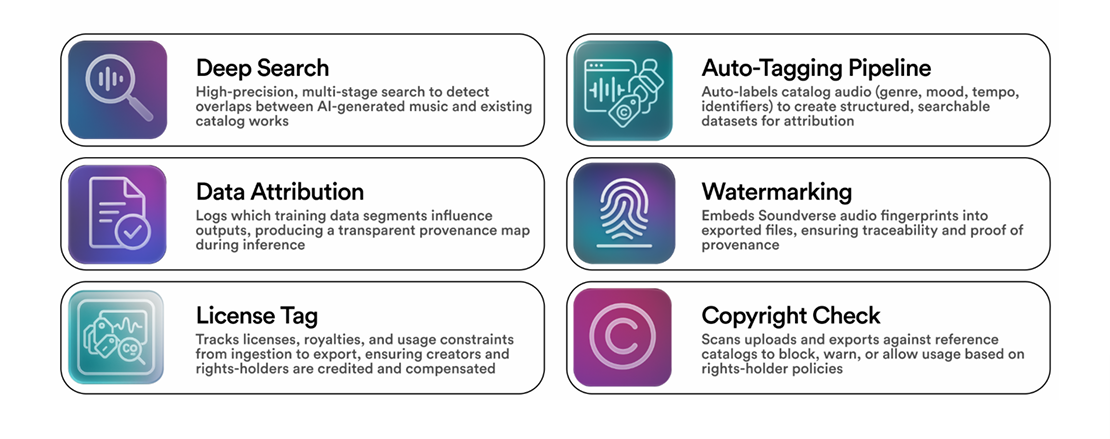
Soundverse Trace is a comprehensive trust layer designed specifically for the evolving AI music ecosystem. It embeds attribution, deep search, and rights protection throughout the entire lifecycle—from dataset creation to final export.
Key Capabilities:
- Deep Search: Its high-precision scanning system can detect overlaps between newly generated music and existing catalogs using 1:1 or 1:N comparisons. This prevents unintentional duplication and accelerates clearance workflows.
- Data Attribution: Soundverse Trace logs which training data influenced each output. This granular insight helps artists, producers, and legal teams prove lineage and origin when questions arise.
- Audio Watermarking: Inaudible fingerprinting technology ensures every generated track carries a unique ID. This helps track unauthorized use or sampling across platforms.
- License Tagging: Embedded rights metadata persists from ingestion to export, giving everyone—from platform distributors to collaborators—transparent access to licensing details.
By using these mechanisms, musicians can confidently distribute AI-assisted music across streaming platforms while maintaining full legal compliance. The system automatically associates historical datasets, ethical consent pathways, and attribution records without relying on manual tagging.
Soundverse Trace also works seamlessly with the broader Ethical AI Music Framework, offering a six-stage pipeline that prioritizes consent, attribution, and recurring royalty compensation. This unified ecosystem not only prevents infringement but also ensures creators get paid for their contributions.
For additional workflow examples, explore our Soundverse Explore tab walkthrough.
How Soundverse Trace simplifies your workflow
Whether you’re an independent producer or a rights management lawyer, Soundverse Trace transforms AI copyright management into a predictable process:
- Upload or Record: Input your generated or mixed audio track.
- Attribution Analysis: The system asynchronously matches segments against the licensed dataset registry.
- Ownership Verification: Receive detailed logs showing attribution, detected overlaps, and license lineage.
- Metadata Export: The AI seals approved metadata into your final audio file, ensuring traceability across all streaming and sync channels.
This streamlined process eliminates ambiguity, helping content creators spend less time managing compliance and more time making music.
Learn more about AI generation workflows in our deep-dive guides on AI music trends in the industry, how to create AI-generated music, and AI tools revolutionizing creative production.
Create Copyright-Safe AI Music Today
Unlock your creativity with Soundverse’s AI tools—designed to help you generate, edit, and customize original tracks without legal worries. Experience freedom, speed, and compliance in your music-making process.
- Navigating the World of Royalty-Free and Copyright-Free Music Using Soundverse AI: Learn how to choose and generate music that’s safe to use across all platforms with Soundverse’s advanced tech.
- The Role of AI Music in Film and Television: Discover how AI-generated music is transforming the entertainment industry and empowering creators to produce cinematic soundscapes.
- Copyright-Free vs Royalty-Free Music: What Creators Should Know: Understand the difference between copyright-free and royalty-free tracks to protect your content and creative rights.
- AI Music Generator and Human Composers: A Future Together: Explore how AI tools like Soundverse complement human creativity rather than replace it, creating new artistic possibilities.
Here's how to make AI Music with Soundverse
Video Guide

Here’s another long walkthrough of how to use Soundverse AI.
Text Guide
- To know more about AI Magic Tools, check here.
- To know more about Soundverse Assistant, check here.
- To know more about Arrangement Studio, check here.
Soundverse is an AI Assistant that allows content creators and music makers to create original content in a flash using Generative AI. With the help of Soundverse Assistant and AI Magic Tools, our users get an unfair advantage over other creators to create audio and music content quickly, easily and cheaply. Soundverse Assistant is your ultimate music companion. You simply speak to the assistant to get your stuff done. The more you speak to it, the more it starts understanding you and your goals. AI Magic Tools help convert your creative dreams into tangible music and audio. Use AI Magic Tools such as text to music, stem separation, or lyrics generation to realise your content dreams faster. Soundverse is here to take music production to the next level. We're not just a digital audio workstation (DAW) competing with Ableton or Logic, we're building a completely new paradigm of easy and conversational content creation.
TikTok: https://www.tiktok.com/@soundverse.ai
Twitter: https://twitter.com/soundverse_ai
Instagram: https://www.instagram.com/soundverse.ai
LinkedIn: https://www.linkedin.com/company/soundverseai
Youtube: https://www.youtube.com/@SoundverseAI
Facebook: https://www.facebook.com/profile.php?id=100095674445607
Join Soundverse for Free and make Viral AI Music

We are constantly building more product experiences. Keep checking our Blog to stay updated about them!
Image Steps: []