AI Music and Trust-Based Monetization Systems in 2026
Explore ethical AI music monetization and trust systems shaping artist royalties in 2026.
AI Music and Trust-Based Monetization Systems
Artificial intelligence continues to redefine every part of the music industry, and as of 2026, the conversation around AI music monetization has evolved from pure novelty into economic necessity. As creators, rights-holders, and platforms experiment with machine-generated compositions, one question drives both innovation and debate: can AI honor human artistry while ensuring fair and transparent payments? The answer increasingly revolves around trust-based monetization systems—ethical infrastructures designed to reward consent, verify attribution, and guarantee recurring compensation.
What is Driving AI Music Monetization in 2026?
The past few years (2024–2025) witnessed explosive growth in generative music models. Tools like Soundverse, Mubert, and Soundraw transformed the creative workflow of musicians and content creators. However, early models often lacked transparency around data sourcing and rights management. In 2026, this gap became the focal point for innovation, with the industry demanding accountability, not merely creativity. AI music monetization now hinges on building systems that ensure fair revenue through verified ownership and auditable usage.

The integration of blockchain music payments and algorithmic royalties is reshaping digital music economies. These technologies enable artists to track how AI-generated works incorporate their licensed material, triggering automatic, microscopic royalty payments whenever their audio DNA contributes to a generated piece.
For independent artists and record labels, the promise of AI is no longer just automated production—it's sustainable compensation. When every sample and sonic identifier carries a traceable value, creators can join AI systems without losing control over their art.
How Are Trust-Based Monetization Systems Evolving?

A trust-based system operates on transparency, consent, and traceability. Instead of opaque AI models scraping data from the web, these new frameworks use permissioned datasets—where contributors are known, and every use of their data generates measurable returns.
- Transparent Licensing – Rights-holders now opt into licensed AI music datasets consciously, ensuring compliance with copyright rules and usage agreements.
- Attribution at Scale – Deep-learning systems analyze audio fingerprints to recognize the source influence of specific artists, enabling them to receive recursive rewards.
- Blockchain Settlement – Each AI-generated track is linked through smart contracts to relevant contributors, ensuring fair revenue flows automatically.
Industry analysts predict that by the end of 2026, nearly 40% of commercial AI music tools will adopt blockchain-enabled rights verification. Platforms are racing to prove that automation and artistry can coexist ethically, transforming AI from a risk into a rights amplifier.
Why Existing Monetization Models Struggle With AI Outputs
Traditional streaming royalties rely on straightforward metrics: play count, territory, and subscription revenue. But with AI-generated or AI-assisted music, creators often find themselves outside the payment cycle. Many “AI models” generate new compositions by referencing large amounts of copyrighted data without consent or compensation.
This lack of ethical infrastructure leads to recurring legal complications, especially for enterprise users seeking copyright-safe AI music. Artists demand systems that can verify whether their recordings or compositional structures influence AI outputs. Without traceability, the promise of AI music monetization cannot be realized.
The evolution toward artist trust systems is a direct response. Transparent attribution layers and automated royalty engines now represent the next phase of music IP protection.
For an overview of how AI content workflows impact creators, see Monetization-First AI Music Systems in 2026 | Strategy Guide.
How Soundverse The Ethical AI Music Framework Solves These Challenges
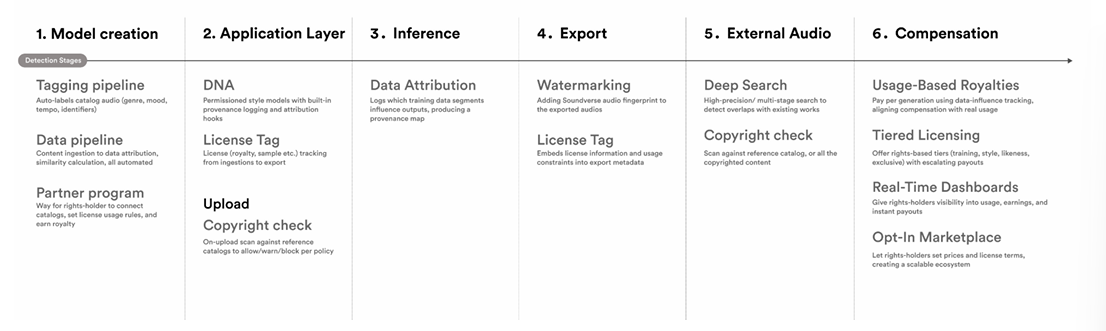
Soundverse has emerged as a leader in ethical AI monetization solutions through its flagship feature, The Ethical AI Music Framework. This comprehensive, end-to-end system bridges technology with artist integrity, ensuring legal compliance from data collection to payment distribution.
Core Capabilities of The Ethical AI Music Framework
The framework replaces opaque, black-box AI models with a transparent six-stage pipeline:
- Stage 1: Licensed Data Sourcing (No Scraping) – Soundverse only trains AI using legally acquired and licensed audio, eliminating unauthorized data mining.
- Stage 2: Permissioned Models (DNA) – Artists participate via Soundverse DNA, training models that represent their sonic identity. Each model contains clear permission metadata.
- Stage 3: Explainable Inference (Attribution) – Every generated piece is traceable to its source influences, ensuring transparent contribution tracking.
- Stage 4: Traceable Export (Watermarking) – Music generated through the platform contains embedded AI watermarks identifying its origin and rights structure.
- Stage 5: Deep Search (External Scanning) – Soundverse Trace scans global media for matches or derivatives, protecting rights across distribution platforms.
- Stage 6: Recurring Compensation (Partner Program) – Through the Content Partner Program, contributors receive continuous royalties whenever their licensed data is used.
For a deeper dive, watch our guide on creating Deep House music or learn about composition basics in our tutorial on how to make music. To explore more about platform navigation, see our “Explore” feature walkthrough.
Industry Alignment and Compliance
This system allows enterprise users and individual musicians to maintain confidence in AI-generated outputs. It complies with international data protection and IP laws, creating a transparent revenue ecosystem anchored on artist trust systems. The result: artists gain predictable income streams while organizations avoid legal uncertainty.
What Role Does Blockchain Play in AI Music Payments?
Blockchain isn’t just a buzzword—it’s becoming the backbone of AI music monetization. Smart contracts synchronize attribution and royalty records in real time, ensuring that every track generated under frameworks like Soundverse’s Ethical AI Music Framework can trigger automated micro-payments.
In practice, blockchain adds an immutable ledger layer to algorithmic royalties, documenting how often particular sonic DNA patterns appear in AI outputs. By combining on-chain tracking with Soundverse's watermarking, artists can audit their earnings transparently.
This innovation supports scalable compensation models without intermediaries and suits global collaborative environments where AI music is rapidly shared across platforms like YouTube, TikTok, and emerging metaverse stages.
Learn more about how AI is redefining digital music workflows in Soundverse’s related articles such as How AI-Generated Music is Transforming the Music Industry and AI Music Generator and Human Composers: A Future Together.
You can also check out insights from the AI Music in 2026: From Fear to Reality, Denial to Monetization video and compare AI tools in the Best AI Music Generators in 2026 article.
How Artist Trust Systems Create Sustainable Revenue
Trust systems reintroduce credit and accountability to AI composition. Instead of passive monetization, artists engage actively with AI infrastructure:
- Opt-in Licensing: Creators decide what content to contribute to AI datasets.
- Usage-Based Royalties: Payments depend on how often their sound data is used by models.
- Verifiable Attribution: Each AI track maintains record-level details about source influences.
Combined with blockchain music payments, these mechanisms address one of the biggest ethical challenges of AI art—unlicensed replication. A transparent system transforms AI into a collaborative tool, giving artists control over both their legacy and their earnings.
For example, compare Soundverse’s partner-driven model with alternatives in Mubert Alternatives or Soundraw Alternative. While those platforms offer creative freedom, few integrate ethical monetization at a systemic level.
What Future Trends Will Define AI Music Monetization?
By late 2026, several notable trends are shaping AI music economics:
- Multi-Model Collaboration – Hybrid AI tracks are combining different artists’ DNA, requiring multi-party payment distribution frameworks.
- Automated Creative Auditing – Platforms use AI-driven search like Soundverse Trace to continuously scan public music archives for attribution matches.
- Royalty Streaming via Smart Contracts – As artists engage with dynamic blockchain contracts, royalty payouts may become continuous rather than periodic.
- AI-Assisted Labeling – Enterprises adopt transparent metadata tagging from models like Soundverse DNA to classify every sound according to license origin.
The general movement points toward an ethical economy of sound, where creativity and compensation coexist harmoniously.
If you’re exploring new-generation monetization models, you can also study related innovations outlined in Music Industry Trends or examine generative workflow features in Soundverse Introduces Stem Separation AI Magic Tool.
Start Earning from Your AI Music Creations Today
Discover how Soundverse empowers artists to create, distribute, and monetize AI-generated tracks effortlessly through transparent, trust-based systems. Build your audience and turn your creativity into sustainable revenue.
Related Articles
- How AI-Generated Music Is Transforming the Music Industry: Explore how AI tools are reshaping music creation, production, and monetization for artists around the world.
- Soundverse AI: Revolutionizing Music Creation for New-Age Content Creators: Learn how Soundverse AI is changing the game by giving creators full control over music generation and monetization.
- Navigating the World of Royalty-Free and Copyright-Free Music Using Soundverse AI: Understand how to legally and ethically use AI-generated music while protecting your creative rights.
- AI Music Generator and Human Composers: A Future Together: Delve into how collaboration between AI and artists is shaping the next era of musical innovation and income models.
Here's how to make AI Music with Soundverse
Video Guide

Here’s another long walkthrough of how to use Soundverse AI.
Text Guide
- To know more about AI Magic Tools, check here.
- To know more about Soundverse Assistant, check here.
- To know more about Arrangement Studio, check here.
Soundverse is an AI Assistant that allows content creators and music makers to create original content in a flash using Generative AI. With the help of Soundverse Assistant and AI Magic Tools, our users get an unfair advantage over other creators to create audio and music content quickly, easily and cheaply. Soundverse Assistant is your ultimate music companion. You simply speak to the assistant to get your stuff done. The more you speak to it, the more it starts understanding you and your goals. AI Magic Tools help convert your creative dreams into tangible music and audio. Use AI Magic Tools such as text to music, stem separation, or lyrics generation to realise your content dreams faster. Soundverse is here to take music production to the next level. We're not just a digital audio workstation (DAW) competing with Ableton or Logic, we're building a completely new paradigm of easy and conversational content creation.
TikTok: https://www.tiktok.com/@soundverse.ai
Twitter: https://twitter.com/soundverse_ai
Instagram: https://www.instagram.com/soundverse.ai
LinkedIn: https://www.linkedin.com/company/soundverseai
Youtube: https://www.youtube.com/@SoundverseAI
Facebook: https://www.facebook.com/profile.php?id=100095674445607
Join Soundverse for Free and make Viral AI Music

We are constantly building more product experiences. Keep checking our Blog to stay updated about them!