AI Music and Transparent Revenue Models: Building Fair Economics in 2026
Discover transparent AI music revenue models driving fair artist payments in 2026.
AI Music and Transparent Revenue Models
As artificial intelligence continues to redefine creative industries, the music world has seen radical change. By 2026, AI-generated music has become mainstream, powering everything from independent artist releases to film soundtracks and commercials. While these technologies unlock new creative potential, they also reveal uncomfortable gaps in how artists are compensated. The conversation around AI music revenue models and transparent payment systems has moved from niche debate to industry-wide urgency.
What are AI music revenue models and why do they matter in 2026?
AI music revenue models describe how income is distributed when artificial intelligence assists in music creation, distribution, or licensing. Historically, the music industry has struggled with fair and transparent royalty systems—artists often receive small portions of streaming income, and contributors to training datasets rarely see recurring payments. In 2026, this issue becomes amplified with AI’s proliferation.
For professionals in the music industry, digital rights advocates, and developers, understanding modern revenue models means navigating both creative ethics and technological innovation. AI-generated music production raises new economic questions: who owns the sound, who gets paid, and how can attribution be automated without sacrificing artistic integrity?

How did AI-generated music evolve between 2024 and 2026?
Between 2024 and 2025, AI generation tools such as text-to-music platforms surged in use. By 2026, these tools matured into sophisticated ecosystems. Platforms like Soundverse led the charge toward transparency and fair music monetization. The evolution paralleled similar changes across digital creative industries—AI-driven audio production became a cornerstone of content creation alongside AI video and design tools.
As adoption increased, so did legal scrutiny. Creators and brands demanded systems capable of verifying that AI outputs were ethically trained and accurately attributed. Traditional royalty structures couldn’t keep pace, prompting new frameworks that built fairness directly into the technical architecture of AI generation pipelines. As noted by Revelator’s industry forecasts, 2026 marks the turning point from a gatekeeper model to an ecosystem model for music creators.

What challenges exist in traditional music industry economics?
The traditional music industry profits heavily through intermediaries—labels, publishers, and distribution platforms. Revenue splits often leave creators with less than 15% of total income. In AI music, this model becomes even less sustainable because thousands of micro-contributions from training data may underpin a single composition. Without transparent attribution, those contributors cannot be compensated fairly.
Opaque systems, black-box algorithms, and unclear licensing mechanisms amplify distrust between developers and artists. The economics of AI music in 2026 require a rethink, where visibility and traceability are embedded from day one. This transition mirrors the same transparency demanded in music industry trends seen across streaming and creative content platforms in recent years. Industry studies such as Tuned Global’s music trends emphasize this convergence of transparency and speed in AI-driven monetization.
Why is artist payment transparency critical for AI-generated music?
Artist payment transparency isn’t just a moral necessity—it’s fundamental to sustaining innovation. When creators understand how their work feeds AI models and what share of revenue they earn from subsequent use, they’re empowered to participate confidently.
Transparent mechanisms also drive consumer trust. Enterprises licensing AI music for media projects need guarantees that all outputs are legally compliant and ethically sourced. Without such frameworks, the risk of copyright disputes and reputation loss grows. Platforms highlighting artist payment transparency—such as those discussed in how AI-generated music is transforming the music industry—prove that ethics is a competitive advantage.
How do fair music monetization and royalties evolve in 2026?
Fair music monetization in 2026 depends on recurring, attribution-driven models replacing traditional one-time licensing fees. Instead of paying upfront for datasets, AI platforms increasingly operate through usage-based royalty systems. Every play, remix, or derivative work automatically triggers compensation to original contributors.
Royalties are calculated dynamically via metadata traceable to the source. Technologies like watermarking and deep audio fingerprinting embed identifiable markers allowing audit trails. Moreover, these monetization flows expand beyond individual artists to collective rights organizations and partner programs that represent communities of creators.
This evolution ensures that the economic benefits of AI aren’t limited to major labels or tech giants. Independent producers, musicians, and developers all receive measurable value for their input. As Jack Righteous notes, turning attention into ownership and transparent revenue will become the defining advantage for serious creators.
How to make AI music revenue models transparent with Soundverse The Ethical AI Music Framework
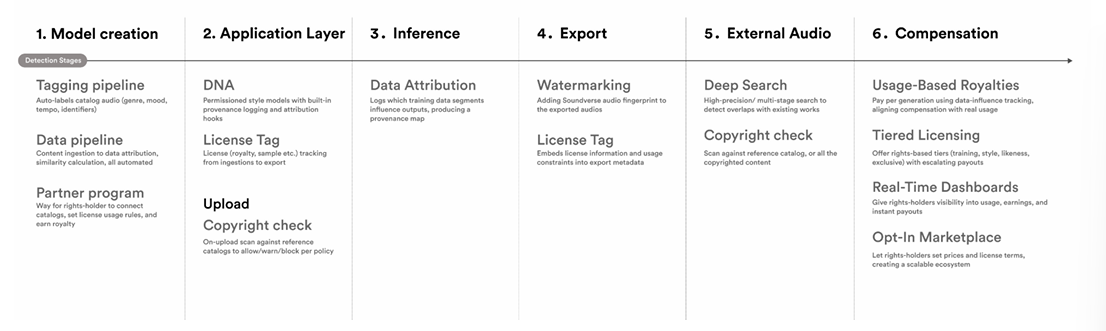
Soundverse’s Ethical AI Music Framework directly addresses the inequalities discussed above. Designed as an end-to-end infrastructure bridging innovation and artist integrity, it replaces opaque black-box models with a transparent, six-stage pipeline. Each stage enforces consent, attribution, and recurring compensation, enabling fair participation in AI music creation.
Stage 1: Licensed Data Sourcing (No scraping) ensures all training data used for Soundverse models is legally acquired and licensed from rights-holders. No unauthorized scraping or public dataset exploitation occurs.
Stage 2: Permissioned Models (DNA) imposes identity-level governance within model training. Every contributor has a registered DNA tag within the Soundverse ecosystem, enabling precise tracking of data usage.
Stage 3: Explainable Inference (Attribution) delivers explainability during generation—each musical idea derived from prior licensed material lists its lineage for auditing purposes.
Stage 4: Traceable Export (Watermarking) adds digital watermarking to every exported track, allowing verification of origin and model accountability.
Stage 5: Deep Search (External Scanning) provides global audio scanning capabilities, confirming that outputs don’t violate external copyrights or reuse unlicensed content.
Stage 6: Recurring Compensation (Partner Program) ties directly into the Soundverse Content Partner Program. Creators contributing sound data or musical elements receive recurring royalties based on usage volume and attribution.
For a deeper dive, watch our guide on creating Deep House music and our tutorial on how to make music through Soundverse’s transparent generation tools.
This framework doesn’t just improve technical compliance—it establishes a transparent economic foundation for the AI music industry. Labels and developers gain legal certainty while artists enjoy measurable financial returns and proper recognition.
For professionals evaluating alternatives to traditional AI tools, this framework contrasts markedly with other systems outlined in Mubert alternatives Soundverse and Soundraw alternative. Its focus isn’t just on generation quality but on ethical monetization and trust-by-design.
How can artists and developers benefit financially from transparent AI music frameworks?
When AI platforms incorporate tracing and royalty automation directly, the barrier to entry for monetization drops. Artists no longer need to negotiate complex contracts or manually track usage across streaming services. Instead, they connect through partner programs allowing metadata linkage between training input and generated output.
Developers equally benefit—transparent pipelines make enterprise adoption faster because compliance is demonstrable. Partnerships formed under ethical AI frameworks often include data-sharing incentives and performance bonuses based on attribution volume.
The combination of fair music monetization and audited AI generation creates a new ecosystem—one where attribution is immediate, royalties are continuous, and ethical compliance is verifiable. Those who invest time and data early stand to earn long-term recurring income. As industry predictions from Wavespeed show, AI music generators with transparent royalty sharing emerge as the most competitive in 2026.
What does the future of AI music economics look like?
Looking ahead to post-2026 trends, the most successful AI music frameworks will likely involve decentralized royalty tracking and real-time attribution verification. Blockchain-based registries may intersect with watermark scanning systems, improving the efficiency of recurring payments. Digital twin technology could represent artist portfolios within AI models, automatically generating derivative licensing agreements.
As AI generation becomes standard in entertainment, transparent economics become the differentiator between platforms competing in creative industries. Artists and developers gravitate toward systems guaranteeing fairness and sustainability, echoing movements seen in other digital creator economies.
Soundverse’s Ethical AI Music Framework embodies this forward-thinking vision. It builds confidence while establishing measurable trust across every stage of music production. Whether used in creating genre-based compositions like those in generate AI music with Soundverse text-to-music or experimenting with new multimedia integrations, transparency remains its foundation.
Start Creating AI Music That Pays Off Fairly
Join Soundverse to generate professional-grade music using AI while maintaining transparency in revenue models. Empower your creativity and earn what you deserve.
Create Music with AI Now
Related Articles
- How AI-Generated Music Is Transforming the Music Industry — Explore how AI is changing the way artists produce, monetize, and distribute music worldwide.
- AI Music Generator and Human Composers: A Future Together — Dive into the collaborative potential of AI and human creativity in shaping the music industry's future.
- Navigating the World of Royalty-Free and Copyright-Free Music Using Soundverse AI — Learn how to produce and monetize music ethically by understanding royalty-free and copyright-free models.
- The Role of AI Music in Film and Television — Discover how AI-driven compositions are redefining the soundtrack landscape for film and TV.
Here's how to make AI Music with Soundverse
Video Guide

Here’s another long walkthrough of how to use Soundverse AI.
Text Guide
- To know more about AI Magic Tools, check here.
- To know more about Soundverse Assistant, check here.
- To know more about Arrangement Studio, check here.
Soundverse is an AI Assistant that allows content creators and music makers to create original content in a flash using Generative AI. With the help of Soundverse Assistant and AI Magic Tools, our users get an unfair advantage over other creators to create audio and music content quickly, easily and cheaply. Soundverse Assistant is your ultimate music companion. You simply speak to the assistant to get your stuff done. The more you speak to it, the more it starts understanding you and your goals. AI Magic Tools help convert your creative dreams into tangible music and audio. Use AI Magic Tools such as text to music, stem separation, or lyrics generation to realise your content dreams faster. Soundverse is here to take music production to the next level. We're not just a digital audio workstation (DAW) competing with Ableton or Logic, we're building a completely new paradigm of easy and conversational content creation.
TikTok: https://www.tiktok.com/@soundverse.ai
Twitter: https://twitter.com/soundverse_ai
Instagram: https://www.instagram.com/soundverse.ai
LinkedIn: https://www.linkedin.com/company/soundverseai
Youtube: https://www.youtube.com/@SoundverseAI
Facebook: https://www.facebook.com/profile.php?id=100095674445607
Join Soundverse for Free and make Viral AI Music

We are constantly building more product experiences. Keep checking our Blog to stay updated about them!