AI Music and Sustainable Creative Futures: Building an Ethical and Inclusive Music Industry in 2026
Explore how AI music drives sustainable creativity and ethical innovation in 2026.
AI Music and Sustainable Creative Futures
What does AI music mean for the future of creativity in 2026?
In 2026, AI music has moved far beyond novelty. It’s no longer just a tool to automate sound generation but a cornerstone of creative sustainability—helping musicians, producers, and digital artists create responsibly while maintaining artistic integrity. The challenge today isn’t whether artificial intelligence can make music; it’s about how it can do so ethically, transparently, and sustainably.
As we reflect on the breakthroughs of 2024 and 2025, the music industry has shifted from experimentation to consolidation. Generative tools like Soundverse, OpenAI’s Jukebox evolutions, and independent AI composers have introduced both massive potential and unprecedented ethical debates. 2026 is a turning point: artists, labels, and technologists are now co-defining the boundaries of ethical AI in music.

Why does sustainable creativity matter for artists and producers?
Sustainable creativity refers to developing artistic tools, infrastructures, and ecosystems that respect the rights, well-being, and future livelihoods of creators. The concept isn’t limited to environmental sustainability—it extends to data ethics, economic fairness, and creative inclusivity.
For musicians, sustainable creativity means:
- Control over their music DNA – deciding how their style, sound, and catalog are used for training AI models.
- Transparent attribution – ensuring their influence is traceable in AI-generated compositions.
- Long-term compensation – earning royalties when their musical identity contributes to AI creations.
- Ethical data sourcing – knowing that training datasets are licensed, not scraped.
Such principles are redefining the future of music technology, merging artistic expression with fair digital practice—ensuring innovation supports, rather than replaces, the human artist.

How is AI reshaping music production and distribution?
AI has already revolutionized how we compose, arrange, and distribute music. With advancements in AI-driven composition, musicians now generate full soundscapes from simple text prompts, explore hybrid genres, and design soundtracks tailored for films, games, and digital ads in a fraction of the time once required. Platforms such as Soundverse AI, music producers’ collectives, and licensing libraries have normalized generative audio workflows. For a deeper dive, watch our guide on creating Deep House music and other Soundverse Tutorial Series videos.
However, automation introduces complexity. When AI models learn from unlicensed or unidentified datasets, the line between inspiration and imitation becomes blurred. That’s why the emphasis on ethical AI in music is now central to sustainable creative practice—ensuring that every generated track has verifiable lineage and that compensation systems evolve alongside the algorithms.
What are the core ethical challenges in AI music development?
- Consent and Attribution – Artists must explicitly opt in before their works can be used to train AI systems. Spontaneous scraping, a common issue in early-generation tools, is no longer acceptable in 2026.
- Model Transparency – Stakeholders need to understand what data drives model behavior to prevent biased or exploitative outcomes.
- Economic Sustainability – As AI tools create vast amounts of revenue-generating content, the originators of training data deserve recurring royalties.
- Cultural Diversity – Equitable representation in training datasets ensures that AI music reflects global creative diversity rather than homogenized Western pop biases.
These ethical imperatives define the new age of responsible AI music generation and underpin frameworks such as Soundverse’s.
How has the concept of creative sustainability evolved by 2026?
From energy-efficient production studios to sustainable licensing economies, creative sustainability now spans environmental, economic, and cultural dimensions.
- Data Integrity: Sustainable creativity now requires models built on verified, opt-in data. This prevents legal risks and supports cultural preservation.
- Monetization Models: Platforms are introducing recurring, usage-based royalties. See how the Soundverse Affiliate Program rewards contributors.
- Collaborative AI Tools: Artists increasingly use hybrid workflows—combining AI assistance with human tuning, arrangement, and storytelling. Tools like those mentioned in AI ranks Soundverse’s AI Singer #1 paved the path for personalized, ethical AI performances.
By 2026, the discussion isn’t just about the power of technology—it’s about who benefits from it and how sustainably those benefits can be distributed.
How to make AI music with Soundverse The Ethical AI Music Framework
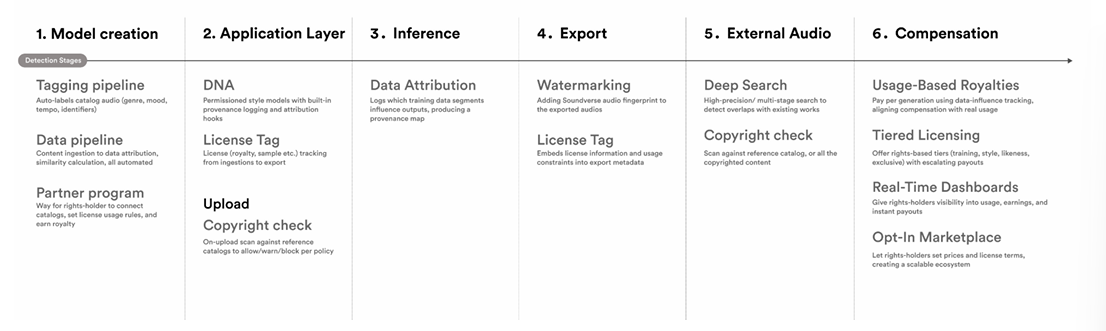
Soundverse’s Ethical AI Music Framework is the foundation for artists and enterprises that prioritize transparency, consent, and fair compensation in AI-driven production. Designed as a six-stage infrastructure, it ensures that creativity and ethics go hand in hand.
Official Description: The Ethical AI Music Framework bridges innovation with artist integrity, replacing opaque black-box models with a transparent workflow that guarantees licensed sourcing, traceable outputs, and recurring royalties.
Core Capabilities:
- Stage 1: Licensed Data Sourcing (No Scraping) – All training data originates from officially licensed catalogs. No unverified scraping or pirated content.
- Stage 2: Permissioned Models (DNA) – Integrates with the Soundverse DNA system, ensuring each AI model is trained only on authorized artist data.
- Stage 3: Explainable Inference (Attribution) – Every AI output includes embedded lineage data for full attribution.
- Stage 4: Traceable Export (Watermarking) – Final outputs carry invisible watermarking for traceability across platforms.
- Stage 5: Deep Search (External Scanning) – Continuous external monitoring detects unauthorized reuse or duplication.
- Stage 6: Recurring Compensation (Partner Program) – Through the Content Partner Program, artists receive usage-based royalties whenever their data fingerprints appear in generated tracks.
Primary Use Cases:
- Maintaining legal compliance for enterprise clients.
- Safeguarding artist rights during training.
- Building ethical AI monetization ecosystems.
- Enabling transparent auditing of AI outputs.
This framework integrates seamlessly with related tools such as Soundverse Trace, the platform’s attribution and rights protection layer. For creators exploring genre-specific generation, the platform also offers workflows highlighted in tutorials like How to Create EDM with Soundverse AI and How to Create Jazz Music with Soundverse AI.
Why is ethical AI music foundational to the industry’s survival?
Consider the cases of infringement controversies that dominated early AI music adoption. Many artists protested datasets trained on their voices or compositions without consent. These incidents accelerated the call for ethical AI governance. By establishing frameworks like Soundverse’s, the industry rebalanced innovation with rights protection.
Beyond legality, ethical AI ensures trust. Institutions, brands, and filmmakers are now reluctant to use AI-generated works without verifiable origin. Ethical AI provides that assurance—certifying that what you hear or use was ethically sourced and that rightful contributors are compensated.
What will the future of music technology look like?
The future of music technology is defined by transparency, interoperability, and creator empowerment. Expect the following trends by late 2026:
- Artist-Branded AI Models: Major labels and independent musicians will release personalized AI models trained exclusively on their catalogs for licensable use cases.
- Smart Licensing: Embedded rights metadata will automate royalty payouts across platforms.
- Cross-disciplinary Integration: AI music tools will merge with immersive media, gaming, and AR-driven sound design.
- Creative Assistants: Co-creative AI systems will evolve into personalized creative partners that recommend structure, genre blending, and emotional tone.
For practical insight into such tools, explore how AI-generated music is transforming the music industry, showcasing how artists maintain authenticity in an increasingly automated landscape.
How can artists balance automation with authenticity?
Human emotion and storytelling remain irreplaceable. AI-driven composition should amplify creativity, not dilute it. Artists using frameworks like Soundverse’s can maintain creative ownership by defining boundaries: specifying which parts of their musical identity are shareable and ensuring that AI outputs credit their influence transparently.
Hybrid creativity—the collaboration between human imagination and algorithmic assistance—is the hallmark of sustainable art. In this sense, AI becomes a canvas extension, not a competitor.
Create Smarter, Sustainable Music with Soundverse AI
Transform your creative process using AI music tools that enhance composition, simplify production, and keep your artistry authentic. Start generating royalty-free tracks that resonate globally.
Start Creating Now →
Related Articles
- How AI-Generated Music Is Transforming the Music Industry: Discover how artificial intelligence is revolutionizing music creation, distribution, and creativity across genres.
- AI Music Generator and Human Composers: A Future Together: Explore the synergy between AI composition and human creativity that’s shaping a more sustainable musical future.
- The Role of AI Music in Film and Television: Learn how AI-generated soundtracks are redefining the world of visual storytelling while supporting ethical creative practices.
- How an AI Music Generator Inspires Creative Fusion: See how AI music tools empower creators to experiment with genre, emotion, and collaboration in new, sustainable ways.
Here's how to make AI Music with Soundverse
Video Guide

Here’s another long walkthrough of how to use Soundverse AI.
Text Guide
- To know more about AI Magic Tools, check here.
- To know more about Soundverse Assistant, check here.
- To know more about Arrangement Studio, check here.
Soundverse is an AI Assistant that allows content creators and music makers to create original content in a flash using Generative AI.
With the help of Soundverse Assistant and AI Magic Tools, our users get an unfair advantage over other creators to create audio and music content quickly, easily and cheaply.
Soundverse Assistant is your ultimate music companion. You simply speak to the assistant to get your stuff done. The more you speak to it, the more it starts understanding you and your goals.
AI Magic Tools help convert your creative dreams into tangible music and audio. Use AI Magic Tools such as text to music, stem separation, or lyrics generation to realise your content dreams faster.
Soundverse is here to take music production to the next level. We're not just a digital audio workstation (DAW) competing with Ableton or Logic, we're building a completely new paradigm of easy and conversational content creation.
TikTok: https://www.tiktok.com/@soundverse.ai
Twitter: https://twitter.com/soundverse_ai
Instagram: https://www.instagram.com/soundverse.ai
LinkedIn: https://www.linkedin.com/company/soundverseai
Youtube: https://www.youtube.com/@SoundverseAI
Facebook: https://www.facebook.com/profile.php?id=100095674445607
Join Soundverse for Free and make Viral AI Music

We are constantly building more product experiences. Keep checking our Blog to stay updated about them!