AI Music Compliance: Navigating Platform Policies and Ethical Creation in 2026
Explore AI music compliance, ethics, and platform policies with Soundverse’s Ethical AI Music Framework.
AI Music and Platform Compliance
In 2026, the discussion around AI music compliance has shifted from abstract ethics to enforceable standards. As AI-generated compositions, vocals, and remixing tools become dominant in mainstream production pipelines, platforms and developers face unprecedented responsibility to align innovation with legal and moral frameworks. The global push for transparent training data, verifiable authorship, and equitable compensation has led to the development of sophisticated infrastructures such as Soundverse’s Ethical AI Music Framework.
What is AI Music Compliance and Why Does It Matter in 2026?
AI music compliance refers to the process of ensuring that all stages of AI music creation—from data sourcing to commercial release—respect copyright laws, artist consent, and platform-specific content regulations. With rapid expansion of generative tools across streaming and licensing markets, compliance in 2026 is no longer optional; it's a gateway to credibility and longevity.
For music labels and AI developers, compliance policies now directly influence distribution rights and platform listings. Non-compliant assets risk removal from major streaming platforms or litigation under revised intellectual property acts introduced between 2024 and 2025. Critical areas include dataset transparency, rights attribution, and model explainability.

How Have Music Platform Policies Evolved for AI-Generated Content?
Between 2024 and 2025, platforms such as Spotify, Apple Music, and YouTube introduced specific directives for AI-generated tracks. These include mandatory disclosure of AI involvement, audit-ready attribution data, and restrictions against synthetic replication of recognizable artist voices without permission.
By 2026, music platform policies emphasize four key compliance checkpoints:
- Source Verification – Confirmation that training data was legally licensed.
- AI Attribution Metadata – Transparent disclosure of generation tool and author data.
- Consent Enforcement – Assurance that likeness-based outputs respect rights-holder permissions.
- Ongoing Royalty Structures – Required agreements for recurring compensation to dataset contributors.
Platforms now implement automated scanning layers to identify AI-generated tracks using proprietary watermarking schemes. This shift supports fair creative ecosystems while safeguarding cultural ownership. For example, Saving Country Music’s new policy on AI Music for 2026 marks an era of stricter platform enforcement across genres.

What Are the Global Regulations on AI-Generated Music in 2026?
Internationally, regulatory entities—including the EU’s Artificial Intelligence Act and the U.S. Copyright Modernization Bill—have concretized principles of AI-generated music regulation. As mentioned in Music and AI: 2025's developments that will shape 2026's disputes, these frameworks align under three universal pillars:
- Transparency – AI models must declare training methodology and data origins.
- Attribution – Generated content should trace authorship and influence lineage.
- Compensation – Rights-holders deserve quantifiable royalties for AI-utilized material.
Asian markets, particularly Japan and South Korea, now require annotation-ready metadata embedded within exported AI tracks to support attribution auditing. This ensures AI music remains culturally accountable. The TRAIN Act and similar initiatives in 2026 further reinforce protection for creators against unauthorized AI training as facilitated by organizations such as BMI’s AI initiative.
How Does Copyright Compliance Integrate with AI Music Production?
Effective copyright compliance in music means upholding laws governing reproduction and derivative works. In generative systems, it extends beyond traditional licensing—developers must prevent unlicensed mimicry of melodies and timbres derived from protected catalogues.
Soundverse’s approach, detailed below, has become the benchmark for maintaining traceability and ethical generation across corporate and creative platforms. Similar conversations appear in advanced industry guides like how AI-generated music is transforming the music industry and navigating royalty-free and copyright-free music. To explore practical compliance implementation, watch our Soundverse Tutorial Series - How to Make Music, or see Soundverse Tutorial Series - Explore Tab for an in-depth platform walkthrough.
What Ethical Challenges Arise from AI Music Creation?
The rise of neural networks trained on vast musical archives has sparked debates around digital music ethics. Ethical challenges include the potential exploitation of artist data, loss of creative attribution, and the erasure of cultural nuance through algorithmic normalization. Watch our guide on creating Deep House music to see ethical audio generation practices in action.
In 2026, ethical frameworks prioritize three safeguards:
- Consent-first Datasets: Every piece of training audio must be traceable to a verified license source.
- Explainable Outputs: Generated results must clarify artistic influences through metadata mapping.
- Revenue Transparency: AI stakeholders must declare how royalties are distributed across production and distribution nodes.
These principles echo the ethics statements promoted in music-AI policy think tanks and integrated compliance modules across professional generation software discussed in soundverse assistant your AI music co-producer.
How to Make AI Music Compliant with Soundverse The Ethical AI Music Framework
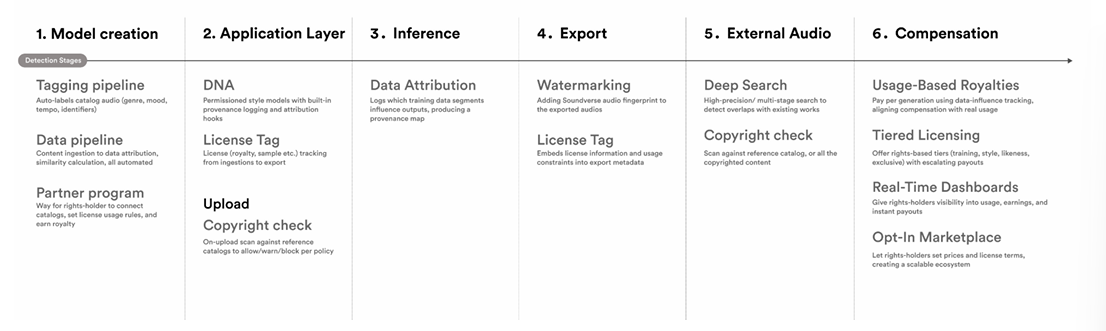
Soundverse’s Ethical AI Music Framework offers a comprehensive solution bridging innovation and artist integrity. It replaces opaque black-box models with a transparent six-stage pipeline ensuring consent, attribution, and recurring compensation.
Stage 1: Licensed Data Sourcing
All data used within Soundverse systems is obtained through proper licensing rather than web scraping. This guarantees pre-approved datasets aligned with rights-holder agreements.
Stage 2: Permissioned Models (DNA)
Models contain permission-linked “DNA” referencing contributor identities and allowed usage scopes. This safeguards individual creative rights throughout AI synthesis.
Stage 3: Explainable Inference (Attribution)
Every output includes embedded attribution, meaning users and auditors can verify the sources or influences behind generated pieces.
Stage 4: Traceable Export (Watermarking)
Watermarking at export ensures AI tracks carry permanent traceable signals, facilitating automated platform verification and royalty tracking.
Stage 5: Deep Search (External Scanning)
The system can scan external repositories and streaming catalogs to identify and confirm legitimate dataset or derivative usage.
Stage 6: Recurring Compensation (Partner Program)
Through the Content Partner Program, rights-holders receive ongoing usage-based royalties whenever their data informs generative outputs.
Complementary tools such as Soundverse Trace, the Soundverse API, and the opt-in Content Partner Program extend this framework across enterprise deployments. Developers integrating Soundverse’s ecosystem benefit from automatic compliance checks without compromising creative flexibility.
To explore platform integrations, readers can refer to related guidance such as generate AI music with Soundverse text-to-music and Soundverse introduces stem separation AI magic tool.
Why Compliance and Creativity Can Coexist
A common myth in the music industry suggests that compliance restricts creativity. However, ethical frameworks like Soundverse’s demonstrate that the opposite is true. Transparent data governance and attribution enable more diverse collaborations and cross-genre explorations while maintaining respect for original artists.
Enterprise clients leveraging AI generation through permissioned APIs now manage thousands of outputs with full audit trails—proving that innovation and accountability can evolve in tandem.
Create Compliant AI Music with Soundverse
Empower your creativity while ensuring your AI-generated music meets ethical and licensing standards. Discover how Soundverse helps you produce original, compliant tracks effortlessly.
- Navigating the World of Royalty-Free and Copyright-Free Music Using Soundverse AI: Understand how to create and use AI-generated tracks that respect licensing laws and copyright boundaries.
- Copyright-Free vs. Royalty-Free Music: What Creators Should Know: Learn the key differences between copyright-free and royalty-free music, and how they impact your content strategy.
- Enhancing YouTube Content with Royalty-Free and Copyright-Free Music Using Soundverse AI: Find out how YouTube creators can stay compliant while adding the perfect soundtrack to their videos using AI tools.
- How AI-Generated Music is Transforming the Music Industry: Explore how AI is reshaping music production, licensing practices, and compliance standards across the industry.
Here's how to make AI Music with Soundverse
Video Guide

Here’s another long walkthrough of how to use Soundverse AI.
Text Guide
- To know more about AI Magic Tools, check here.
- To know more about Soundverse Assistant, check here.
- To know more about Arrangement Studio, check here.
Soundverse is an AI Assistant that allows content creators and music makers to create original content in a flash using Generative AI. With the help of Soundverse Assistant and AI Magic Tools, our users get an unfair advantage over other creators to create audio and music content quickly, easily and cheaply. Soundverse Assistant is your ultimate music companion. You simply speak to the assistant to get your stuff done. The more you speak to it, the more it starts understanding you and your goals. AI Magic Tools help convert your creative dreams into tangible music and audio. Use AI Magic Tools such as text to music, stem separation, or lyrics generation to realise your content dreams faster. Soundverse is here to take music production to the next level. We're not just a digital audio workstation (DAW) competing with Ableton or Logic, we're building a completely new paradigm of easy and conversational content creation.
TikTok: https://www.tiktok.com/@soundverse.ai
Twitter: https://twitter.com/soundverse_ai
Instagram: https://www.instagram.com/soundverse.ai
LinkedIn: https://www.linkedin.com/company/soundverseai
Youtube: https://www.youtube.com/@SoundverseAI
Facebook: https://www.facebook.com/profile.php?id=100095674445607
Join Soundverse for Free and make Viral AI Music

We are constantly building more product experiences. Keep checking our Blog to stay updated about them!