AI Music and Human-Centered AI Design: Building Ethical Creativity in 2026
Explore how AI music and human-centered AI design shape ethical, transparent music technology in 2026.
AI Music and Human-Centered AI Design
Artificial intelligence has permanently altered the creative landscape, but 2026 marks a turning point where the focus is no longer only on technological sophistication—it’s about ethics, ownership, and the human experience behind AI music. As tools for generating and producing music with algorithms proliferate, the concept of human-centered AI design has become central to ensuring that innovation remains transparent, fair, and inclusive. This article explores how designers, researchers, and creators are aligning ethical UX, responsible design, and music technology to empower creativity while protecting artistic integrity.
What is human-centered AI design and why does it matter for AI music?
Human-centered AI design places people at the core of technological innovation. In AI music, this means developing systems that respect the intent, contribution, and emotional connection of both artists and listeners. Rather than replacing musicians, human-centered AI augments their capabilities—offering new tools for sound discovery, composition, and collaboration.
A key principle behind this approach is transparency. Musicians, producers, and rights holders deserve clarity around how their data is used. Ethical UX principles also ensure that anyone interacting with an AI music system understands the origins of generated content, how attribution works, and how compensation flows back to creators.
In 2026, this design philosophy is critical. The global surge in AI-generated tracks has forced the creative industry to confront complex ethical questions: How can AI creativity coexist with copyright law? What does consent look like in the data economy? And how can machine learning models be built to preserve cultural diversity rather than homogenize it?
How does ethical UX connect to AI creativity?
Ethical UX—user experience based on transparency, accountability, and inclusivity—ensures that AI tools remain fair and representative. For AI music platforms, that could mean:
- Transparency in data usage: Users must know where training data comes from.
- Attribution clarity: A clear system showing which artists influenced generated outputs.
- Control and consent: Musicians should have the choice to opt-in rather than be passively included.
- Reciprocal reward systems: Users who contribute to a model should benefit from its success.

In practice, ethical UX doesn’t hinder creativity—it empowers it. When designers build interfaces that explain how algorithms operate, users feel confident experimenting. Artists can use AI tools without sacrificing ownership, and the public gains trust in new music technology ecosystems. For instance, human-centered AI models ensure that technological systems prioritize human well-being over automation, as covered in frameworks like A Proposed Framework for Human-Centered AI Design Principles.
Why AI music demands a shift toward responsible design
Unlike other AI applications, music generation deals directly with emotional expression—something deeply tied to human identity. Without careful consideration, automation can inadvertently commodify creativity. Responsible design provides the structure to prevent that. It demands reflection on who benefits from innovation, how power is distributed, and how cultural heritage is treated in the age of digital intelligence.
In 2026, responsible design is guiding how AI music products are developed and deployed. The aim is no longer speed or volume in content creation, but sustainability and fairness. Researchers now integrate explainable AI tools to attribute creative influence, and startups adopt traceable watermarking systems that connect outputs back to their origins. As covered in Soundverse’s analysis on AI music industry trends, this transparency-driven shift defines the new standard for creative innovation.
What challenges remain in building ethical AI music systems?
While progress is significant, there are still barriers:
- Data bias and representation – Models may overrepresent mainstream genres, marginalizing smaller cultural identities.
- Attribution complexity – Music blending multiple influences complicates transparent credit distribution.
- Scalability of rights management – Tracking millions of AI outputs in an automated, verifiable manner requires robust infrastructure.
- User understanding – Even ethically built models need UX clarity to help users grasp consent forms, metadata flows, and reward systems.
Addressing these challenges is essential for aligning AI creativity with human-centered AI principles.
How to make AI music with Soundverse The Ethical AI Music Framework
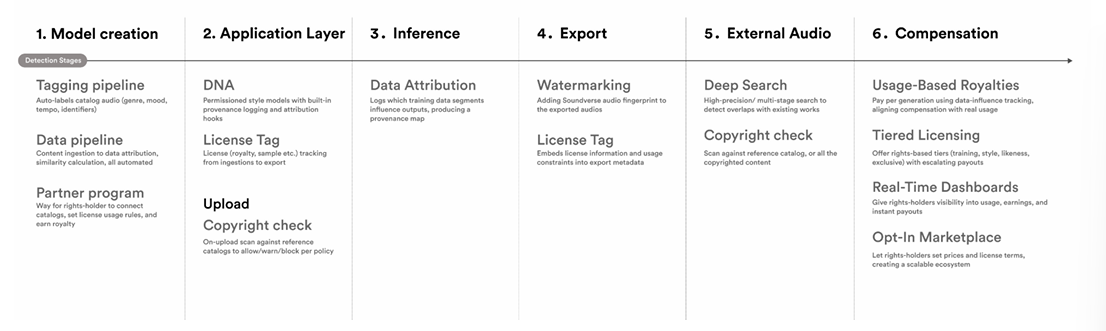
Soundverse’s Ethical AI Music Framework directly embodies these priorities by bridging innovation and artist integrity. Rather than operating as a black-box generator, it delivers a transparent, end-to-end infrastructure designed for creators, labels, and developers who want to build responsibly.
The foundation: six transparent stages
The framework establishes a structured process to ensure trust throughout the AI music lifecycle:
- Licensed Data Sourcing (No scraping) – All music data used for model training is licensed, ensuring full consent and zero unapproved scraping.
- Permissioned Models (DNA) – Models operate with artist-approved datasets, powered by Soundverse DNA, giving artists control over how their sonic identity is used.
- Explainable Inference (Attribution) – The system provides understandable attribution, showing which influences shape generated outputs.
- Traceable Export (Watermarking) – Every piece of generated music carries a watermark linking back to its source for rights protection and audit transparency.
- Deep Search (External Scanning) – This stage checks generated outputs across the web to prevent data misuse and plagiarism.
- Recurring Compensation (Partner Program) – Integrated with Soundverse’s Content Partner Program, the framework automatically provides recurring, usage-based payments to contributors.
By applying these stages, Soundverse manages to balance innovation with accountability—creating a model for truly ethical AI creativity.
Supporting tools and partnerships
- Soundverse Trace introduces an advanced trust layer, constantly verifying attribution across datasets and external platforms.
- The Content Partner Program allows artists and labels to opt-in for royalties when their work trains AI systems.
- Soundverse DNA specializes in generating music within specific artistic styles, ensuring originality and copyright safety.
For a hands-on perspective, watch our Soundverse Tutorial Series - How to Make Music or explore step-by-step guides like Soundverse Tutorial Series - Explore Tab. For genre-specific creation, check out the Deep House tutorial.
These components collectively make the Ethical AI Music Framework more than just a technology—it’s a design philosophy in action. It’s how human-centered AI becomes operational within creative platforms.
To see how these systems integrate in real scenarios, you can explore how creators generate full tracks in Soundverse’s text-to-music generator or discover how genre-based creation works in guides like How to Create Country Music with Soundverse AI and How to Create EDM with Soundverse AI.
What does the future of AI music ethics look like in 2026 and beyond?
If 2024 and 2025 were about experimentation, 2026 is about refinement and reinforcement. Policymakers, creative collectives, and AI music developers are converging around frameworks like Soundverse’s to form ethical standards that can scale globally.
Looking ahead, we expect:
- Increased interoperability between AI music ecosystems through open licensing standards.
- Growth in artist cooperatives defining AI training rules.
- Integration with education, helping young producers learn ethical music generation early in their careers.
- Richer user experiences built on ethical UX patterns that merge transparency with aesthetic pleasure.
This future shows that human-centered design doesn’t just enhance functionality—it elevates culture. Music remains a fundamentally human pursuit, and AI’s best contribution is to extend, not replace, that humanity.
Start Creating Human-Centered AI Music Today
Unleash your creativity with Soundverse's powerful AI music tools that adapt to your artistic vision. Craft soundscapes that feel human, emotional, and entirely your own.
Create Your First Track
Related Articles
- AI Music Generator and Human Composers: A Future Together — Discover how human creativity and AI music technology can inspire a harmonious new era of composition.
- How an AI Music Generator Inspires Creative Fusion — Explore how AI tools are transforming artistic workflows and empowering creators to push musical boundaries.
- The Role of AI Music in Film and Television — Learn how AI-generated compositions are evolving the way soundtracks are created across film and TV industries.
- How AI-Generated Music Is Transforming the Music Industry — See how the rise of AI music tools is reshaping production, distribution, and artist collaboration worldwide.
Here's how to make AI Music with Soundverse
Video Guide

Here’s another long walkthrough of how to use Soundverse AI.
Text Guide
- To know more about AI Magic Tools, check here.
- To know more about Soundverse Assistant, check here.
- To know more about Arrangement Studio, check here.
Soundverse is an AI Assistant that allows content creators and music makers to create original content in a flash using Generative AI.
With the help of Soundverse Assistant and AI Magic Tools, our users get an unfair advantage over other creators to create audio and music content quickly, easily and cheaply.
Soundverse Assistant is your ultimate music companion. You simply speak to the assistant to get your stuff done. The more you speak to it, the more it starts understanding you and your goals.
AI Magic Tools help convert your creative dreams into tangible music and audio. Use AI Magic Tools such as text to music, stem separation, or lyrics generation to realise your content dreams faster.
Soundverse is here to take music production to the next level. We're not just a digital audio workstation (DAW) competing with Ableton or Logic, we're building a completely new paradigm of easy and conversational content creation.
TikTok: https://www.tiktok.com/@soundverse.ai
Twitter: https://twitter.com/soundverse_ai
Instagram: https://www.instagram.com/soundverse.ai
LinkedIn: https://www.linkedin.com/company/soundverseai
Youtube: https://www.youtube.com/@SoundverseAI
Facebook: https://www.facebook.com/profile.php?id=100095674445607
Join Soundverse for Free and make Viral AI Music

We are constantly building more product experiences. Keep checking our Blog to stay updated about them!