AI Music and Fair Use: What Creators Should Know in 2026
Learn how AI music and fair use intersect in 2026 and what creators must know.
AI Music and Fair Use: What Creators Should Know
Artificial intelligence continues to transform how music is made, shared, and monetized. As we move through 2026, AI-generated music has matured beyond experimental stages, finding its way into streaming platforms, film scoring, advertising, and social media content. Yet, this innovation brings complex legal and ethical challenges—especially around copyright, intellectual property (IP) laws, and fair use. For creators, understanding how AI music and fair use intersect is now as important as knowing how to produce a hit track.
What is fair use and why does it matter for AI-generated music?
Fair use is a legal doctrine that allows limited use of copyrighted material without permission from the copyright holder. It enables activities such as commentary, parody, criticism, and educational use. In music, fair use has traditionally covered short sampling for reviews or transformative art that adds new meaning to existing works.
However, with AI-generated music, the boundaries of fair use have turned blurry. When AI systems are trained on vast libraries of existing copyrighted works, are they infringing rights or just learning patterns? That question continues to evolve legally and ethically in 2026.
The rise of AI models capable of generating realistic songs, compositions, and performances—often influenced by millions of data points—has made copyright owners more protective of their catalogues. Many lawsuits between 2024 and 2025 laid the groundwork for how AI companies handle licensing. Today, any creator using AI tools must responsibly understand the scope of copyright exceptions and how AI training datasets are compiled.
How does copyright apply to AI music in 2026?
Under most intellectual property laws, copyright applies to works created by humans. Many jurisdictions, including the U.S. and the EU, currently do not recognize non-human authorship. This means purely AI-generated tracks might not enjoy traditional copyright protection.
That creates a conundrum for creators: if a track made entirely by an algorithm has no human origin, who owns it? The answer often depends on how much human input was involved. For instance:
- Prompt-based generation: If a musician guides the AI with specific creative instructions, they might claim authorship through their contribution.
- Hybrid compositions: A human-produced melody combined with AI-generated instrumentation might be protected collectively.
- Fully autonomous generation: If the AI creates music without human oversight, it may fall outside standard copyright protections.
To explore these boundaries further, check out our breakdown of AI music transforming the industry and how lawmakers are responding.
What do copyright exceptions mean for AI developers and musicians?
Copyright exceptions are safe zones that allow the use of copyrighted material for purposes such as research, criticism, or education. For AI music systems, developers often claim that training models under these frameworks qualifies as fair use or fair dealing.
Yet, new fair use definitions in 2026 regulations are closing loopholes. Many AI developers now must license the datasets they use to train models. This move protects artists from having their songs scraped or copied without consent. For musicians, content creators, and producers, this provides reassurance that their work won’t be unfairly utilized.
As a musician, you should verify whether your AI tool uses licensed data sourcing. Transparency in dataset origin ensures your outputs won’t later face takedowns or legal disputes. Learn more about transparency standards in our article on AI music creation and compliance tools.
For creators interested in seeing practical AI composition processes, watch our guide on creating music and explore Soundverse’s workflow tutorials.
How does fair use differ from music licensing?
While fair use covers limited or transformative reuse, music licensing grants explicit permission for broader use. Licensing can cover everything from sampling classic songs to distributing AI-generated works that were trained on copyrighted content.
In practice, licensing provides safety. Rather than gambling on whether a court will see your use as fair, obtaining proper rights through licensing ensures long-term monetization and peace of mind. For instance, if your AI-generated track incorporates an identifiable melody from a copyrighted song, licensing agreements can clarify your legal standing.
Licensing is fundamental to sustainable creative rights. It converts risk into opportunity—especially as more creators depend on AI for their workflows.
Why is transparency key in the AI music ecosystem?
Transparency enables trust. It allows creators to trace how their work is used and ensures consumers know whether a song is human-made, AI-generated, or collaborative. As AI music becomes prevalent in 2026 streaming catalogs, metadata transparency helps maintain ethical standards.
The lack of transparency has been one of the chief criticisms of early AI systems. Many scraped music from the web without consent, leaving artists uncompensated. In contrast, modern ethical frameworks prioritize explainability, traceability, and recurring royalties.
This is where Soundverse plays a central role.
How to make ethical and compliant AI music with Soundverse The Ethical AI Music Framework
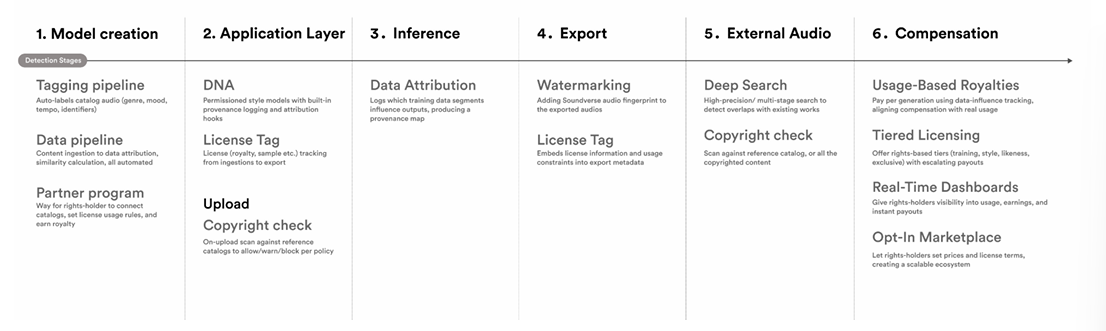
Soundverse’s Ethical AI Music Framework bridges the gap between technological innovation and artist integrity. It replaces opaque, black-box AI models with a transparent six-stage pipeline that prioritizes consent, attribution, and recurring compensation.
Here’s how the framework ensures ethical alignment and legal compliance:
- Stage 1: Licensed Data Sourcing – Soundverse never scrapes content. Instead, it sources music from rights-holders who consent to include their data, establishing a legal foundation from the start.
- Stage 2: Permissioned Models (DNA) – Each model is trained only on approved and attributed materials, preventing unauthorized usage of copyrighted tracks.
- Stage 3: Explainable Inference (Attribution) – Generated outputs are traceable, showing which influences contributed to a particular result.
- Stage 4: Traceable Export (Watermarking) – Every exported audio carries an invisible watermark for tracking its origin across the web.
- Stage 5: Deep Search (External Scanning) – The system can detect whether any generated content contains external copyrighted segments.
- Stage 6: Recurring Compensation (Partner Program) – Rights-holders who contribute data to Soundverse’s Content Partner Program receive recurring royalties tied to AI usage metrics.
The framework addresses major pain points for creators: transparency in training data, rightful attribution, and a steady revenue stream from their contributions. Its structure makes it easier for labels, producers, and independent artists to adopt AI ethically.
If you’re looking for even broader rights tracking, Soundverse offers Soundverse Trace, a trust layer that embeds attribution and protection throughout the audio lifecycle. Together with the Content Partner Program, it represents a sustainable model for AI-driven music creation in 2026.
Curious about additional AI tools or workflows? You can explore how to generate text-to-music compositions or how Soundverse compares among top AI music generators. For genre-specific tutorials, watch our Deep House music creation walkthrough.
How can creators protect their creative rights in the AI music era?
Protecting creative rights for artists involves three pillars:
- Due diligence: Use AI tools that disclose their data sources and adhere to copyright principles.
- Metadata management: Include creator information, model IDs, and licensing terms with every published track.
- Collaboration agreements: When collaborating with AI systems or producers, outline ownership expectations from the start.
AI has democratized music creation, allowing beginners to generate professional-grade tracks. However, that accessibility doesn’t negate the need for ethical awareness. With transparent frameworks, musicians can embrace AI while preserving artistic integrity.
The future of AI music and fair use beyond 2026
Looking ahead, AI music regulation will likely evolve alongside global copyright reforms. More organizations are advocating for opt-in datasets, watermarking policies, and artist transparency metrics. Instead of seeing AI as a legal threat, creators who educate themselves on fair use, licensing, and attribution will position themselves at the forefront of this digital revolution.
Platforms like Soundverse are paving the way for a balanced future—one where technology empowers creativity without compromising artistic rights. As more labels and producers join programs like the Soundverse Content Partner Program, 2026 might be remembered as the year AI and copyright found common ground.
For more on ethical production practices and AI-driven creativity, explore articles like enhancing YouTube content with royalty-free music or how AI music changes industry trends.
Start Creating Legally Safe AI Music Today
Generate music with Soundverse knowing your creations are copyright-compliant and royalty-free. Explore limitless possibilities while staying on the right side of fair use.
Related Articles
- Copyright-Free vs. Royalty-Free Music: What Creators Should Know: Learn the core differences between copyright-free and royalty-free music and how they affect your creative rights online.
- Navigating the World of Royalty-Free and Copyright-Free Music Using Soundverse AI: Discover how Soundverse helps creators legally source and generate music that is both original and safe for content use.
- Enhancing YouTube Content with Royalty-Free and Copyright-Free Music Using Soundverse AI: Find out how to elevate your YouTube videos by using AI-generated music that avoids copyright issues and boosts engagement.
- How AI-Generated Music Is Transforming the Music Industry: Explore how AI tools are reshaping the creative landscape and redefining ownership and fair use in modern music production.
Here's how to make AI Music with Soundverse
Video Guide

Here’s another long walkthrough of how to use Soundverse AI.
Text Guide
- To know more about AI Magic Tools, check here.
- To know more about Soundverse Assistant, check here.
- To know more about Arrangement Studio, check here.
Soundverse is an AI Assistant that allows content creators and music makers to create original content in a flash using Generative AI. With the help of Soundverse Assistant and AI Magic Tools, our users get an unfair advantage over other creators to create audio and music content quickly, easily and cheaply. Soundverse Assistant is your ultimate music companion. You simply speak to the assistant to get your stuff done. The more you speak to it, the more it starts understanding you and your goals. AI Magic Tools help convert your creative dreams into tangible music and audio. Use AI Magic Tools such as text to music, stem separation, or lyrics generation to realise your content dreams faster. Soundverse is here to take music production to the next level. We're not just a digital audio workstation (DAW) competing with Ableton or Logic, we're building a completely new paradigm of easy and conversational content creation.
TikTok: https://www.tiktok.com/@soundverse.ai Twitter: https://twitter.com/soundverse_ai Instagram: https://www.instagram.com/soundverse.ai LinkedIn: https://www.linkedin.com/company/soundverseai Youtube: https://www.youtube.com/@SoundverseAI Facebook: https://www.facebook.com/profile.php?id=100095674445607
Join Soundverse for Free and make Viral AI Music

We are constantly building more product experiences. Keep checking our Blog to stay updated about them!