AI Music and Creator Advocacy: Building a Fair Future for Artists in 2026
Explore how AI music shapes creator rights and ethical creation in 2026.
AI Music and Creator Advocacy
The explosion of AI music tools over the past two years has changed the relationship between creators, technology, and ownership forever. As we enter 2026, the conversation has shifted from what AI can generate to what it should generate—and under whose terms. Musicians, producers, and rights advocates across the globe are pushing for transparency, consent, and fair compensation in the AI-driven music ecosystem.
What does AI music mean for creators in 2026?
In 2024 and 2025, AI music generators went mainstream, empowering millions to create songs and soundscapes in seconds. However, this convenience often came at a hidden cost: the unlicensed use of copyrighted material in training data. Artists whose work was unknowingly included in these datasets began demanding recognition and compensation. By 2026, discussions around ethical AI creation have evolved into policy-level debates around creator rights and music copyright enforcement.
AI in the music industry is no longer a novelty—it’s an operational reality. From mainstream record labels to indie artists uploading to streaming platforms, nearly all participants in the modern music economy engage with AI-generated or AI-assisted content. The key issue now is ensuring that innovation remains aligned with artistic integrity.

Why are creator rights at the center of the AI music revolution?
Creator rights form the legal and moral foundation of music production. When AI models are trained on unlicensed content, they risk replicating or mimicking artists’ creative DNA without acknowledgment. This not only raises ethical concerns but also legal challenges as copyright law struggles to catch up with machine learning technology. Recent findings, as reported by AI Highlights the Copyright Crisis - Hentons, suggest potential financial impacts worth over €10 billion if licensing is ignored.
In response, advocacy groups and digital rights organizations have worked to build transparency frameworks. These efforts stress that any music AI model used in production or commercial environments must respect consent, compensation, and attribution. The music industry trends of 2026 reflect this shift, emphasizing collaboration between developers and creators rather than competition.

How is the music copyright landscape evolving around AI?
The evolution of music copyright in 2026 revolves around three main principles: traceability, permission, and monetization. AI-generated works must be traceable to ensure that no copyrighted input remains hidden in the final product. Platforms are integrating watermarking and metadata tagging systems to identify the origin of every sound fragment. New rulings, discussed in Top Noteworthy Copyright Stories from January 2026, show growing legal clarity in such areas.
Meanwhile, permission-based systems are becoming the new standard for training AI engines. Instead of scraping public audio from streaming platforms, responsible entities curate licensed, consent-based datasets. Finally, the monetization component ensures that artists continue to receive recurring royalties whenever an AI uses their data for derivative generation.
This combination of traceability, permission, and monetization provides a roadmap toward more ethical AI music creation. For creators and producers trying to understand their rights in this new ecosystem, exploring structured frameworks becomes essential.
What challenges exist in ethical AI music production?
Even in 2026, several challenges persist:
- Data provenance – Verifying whether training data is truly licensed remains a complex problem, especially when datasets span millions of samples.
- Attribution accuracy – While AI can detect stylistic patterns, ensuring correct attribution to original artists involves consistent metadata standards.
- Royalty distribution – The infrastructure for automated micropayments and long-term compensation is still developing in many jurisdictions.
- Public perception – Some audiences remain skeptical of AI-assisted music, considering it less authentic despite ethical safeguards.
The balance between technology and trust defines whether AI music will empower or exploit creators. Many solutions now aim to make this balance measurable and enforceable.
How to make AI music ethically with Soundverse The Ethical AI Music Framework
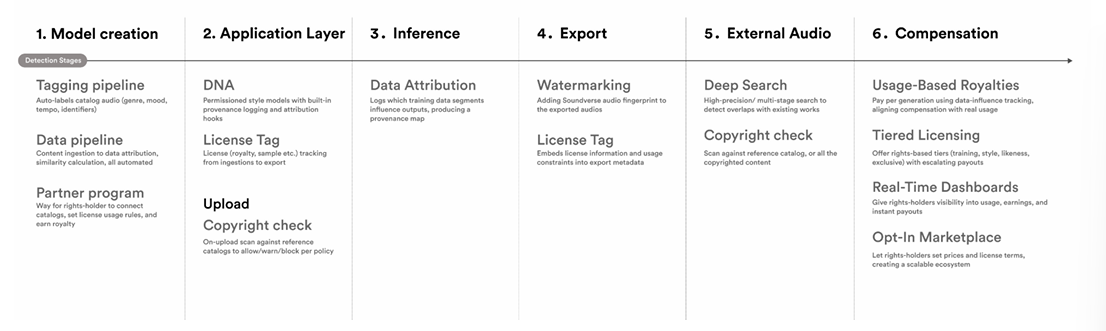
The shift toward ethical innovation is best represented by Soundverse’s Ethical AI Music Framework—a transparent six-stage infrastructure that ensures every track generated through AI maintains artistic integrity and compliance.
This comprehensive model replaces black-box systems with verifiable ethics, anchored around consent and traceability. It’s designed for enterprise clients, individual creators, and labels seeking a fair and legally sound creative environment.
The Six Stages of the Ethical AI Music Framework
- Licensed Data Sourcing – Soundverse only uses fully licensed and consent-based datasets. No scraping or unauthorized inclusion occurs at any stage.
- Permissioned Models (DNA) – Through the Soundverse DNA system, artists participate by licensing their style, instrumentals, or vocals for training. The result is a network of permissioned models that replicate stylistic DNA legally and respectfully.
- Explainable Inference (Attribution) – Every output includes transparent metadata revealing which artist models contributed to the composition style, ensuring full attribution.
- Traceable Export (Watermarking) – Every song generated carries an embedded, non-invasive watermark traceable through Soundverse Trace, reinforcing accountability.
- Deep Search (External Scanning) – Tracks can be verified against external databases to detect similarities or overlaps with existing works, ensuring originality before publishing.
- Recurring Compensation (Partner Program) – Artists earn royalties continuously through the Content Partner Program, where usage data determines recurring payouts.
By embedding explainability into every phase, the Ethical AI Music Framework transforms AI generation from a gray area into a verified chain of consent.
How does Soundverse support ongoing creator advocacy?
Beyond compliance tools, Soundverse actively champions creator rights through initiatives that make advocacy profitable, not just idealistic. Its ecosystem encourages ethical participation rather than passive exploitation.
- Soundverse DNA helps musicians monetize their sonic identity by licensing their creative DNA to producers through consented AI models.
- Soundverse Trace secures attribution from dataset creation to export, proving authorship and establishing legal protection.
- The Content Partner Program transforms the traditional licensing model into a recurring revenue stream. Artists are no longer paid once for sample packs—they receive royalties based on continuous AI usage.
This transforms how revenue flows. For example, when a producer generates AI music using a Soundverse-trained identity, a portion of that royalty returns to the original artist automatically. This encourages a fair loop between innovation and integrity. For a practical demonstration, watch our guide on how to make music with Soundverse.
What can musicians and producers do to advocate for ethical AI creation?
In 2026, artist advocacy has become a community-driven effort. Musicians and producers can lead ethical reform by practicing three actions:
- Verify Tools Before Use – Always choose AI platforms that disclose their training sources and follow legitimate licensing. AI tools without transparent sourcing may endanger your long-term rights.
- Read about reliable platforms like Soundverse’s AI Music Generator.
- Support Open Licensing Movements – Join partner programs that share royalties fairly among stakeholders. Participation in permission-based ecosystems protects the future of creative diversity.
- Explore real-world use cases in AI-generated music industry practices.
- Educate Fellow Artists – Disseminate awareness of ethical creation principles through mentorship and forums. Advocacy at the grassroots level leads to stronger legislation.
- Learn about ethical incentives through the Soundverse Affiliate Program.
How is the future of AI in music industry shaping up?
By late 2026, AI music isn’t just a tool for rapid content creation—it’s a newly regulated and ethically audited ecosystem. With clear legal frameworks forming and transparent models leading the way, the industry is moving closer to sustainable coexistence between humans and machines.
Soundverse’s proactive stance on ethical creation sets the tone for how technology companies should approach art. It bridges innovation and advocacy, proving that business models built on integrity are not only viable but essential.
Empower Your Creative Journey with AI Music
Discover how Soundverse enables musicians and creators to produce original, high-quality tracks using cutting-edge AI music tools. Amplify your creativity—no studio required.
Start Creating Now
Related Articles
- How AI-Generated Music is Transforming the Music Industry: Explore how artificial intelligence is reshaping music production, distribution, and creative collaboration.
- The Role of AI Music in Film and Television: Learn how AI-generated compositions are revolutionizing soundtracks in film, TV, and digital entertainment.
- AI Music Generator and Human Composers: A Future Together: Discover how AI tools and human musicians can collaborate to create the next chapter of musical innovation.
- The Benefits of Composing with AI Music Generator: Find out how AI can enhance your composition process with speed, inspiration, and limitless creativity.
Here's how to make AI Music with Soundverse
Video Guide

Here’s another long walkthrough of how to use Soundverse AI.
Text Guide
- To know more about AI Magic Tools, check here.
- To know more about Soundverse Assistant, check here.
- To know more about Arrangement Studio, check here.
Soundverse is an AI Assistant that allows content creators and music makers to create original content in a flash using Generative AI. With the help of Soundverse Assistant and AI Magic Tools, our users get an unfair advantage over other creators to create audio and music content quickly, easily and cheaply. Soundverse Assistant is your ultimate music companion. You simply speak to the assistant to get your stuff done. The more you speak to it, the more it starts understanding you and your goals. AI Magic Tools help convert your creative dreams into tangible music and audio. Use AI Magic Tools such as text to music, stem separation, or lyrics generation to realise your content dreams faster. Soundverse is here to take music production to the next level. We're not just a digital audio workstation (DAW) competing with Ableton or Logic, we're building a completely new paradigm of easy and conversational content creation.
TikTok: https://www.tiktok.com/@soundverse.ai
Twitter: https://twitter.com/soundverse_ai
Instagram: https://www.instagram.com/soundverse.ai
LinkedIn: https://www.linkedin.com/company/soundverseai
Youtube: https://www.youtube.com/@SoundverseAI
Facebook: https://www.facebook.com/profile.php?id=100095674445607
Join Soundverse for Free and make Viral AI Music

We are constantly building more product experiences. Keep checking our Blog to stay updated about them!