AI Music and Content Saturation: How Technology is Redefining the Creative Economy in 2026
Explore the challenges and opportunities of AI music in 2026 amid content saturation and new attribution tools.
AI Music and Content Saturation
Introduction
As we progress through 2026, the digital soundscape is overflowing with noise — not figuratively, but literally. Artificial intelligence has accelerated music production to unprecedented speeds. What once took artists months in the studio can now be created in moments using AI-driven generators, such as Soundverse. This explosive growth has led to what analysts call audio abundance — a world where supply vastly outpaces demand.
For music producers, digital artists, and AI technologists, this era of hyperproduction raises profound questions: How can creators stand out when anyone can generate a song in seconds? What does originality mean in a landscape of infinite variations? And, most crucially, how can creators and rights-holders maintain control in this flood of AI-generated content?
This article explores the phenomenon of AI music in 2026, examining its creative potential, the pitfalls of content overload, and how new tools such as Soundverse Trace are establishing trust, attribution, and integrity in an otherwise saturated market.
What is driving the explosion of AI music in 2026?
The year 2026 marks the consolidation of artificial intelligence as a mainstream co-producer in music creation. With the maturation of diffusion-based and transformer-driven generative models, AI systems can now interpret mood, genre, texture, and cultural nuance with uncanny accuracy. Platforms inspired by pioneers like OpenAI’s Jukebox, Mubert, and Soundverse have transformed how both independent musicians and major studios approach composition. According to iMusician’s 2026 Industry Report, tens of thousands of fully AI-generated tracks are published daily across streaming platforms.
This democratization of creation has led to an audio renaissance — but also a paradox. While more people than ever can make music, the value of each individual track is declining. In many streaming libraries, thousands of new songs are uploaded every hour, most of which receive minimal or no plays. The abundance of sound has become both a technological triumph and an economic dilemma.

How is AI changing digital music production workflows?
In the past, digital music production required technical fluency: mastering workstations, sound design, and meticulous arrangement. Today, AI automates much of that labor. Producers can generate stems, remix tracks, or even design custom soundscapes with a single text prompt. According to new music technology trends for 2026, creative roles are shifting from technical execution to conceptual direction — the artist’s new job is to guide, not grind. AI & Music Tech in 2026 also reveals that only a small share of the industry expects full automation, with most embracing human oversight as key to artistic quality.
AI also empowers experimentation. Musicians can now iterate dozens of versions of a composition before deciding which to develop further. Collaboration tools allow humans and algorithms to co-compose seamlessly. The downside is that this ease amplifies content saturation, where discovery becomes a bigger challenge than production itself. For creators who want to understand how to make AI-driven genres step-by-step, watch our guide on creating Deep House music and tutorial on music generation basics.
What is content overload in music and why does it matter?
Content overload in music refers to the point where the sheer quantity of available tracks overwhelms both audience attention and recommendation systems. As algorithms scramble to filter and personalize, new creators struggle to find visibility. Reports like AI Music Analysis 2026 point out that even descriptive AI systems analyzing genres and moods are buckling under the sheer data flow.
For AI-generated songs in particular, the line between innovation and imitation blurs rapidly. With AI models trained on massive datasets, even small overlaps can raise questions about originality and ownership. Musicians worry about their catalog being used without credit; listeners question authenticity. Without transparent attribution and rights tracking, the ecosystem risks collapsing into distrust.
How are artists adapting to the age of audio abundance?
Creators are evolving in three key ways:
- Curation as artform: Instead of producing more tracks, artists focus on curating sound identities — cohesive series of pieces that establish aesthetic unity in a saturated landscape.
- Authenticity signaling: Verified provenance and on-chain credits are becoming marketing tools. Fans support creators who can prove genuine authorship or ethical AI sourcing.
- AI collaboration credits: In 2026, many labels now list the AI model or tool used in a song’s creation, normalizing hybrid authorship between human and machine.
The broader industry is recognizing that the future isn’t human versus machine but rather human with machine — an ongoing theme shared in recent features like The Role of AI Music in Film and Television and How an AI Music Generator Inspires Creative Fusion.
What challenges does content saturation pose for rights and royalties?
Content saturation complicates copyright management. When billions of tracks exist, identifying plagiarism or unauthorized usage becomes a technical nightmare. Many AI tools generate pieces that unintentionally borrow melodic fragments from their training sets. Without clear attribution data, creators risk unknowingly infringing upon others’ work. As noted in Remix the Future: AI Predictions Shaping Music in 2026, massive user adoption of generative tools has made such issues widespread.
Moreover, monetization models dependent on streams or shares falter when attention becomes the scarcest resource. As more content competes for fewer listeners, per-track payouts shrink. Transparency about who owns what, and whether AI datasets were ethically sourced, becomes vital for both compliance and trust.
How to make AI music accountable with Soundverse Trace
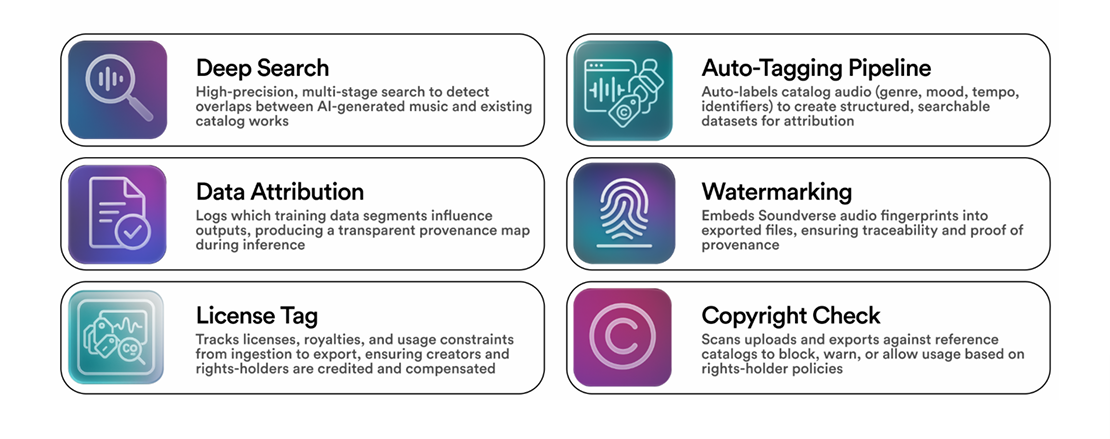
Enter Soundverse Trace — a groundbreaking solution redefining trust and transparency in AI-driven audio creation. Acting as a comprehensive trust layer for AI music, it ensures that every stage of production — from dataset ingestion to final export — carries attribution and verification metadata.
Core Capabilities of Soundverse Trace
- Deep Search: With high-precision 1:1 and 1:N scanning, Soundverse Trace detects overlaps across massive catalogs. This allows producers to identify whether a generated segment resembles existing material before release.
- Data Attribution: This component logs which segments of training data influenced specific outputs, clarifying origin and reducing legal ambiguity. It transforms black-box AI generation into a transparent, auditable process.
- Audio Watermarking: Proprietary, inaudible fingerprints are embedded in every output — a safeguard that persists through remixing, compression, or format conversion. Rights-holders can later prove ownership or originality.
- License Tagging: Rights metadata persists across the entire lifecycle, from ingestion to export, ensuring compliance with licensing terms and enabling automated royalty distribution.
Primary Use Cases
- Preventing unauthorized sampling or plagiarism in AI outputs.
- Tracking how catalog pieces are reused or remixed via generative pipelines.
- Verifying provenance for user-generated or AI-assisted compositions.
- Automating royalty and takedown actions when violations occur.
Soundverse Trace integrates seamlessly with initiatives such as the Content Partner Program, which allows rights-holders to contribute datasets for ethical AI training in exchange for recurring royalties. Together with The Ethical AI Music Framework, these tools position Soundverse as a guardian of transparency — a critical shield against the perils of digital excess. For a practical example, explore our “Explore Tab” tutorial to understand how discovery and traceability merge in the Soundverse ecosystem.
What does a sustainable future for AI music look like?
The next phase of music technology will prioritize traceability, consent, and creative integrity. Platforms deploying attribution engines like Soundverse Trace will lead the shift from opaque generation to responsible innovation. Instead of drowning in endless output, the industry will move toward systems that reward originality, credit collaboration, and allocate fair compensation automatically.
AI will continue to redefine digital composition, but sustainability will hinge on ethical infrastructure. Developers, producers, and regulators are already rallying around frameworks that ensure every generated sound tells a verifiable story.
Start Creating with AI Music Today
Experience the next evolution of sound creation with Soundverse. Generate unique, royalty-free music effortlessly using cutting-edge AI tools designed for creators, podcasters, and musicians.
Try Soundverse Free →
Related Articles
- How AI-Generated Music Is Transforming the Music Industry — Discover how AI music tools are reshaping production workflows and redefining creativity in today's music landscape.
- AI Music Generator and Human Composers: A Future Together — Explore the synergy between human artistry and AI composition and how collaboration drives new forms of musical expression.
- The Role of AI Music in Film and Television — Learn how AI music creation is influencing scores, soundtracks, and storytelling across movies and TV.
- The Benefits of Composing with AI Music Generator — Uncover the advantages of using AI tools for music creation—from speed and personalization to creative freedom.
Here's how to make AI Music with Soundverse
Video Guide

Here’s another long walkthrough of how to use Soundverse AI.
Text Guide
- To know more about AI Magic Tools, check here.
- To know more about Soundverse Assistant, check here.
- To know more about Arrangement Studio, check here.
Soundverse is an AI Assistant that allows content creators and music makers to create original content in a flash using Generative AI. With the help of Soundverse Assistant and AI Magic Tools, our users get an unfair advantage over other creators to create audio and music content quickly, easily and cheaply. Soundverse Assistant is your ultimate music companion. You simply speak to the assistant to get your stuff done. The more you speak to it, the more it starts understanding you and your goals. AI Magic Tools help convert your creative dreams into tangible music and audio. Use AI Magic Tools such as text to music, stem separation, or lyrics generation to realise your content dreams faster. Soundverse is here to take music production to the next level. We're not just a digital audio workstation (DAW) competing with Ableton or Logic, we're building a completely new paradigm of easy and conversational content creation.
TikTok: https://www.tiktok.com/@soundverse.ai
Twitter: https://twitter.com/soundverse_ai
Instagram: https://www.instagram.com/soundverse.ai
LinkedIn: https://www.linkedin.com/company/soundverseai
Youtube: https://www.youtube.com/@SoundverseAI
Facebook: https://www.facebook.com/profile.php?id=100095674445607
Join Soundverse for Free and make Viral AI Music

We are constantly building more product experiences. Keep checking our Blog to stay updated about them!
Image Steps: []