Why Attribution Is Harder Than Licensing, But More Important
Licensing is not ethics. Learn why true ethical AI requires attribution, not just permission, to ensure fairness, accountability, and meaningful creator compensation.
Contents
1. Introduction. Why permission alone does not equal fairness.
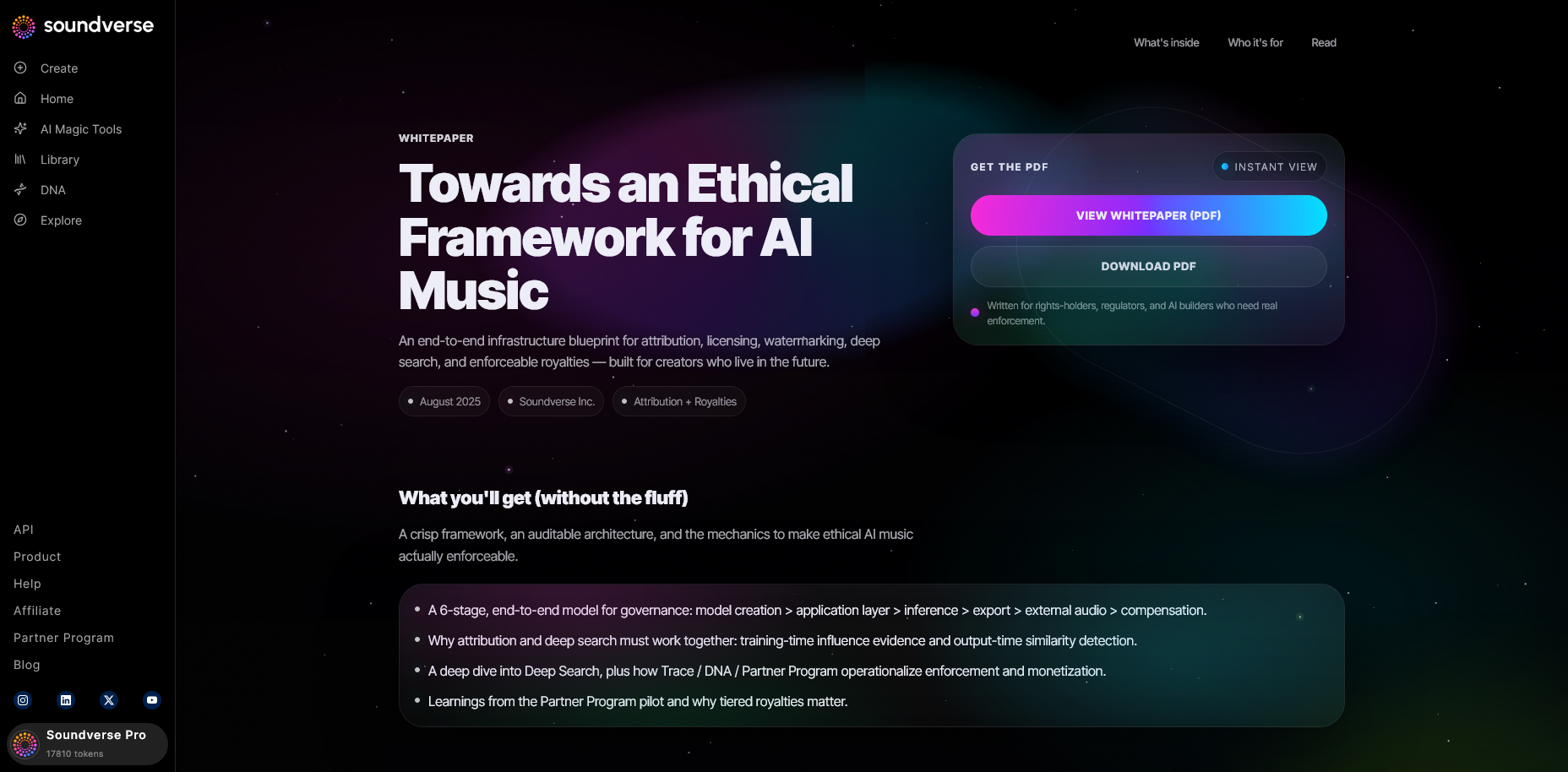
In recent discussions about AI and music, licensing has become the dominant proxy for ethics. If a system is trained on licensed data, it is often described as responsible or ethical by default. The Soundverse whitepaper challenges this framing directly, not by dismissing licensing, but by showing its limits. Licensing addresses a narrow but important question: whether data may be used at all. It does not answer how value flows after that use begins. Ethical AI cannot be evaluated only at the point of data ingestion, because the real impact of AI systems emerges later, during generation, distribution, and monetization.
This is where attribution becomes central. Attribution addresses questions that licensing cannot reach. Who influenced a given output? How influence accumulates across a model. How creators remain visible once their work has been abstracted into embeddings and weights. The whitepaper positions attribution as the missing connective tissue between consent and compensation. Without it, ethical claims remain theoretical rather than operational.

2. What licensing actually solves, and what it leaves unresolved.
Licensing is fundamentally a legal instrument. It establishes boundaries around use, defines permissions, and reduces exposure to infringement claims. In the context of AI training, licensing determines whether a dataset can be included at all. This is a necessary foundation, and the whitepaper is explicit about that necessity. However, licensing operates as a static agreement applied at a single moment in time. Once training begins, licensing largely steps out of the picture.
What licensing does not do is explain outcomes. It does not describe how individual works contribute to specific generations. It does not evolve as models are updated or fine-tuned. It does not create visibility for creators once their work is absorbed into a model. The whitepaper emphasizes that treating licensing as the end of the ethical conversation conflates legality with alignment. A system can be legally licensed and still structurally incapable of fair attribution or meaningful compensation.
3. Defining attribution in the context of AI music.
Attribution, as defined in the whitepaper, is not a symbolic credit or a courtesy acknowledgment. It is a technical and systemic capability. Attribution means being able to trace the influence of training inputs on generated outputs in a way that is measurable and explainable. In music AI, this involves understanding how melodic structure, rhythm, timbre, arrangement, or stylistic patterns propagate through a model and appear in new creations.
This is a much higher bar than licensing. Attribution requires systems that can evaluate similarity and contribution across vast output spaces. It also requires thresholds that determine when influence becomes meaningful rather than negligible. The whitepaper treats attribution as a prerequisite for fairness rather than an optional enhancement. Without it, any attempt at compensation or governance becomes approximate at best and misleading at worst.
4. Why attribution is a continuous problem, not a one-time decision.
One of the whitepaper’s key insights is that attribution does not end when training ends. Models do not produce a single output. They produce millions of variations across different prompts, contexts, and user intentions. Each generation represents a unique combination of learned influences. Attribution must therefore operate at inference time, not just during dataset preparation.
This creates significant technical complexity. Influence is not binary. It exists in degrees. The whitepaper discusses mechanisms such as influence functions and similarity analysis precisely because attribution must remain dynamic. A system that cannot observe itself during generation cannot meaningfully claim ethical accountability. This is why attribution cannot be retrofitted without introducing instability. It must be present from the moment a system is designed.
5. Why compensation without attribution eventually fails.
Many AI systems attempt to compensate creators without precise attribution. Payments are pooled. Revenue is distributed evenly or based on coarse metrics. At a small scale, this can appear functional. On a larger scale, it becomes unsustainable. The whitepaper explains that without attribution, there is no principled way to justify why one contributor earns more than another.
This lack of clarity erodes trust. Creators begin to question whether participation is worth it. Platforms struggle to explain their own payout logic. Over time, participation quality declines as incentives weaken. Attribution is what allows compensation to remain intelligible as systems scale. It turns payment from a vague promise into a verifiable outcome.

6. Attribution as accountability, not just recognition.
Attribution plays a role that extends beyond recognition or payment. The whitepaper frames attribution as a prerequisite for accountability within AI systems. When influence can be traced, responsibility becomes possible. If an output is disputed, flagged, or challenged, the system can examine how it was formed and which inputs meaningfully contributed to it.
Without attribution, accountability collapses into abstraction. Decisions are justified by model complexity rather than evidence. The whitepaper argues that ethical AI systems must be able to explain themselves, not in philosophical terms, but in operational ones. Attribution provides the audit trail that makes governance actionable rather than symbolic. It transforms ethical intent into something that can be examined and improved over time.
7. Why attribution must be treated as infrastructure.
A recurring theme in the whitepaper is that ethics cannot rely on policy alone. Policies express intent, but systems determine outcomes. Attribution is therefore positioned as infrastructure rather than a feature. Infrastructure shapes what is possible by default, without requiring constant intervention or enforcement.
When attribution is infrastructural, creator visibility is automatic. Influence tracking is embedded into generation workflows. Compensation logic has a solid foundation. The whitepaper contrasts this with systems where attribution is added later as a reporting layer. In those cases, attribution becomes fragile, incomplete, and easy to bypass. Infrastructure-level decisions determine whether ethics scales or degrades under growth.
8. What breaks when attribution is absent.
The absence of attribution creates cascading failures across an AI music ecosystem. Creators lose visibility and agency. Users lose context about how music is produced. Platforms lose credibility when they cannot explain how value is distributed. The whitepaper highlights that these failures are not abstract risks. They are structural consequences of early design choices.
Over time, systems without attribution accumulate technical debt. Retrofitting influence tracking into an existing model architecture is complex and often impractical. Governance becomes reactive instead of proactive. Legal defensibility replaces trust as the primary safeguard. The whitepaper warns that this path leads to brittle systems that struggle to adapt as scrutiny increases.
9. Attribution and the future of ethical scale.
Scaling AI music is not only about compute or adoption. It is a question of alignment. The whitepaper argues that ethical systems must scale in a way that preserves creator participation and trust. Attribution enables this by ensuring that value remains connected to contribution as usage grows.
This is why attribution is described as harder than licensing. It demands continuous measurement, technical rigor, and system-wide integration. It also unlocks something licensing alone cannot provide. A pathway where ethical alignment and economic alignment reinforce each other rather than compete. The whitepaper frames this as the foundation for sustainable AI music ecosystems rather than short-term extraction.
10. Closing. Why attribution is the real test of ethical AI.
Licensing establishes permission. Attribution establishes responsibility. The whitepaper argues that ethical AI cannot stop at the question of whether data may be used. It must answer how that use shapes outcomes and who benefits as a result.
Attribution is more demanding because it never ends. It operates during training, during inference, and after distribution. It requires systems to observe themselves and remain accountable as they evolve. This is precisely why it matters. Attribution is the mechanism that turns ethical AI from a claim into a practice.

We are constantly building more product experiences. Keep checking our Blog to stay updated about them!