Music Distribution Services for Gaming Companies?
Music distribution services for gaming studios: distributors, game-music labels, Bandcamp, Steam soundtracks, ISRCs, Content ID and a launch checklist.
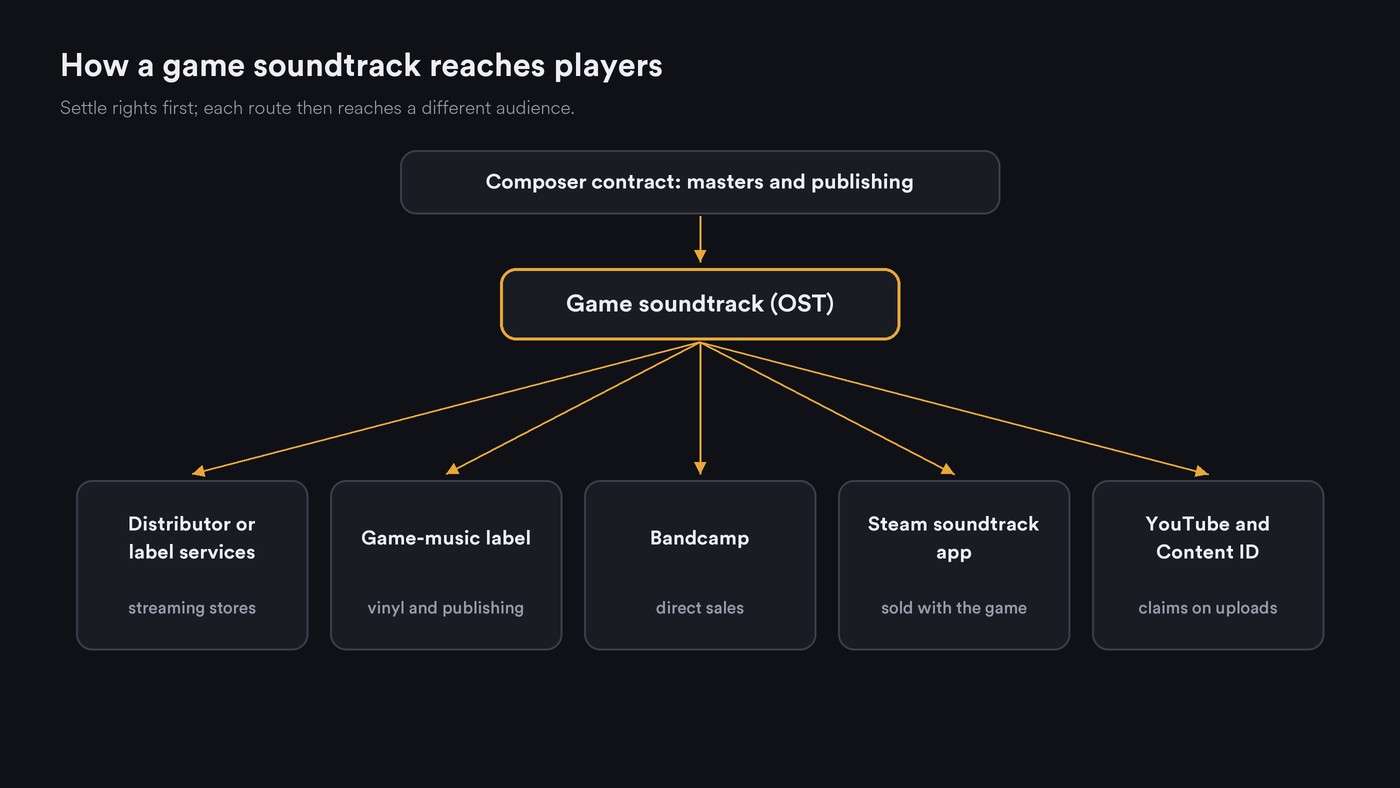
Music distribution services for gaming companies come in five routes: a digital distributor or label-services partner for streaming stores, a game-music label, Bandcamp for direct sales, a Steam soundtrack app sold beside the game, and YouTube with Content ID. Most studios combine two or three, after settling who owns the masters and publishing.
We read each service's own pages on 21 November 2026. Soundverse is not a distributor and does not deliver music to stores; this guide covers the services that do. It's general information, not legal advice.
Five routes for releasing a game soundtrack
- A digital distributor or label-services partner. This gets your OST onto Spotify, Apple Music, YouTube Music and other stores, handles ISRCs and UPCs, and pays you. Self-serve distributors such as DistroKid, TuneCore, CD Baby and Ditto suit a studio releasing one or two albums. A publisher with soundtracks across several games needs multi-label, multi-artist accounts; our guide to distribution tools for label workflows compares those.
- A game-music label. Specialist labels release OSTs, arrangement albums, vinyl and sheet music. Materia Music runs a game-music record label, a sheet music brand and a store, and offers publishing and publishing administration. Its AI policy says its releases, compositions and recordings are made without generative AI or other machine learning, so AI-made cues won't fit there. Laced Records also releases game soundtracks, with vinyl editions in its store. Expect a label to ask for a revenue share and a term, so read the territory and exclusivity clauses.
- Bandcamp. Direct sales of digital albums, vinyl and merch to fans. Its fees page (dated 10 June 2026) lists a 15% share on digital items, dropping to 10% once you reach $5,000 in sales, 10% on physical goods, and payment processor fees that typically range between 4 and 6%. Its generative AI policy (13 January 2026) is blunt: "Music and audio that is generated wholly or in substantial part by AI is not permitted on Bandcamp."
- A Steam soundtrack app. Valve's soundtrack documentation lets you sell a soundtrack attached to your game, like DLC, or as a standalone app. Valve's advice: "Soundtracks sell particularly well as a component of a bundle including the base game and the soundtrack for a slight price increase." People who don't own the game can still buy a soundtrack app, and revenue from a soundtrack attached to your game counts toward the game's total for revenue share.
- YouTube and Content ID. Your distributor delivers the album to YouTube Music and, if you opt in, registers the recordings in Content ID, which then claims videos that use them. For a game, that includes gameplay videos, so this route needs a decision of its own (see below).
Music distribution services for gaming: which mix suits your studio
- Solo developer or small indie: a Steam soundtrack app bundled with the game, plus one self-serve distributor for streaming, with Content ID off for the in-game score.
- Studio with a composer-led, human-made score: a distributor or a game-music label for streaming and vinyl, the Steam soundtrack app, and Bandcamp for fans who buy direct.
- Publisher with several games: a label-services partner that handles several labels and catalogs, plus publishing administration so composition royalties are collected.
Who owns the masters and publishing: settle the composer contract first
Every route asks who owns the recording (the master) and the composition (the publishing). The composer contract answers that, not the distributor's upload form. Common arrangements:
- Buyout or work for hire: the studio usually owns both and releases the OST itself.
- Licence for the game only: the composer keeps ownership, and a soundtrack album needs a separate agreement.
- Split: the studio owns the masters and the composer keeps the publishing, or both share it through an administrator.
Write down, in the contract: who may release the soundtrack and where; who decides on Content ID; who administers publishing and registers the works with a performing rights organization (see registering music with PROs); the credit line; the composer's share of album income; whether AI tools may be used on any cue; and who approves album edits.
Metadata for game soundtracks
- Album title: the game's name plus one version tag, such as "Skyline Drift (Original Soundtrack)", spelled the same on every store.
- Artist: the composer or composers. The studio goes on the label and copyright lines.
- Track titles: names players recognise, such as level or boss names, never file names like "mus_lvl3_combat_loop".
- Steam files: Valve says the Steam music player reads track, title, artist and album from ID3 tags but takes play order from filenames, so start each with a number ("01 - Title" when there are 10 or more tracks). On multi-disc soundtracks, track numbers must be unique across discs.
Our guide to metadata required for distribution lists the store fields.
ISRCs per cue: one recording, one code
Each released recording needs its own ISRC, and the album gets a UPC or EAN instead. IFPI's ISRC FAQ lists remixes and edits, and changes in playing time over 10 seconds, among the changes that need a new code. That matters for games: if you release a 21-second in-game loop and a three-minute album edit of it, they're two recordings with two ISRCs. The FAQ also says an ISRC must never be reused, a music video needs its own code, and a remaster generally keeps the original one.
Keep a cue sheet that maps each in-game file name to its album title and ISRC. Our guide to why ISRC codes matter explains how stores use them.
Timing the soundtrack with the game launch
- Steam: a soundtrack attached to a released game can go live as soon as its store page and content are reviewed and approved. A standalone soundtrack needs a "coming soon" page visible for at least two weeks first. Submit the soundtrack app for review before launch so it's ready on day one.
- Streaming stores: deliver to your distributor weeks ahead and set the game's launch date as the release date. Our guide to delivery timelines explains the lead times.
- A theme single from the trailer can go out before launch. Use the same ISRC for that recording on the single and the album.
- Vinyl takes longer to make than a digital release, so start label talks early.
Keeping streamers and creators safe from Content ID claims
Gameplay videos and streams are free marketing for a game. If your in-game score sits in Content ID, those videos get claimed. Your options:
- Leave the in-game score out. Content ID can be a per-release choice: Ditto's Content ID page says Pro and Label artists add it to individual releases in its Release Builder. Releasing the OST to streaming doesn't require registering it.
- Allowlist channels. YouTube's allowlist exempts named channels from Content ID claims going forward, but existing claims aren't released automatically. Only partners using Content Manager can do it, so ask your distributor. It suits your own channels, partners and press, but a list can't keep up with every streamer.
- Register only music that isn't in the game, such as a vocal theme or a remix album, so it earns on YouTube while gameplay stays unclaimed.
- Say it publicly. Add a short music-use note to your store page or press kit telling creators the soundtrack is safe to stream, and how to report a mistaken claim.
For how claims, disputes and payouts work, see our guide to how distribution platforms handle Content ID.
A launch checklist for your OST
- Signed composer contract covering masters, publishing, soundtrack rights, Content ID, credits and AI use.
- Final masters as WAV, plus MP3s for Steam (lossless files can go in an optional second depot).
- Album edits of in-game loops, each with its own ISRC, and a UPC for the album.
- Metadata sheet with album title, credits, label line, track titles and numbered filenames.
- An album cover image, which Steam's soundtrack settings ask for.
- Steam soundtrack app created, bundled with the game and submitted for review before launch.
- Distributor delivery set for launch day, with the Content ID decision recorded per release.
- Allowlist of your own, partner and press channels, and a public music-use note.
- Bandcamp page if every cue meets its AI policy, and label talks if you want vinyl.
- Compositions registered with a PRO by whoever administers the publishing.
Where Soundverse fits
Soundverse is an AI music platform that takes you from idea to audience. It isn't a distributor and doesn't deliver music to streaming stores, Steam or Bandcamp, so the routes above are how your soundtrack reaches players. Soundverse fits earlier, in making and preparing the music. In AI Studio, Mastering One masters toward a target such as Streaming −14 LUFS, Analysis One shows loudness and true peak, and Creator and above export WAV and stems. Copyright Checker, on every plan, fingerprints a master and reports any match with a known released recording, with title, artist, label and ISRC where known; Soundverse calls it a recognition check, not legal clearance. Asset Studio makes matching cover art and a YouTube thumbnail from a track, and Release Planner builds a day-by-day rollout around your release date.
Licensing is set by plan: the Free plan is for personal use, and the Creator plan comes with a royalty-free license.
FAQ
Can Soundverse distribute my game's soundtrack? No. Soundverse doesn't deliver music to streaming stores, Steam or Bandcamp. Use a distributor, a label, Steam's soundtrack tools or Bandcamp for release, and Soundverse to make, master and check the music before delivery.
Should a game soundtrack be in YouTube Content ID? Only tracks you want to earn from on YouTube, and only ones you control exclusively. Registering the in-game score claims gameplay videos that contain it, so leaving it out is the simplest way to keep those videos unclaimed.
Do in-game loops need ISRCs? Only if you release them. A released loop and its longer album edit each get their own code.
Can players buy my soundtrack on Steam without owning the game? Yes, if it's a soundtrack app. Steam's documentation says people who don't own your game can buy it, unlike DLC, which requires the base game.
Can an AI-assisted soundtrack go on Bandcamp? Bandcamp bars music generated wholly or in substantial part by AI. Release heavily AI-made cues through a route whose policy allows them.
Sign up for Soundverse free to make and master your music before it ships. More release guides on the Soundverse blog.