How Do Distribution Platforms Handle Content ID and Monetization?
Content ID and monetization explained: how distributors turn your master into a reference file, how claims, disputes, allowlists and Art Tracks work.
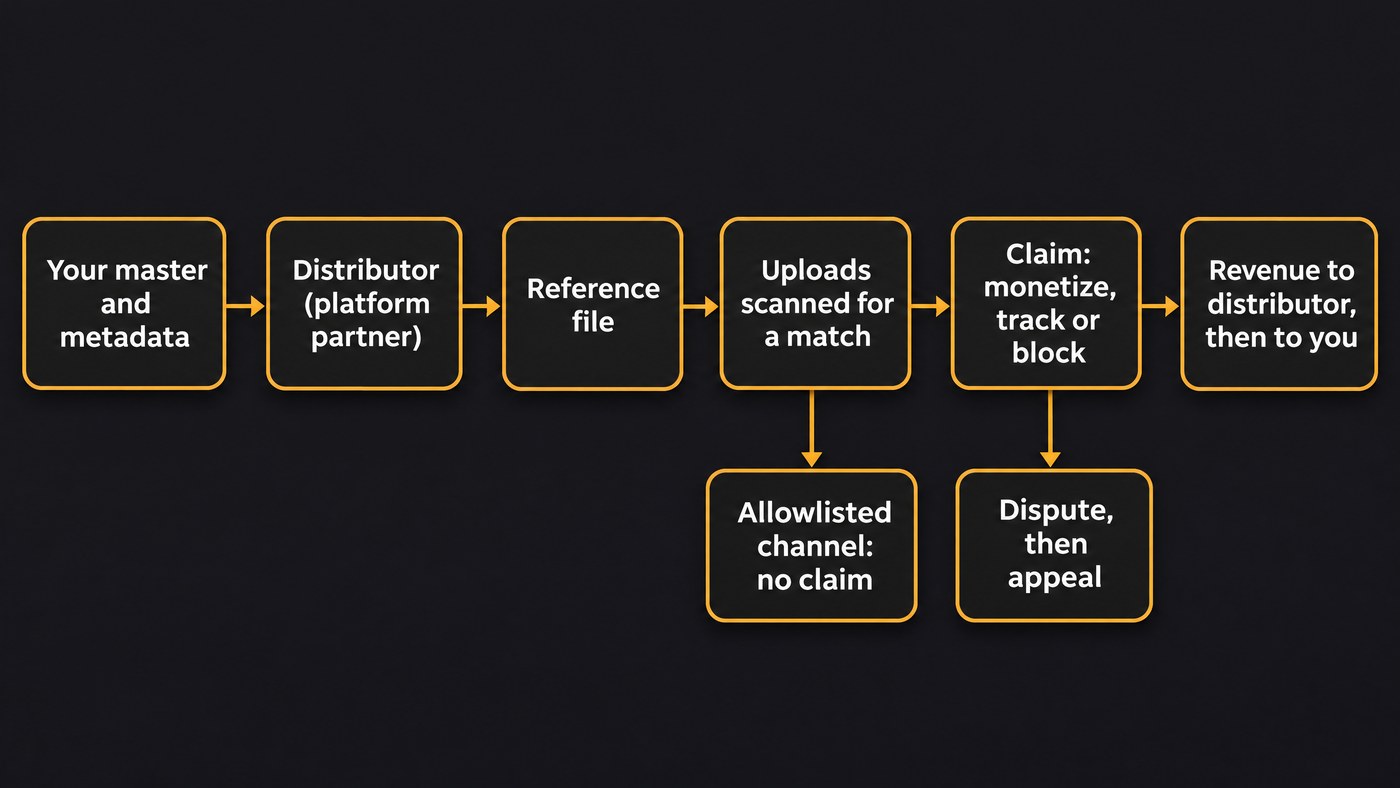
Distribution platforms handle content ID and monetization by delivering your master and metadata to YouTube, Meta and TikTok under their own partner accounts. Each platform scans uploads against that reference, places a claim on a match and applies the policy your distributor set: monetize, track or block. The revenue goes to the distributor, which pays you.
Below are the mechanics, from reference file to payout, taken from each platform's help pages as they read on 19 November 2026. For which distributors include social monetization and what each keeps, see our comparison of distributors for social media monetization. This is general information, not legal advice.
Who runs Content ID for your music
YouTube's page on how Content ID works approves copyright owners with exclusive rights to a substantial body of original material that people upload often. Few solo artists or small labels qualify alone, so distributors hold the partner accounts.
Your recording becomes an asset in the distributor's Content Manager: YouTube's record of who owns it in which territories, its reference file and its policy. That's why the claimant on a matched video is usually your distributor, though you still own the recording. Amuse's UGC matching page (updated 19 October 2026) says Amuse handles claims in the background and collects the revenue for the artist.
How a reference file is created from your master
- You deliver audio and metadata to your distributor and opt the release into YouTube or Content ID.
- The distributor delivers it to YouTube. YouTube's page on assets created for Art Tracks says each track creates a sound recording asset (if none exists for that ISRC), an Art Track, and the audio as an inactive reference. Content ID needs a separate delivery to make that reference active.
- The reference must be eligible. YouTube's Content ID eligibility rules require exclusive rights in the territories claimed. They exclude content licensed non-exclusively, Creative Commons releases, public domain recordings or compositions, karaoke versions, remasters, sound-alikes, production loops, DJ mixes, mashups and full-album recordings. Matches against "royalty free" production libraries go to manual review first.
- The metadata must name the owner: title, artist and record label for a recording, title and writer for a composition, and an informative title, not "Track 4".
Keep one ISRC per recording for life; our guide on why ISRC codes matter explains why.
How matching and claims work
Content ID scans every upload against active references, and a match can cover only part of a video. Amuse adds that it also scans existing videos, most viewed first, so matches take time to appear.
A match creates a claim. The policy blocks the video, monetizes it with ads (sometimes sharing revenue with the uploader) or tracks its statistics, and it can differ by country. YouTube's page on copyright claims adds:
- Monetize is the most common policy on music claims.
- Shorts of one to three minutes with an active claim are blocked, whatever the policy. Vertical uploads of that length count as Shorts since 15 October 2024 (8 December 2025 for Official Artist Channels and channels linked to a music content owner).
- One video can carry separate claims for the recording and the song, including from "one or more music publishing rights collecting societies".
- A claim isn't a copyright strike. Strikes follow valid removal requests.
Why each track has one administrator
- Exclusivity. Two companies each claiming the whole recording in the same territory end up in conflict.
- One Art Track per ISRC. If two partners deliver the same ISRC for the same territories, YouTube uses the submission with the earliest release date and assigns ownership the same way.
- Penalties. YouTube can disable Content ID for claimants who repeatedly make erroneous claims. That's your distributor's account at risk, so distributors police what goes in.
When a label moves its catalogue, agree with both distributors who switches Content ID off and when. Our guide to distribution tools for label workflows covers multi-artist accounts.
Content ID and monetization: how revenue reaches you
- A monetize policy runs ads on the matched video.
- The claimed share is credited to the claimant, your distributor.
- Your distributor adds it to your statement on its usual cycle, minus its fee.
- The recording and the song pay separately: your distributor collects for the recording, publishers and collecting societies for the composition.
Disputes change the timing. YouTube's page on monetization during disputes says a dispute filed within five days holds all revenue from the first day of the claim; a later one holds it from the dispute date. Without a dispute, held revenue goes to the claimant after five days, and after a dispute it goes to whoever wins.
Disputes and appeals on YouTube
YouTube's page on how to dispute a copyright claim gives examples of valid reasons: holding the necessary rights, a copyright exception such as fair use, or misidentification. Crediting the owner or owning a copy isn't one.
- The uploader disputes in YouTube Studio. The claimant has 30 days to release, reinstate, request removal or let the claim expire.
- A reinstated claim can be appealed. The claimant has 7 days.
- For claims that block a video, Escalate to Appeal skips the first step.
- A claimant who rejects an appeal can file a removal request; if valid, the video comes down and the channel gets a strike.
YouTube explains who decides: "The initial dispute and the appeal are reviewed by the claimant because YouTube can’t make ownership determinations." Disputes on your track land with your distributor, so ask how it handles them and how fast.
Allowlisting your own and your clients' channels
YouTube's allowlist exempts channels from Content ID claims by channel ID (the 24-character string starting with "UC"). Only partners using Studio Content Manager can add channels, so artists ask their distributor. It works going forward only, existing claims aren't released automatically, and if several partners own an asset, each must allowlist the channel.
Amuse says a claim on your own video means you're earning from it. Shorts are the exception: claimed one-to-three-minute Shorts are blocked, so allowlist your channel before posting clips of your songs. Do the same for clients you score for, your label's artists and collaborators.
Art Tracks versus user uploads
An Art Track is the video YouTube generates for each delivered track. YouTube claims it from the art track asset, monetizes it where ownership is set and blocks it elsewhere, worldwide if the delivery carries no subscription terms.
User uploads are covers, edits and dance videos using your recording, and only an active sound recording reference finds them. A song can sit on YouTube Music as an Art Track and earn nothing from other people's videos until Content ID is switched on.
Meta, TikTok and SoundCloud
Meta. Its intellectual property transparency page says Rights Manager finds Facebook and Instagram videos, including Live, that match reference files from participating rights holders, who can block (only the uploader sees it), claim available ad earnings, monitor, or report the video. Meta also uses Audible Magic. Amuse adds that not every use is monetized and there's no public claim system like YouTube's.
TikTok and SoundOn. TikTok's help centre and the SoundOn site returned errors or empty pages for us on 19 November 2026. Amuse says most TikTok earnings come from the audio library: "There’s no public claim system on TikTok, and library usage is treated separately from detected usage." TikTok's Intellectual Property Policy (effective 26 April 2025) uses infringement reports and in-app appeals.
SoundCloud. Its help centre blocked automated reading on 19 November 2026, so check its content identification articles yourself.
Common problems and fixes
- Public domain material can't be a reference, and Amuse rules out public domain recordings. If you arranged an old folk or devotional melody, ask your distributor first.
- Leased beats fail the exclusivity rule: register one and other lessees get claimed. See our guide to exclusive and non-exclusive deals.
- Samples, stock loops, remixes and AI-generated tracks are on Amuse's ineligible list. Check your distributor's own rules.
- Your own or a client's channel claimed: allowlist it and ask for existing claims to be released.
- Two administrators for one recording mean overlapping claims. Keep one.
A checklist before you opt in
- Confirm exclusive rights to the whole recording in every territory you'll claim.
- Keep written terms for every beat, sample and feature.
- Use one ISRC and complete title, artist, label and writer fields.
- Send channel IDs to allowlist: yours, your label's, your clients'.
- Make sure no other company has the recording in Content ID.
- Agree the policy (monetize, track or block) and how disputes are handled.
- After release, check the Art Track exists and claims appear on user uploads.
Where Soundverse fits
Soundverse is an AI music platform that takes you from idea to audience. It isn't a distributor and doesn't register tracks for Content ID.
It helps with the checks around that step. Copyright Checker, on every plan, fingerprints a beat, sample or master and reports any match with a known released recording, with title, artist, label and ISRC where known. Soundverse calls it a recognition check, not legal clearance, and it doesn't compare melodies, so covers may not be flagged. Music Business Agent can search YouTube, SoundCloud and Audiomack for re-uploads and sped-up or slowed rips of your songs, each with its link.
Licensing is set by plan: the Free plan is for personal use, and the Creator plan comes with a royalty-free license.
FAQ
Does my distributor own my song if its name is on the claims? No. The claim comes from the asset in your distributor's partner account, which administers it for you. Ownership stays with whoever owns the recording under your contracts, so read what your agreement says about Content ID.
Can my song be on YouTube Music without being in Content ID? Yes. Delivery for YouTube Music creates an Art Track and an inactive reference. Content ID claims user uploads only after the reference is activated.
How long does a claimant have to answer a dispute? Thirty days for a dispute and seven for an appeal. If the claimant doesn't respond in time, the claim expires and is released.
Sign up for Soundverse free and check your next beat with Copyright Checker before it goes into Content ID. More release guides on the Soundverse blog.