The Process of Registering Music With Performance Rights Organizations, Step by Step
How registering music with performance rights organizations works: choosing a PRO, joining, registering works, ISWCs, setlists, cue sheets and pay times.
The process of registering music with performance rights organizations has two stages. First you join one PRO in your home territory as a songwriter, and as a publisher if you self-publish. Then you register every song as a work, with its title, writers and percentage shares, so the society can match each performance and pay you.
Everything below comes from the organizations' own pages, checked on 14 November 2026. Fees and rules change, so confirm on your society's site before you apply.
What performance rights organizations collect
A performance rights organization (PRO) licenses the public performance of songs, meaning the composition: the words and melody. Radio stations, TV channels, venues, shops and streaming services pay the PRO for a license, and the PRO pays the writers and publishers of the songs it can identify.
PRS for Music in the UK spells out the deal on its join page: when you join, you assign your performing right to PRS exclusively. That exclusivity is why you pick one society for your home territory. It then collects from other countries through agreements with sister societies.
Joining is only half the job. As PRS puts it: "You need to register each work you create in order for us to be able to collect on your behalf and pay you the royalties you are due." The same page notes that registering a work is different from copyright, so a PRO registration doesn't replace your own proof of authorship.
The main PROs by country
- United States: ASCAP and BMI take online applications from songwriters and publishers. SESAC and Global Music Rights (GMR) both describe themselves on their own sites as invitation-only; SESAC asks that a lawyer, manager or agent contact it on your behalf.
- United Kingdom: PRS for Music. Its join page lists a one-off £100 fee for lifetime writer membership, or £30 if you are under 25. MCPS, which handles mechanical royalties, is a separate membership with its own one-off £100 fee.
- Canada: SOCAN.
- Germany: GEMA. France: SACEM. India: IPRS (the Indian Performing Right Society). Australia and New Zealand: APRA AMCOS. Japan: JASRAC.
Outside the US, most countries have one main society. If you live in one country and most of your plays happen in another, join at home first and check that your society has an agreement covering the other territory.
How to register music with a performance rights organization, step by step
- Choose your PRO. Start with the society where you live. In the US, compare ASCAP and BMI on their current join pages, since fees and terms change. Check its rules on AI-assisted works too if you use AI tools (more on that below).
- Join as a writer. Apply online with your legal name, contact, tax and bank details. Use the exact name you will put on every song credit, because that name is how your works get matched to you.
- Join as a publisher, if it applies. If you have a publishing deal, your publisher registers its share and you only join as a writer. If you self-publish, ask your PRO how the publisher share reaches you: some writers open their own publisher account, others use a publishing administrator.
- Register each work. For every song, enter the title (and any alternate titles), every writer with their PRO and IPI number, each writer's share, and any publisher. Shares should add up to 100%. You don't apply for the ISWC, the international code for a composition: the ISWC site says new works get one automatically when they are registered, and only once every creator on the work has been uniquely identified.
- Match your distributor and co-writers. Use the same title spelling, writer names and splits on your distributor's songwriter fields, your PRO registration and your co-writers' registrations. Each co-writer registers their own share through their own society, and mismatched shares can hold a song in dispute. Our list of what to prepare before uploading for distribution has a release sheet you can reuse here.
- Report your live shows. Venues pay for licenses, but the society still needs your setlist. PRS's live reporting terms ask for the venue name and address including postcode, the date, who performed, and all works played, including songs you didn't write. The works must be registered to count. Deadlines are 12 months for smaller UK venues, 3 years for concert venues and 2 years for international shows. In the US, ASCAP runs ASCAP OnStage and BMI runs BMI Live for the same job.
- Check cue sheets for sync placements. When your song goes into a film, TV episode or ad, a cue sheet lists every piece of music used. SOCAN's cue sheet FAQ says the producer's cue sheet is the authoritative source, that you should tell production companies to file theirs and request copies, and that without one, those performances stay unidentified and unpaid.
- Read your statements. Look for songs with no earnings after a period of plays, and fix titles, writer names or shares where they don't match.
Registering songs made with AI tools
On 28 October 2025, ASCAP, BMI and SOCAN announced aligned policies: each now accepts registrations of works that combine AI-generated material with elements of human authorship, while compositions created entirely with AI tools are not eligible with any of the three.
So if you use AI in your process, keep notes on what you wrote yourself, such as lyrics, topline melody or arrangement choices, and register only works that include your own authorship. Other societies set their own rules, so check yours before registering.
How PROs differ from The MLC, SoundExchange and your distributor
A released song earns from two copyrights, and several organizations collect different slices.
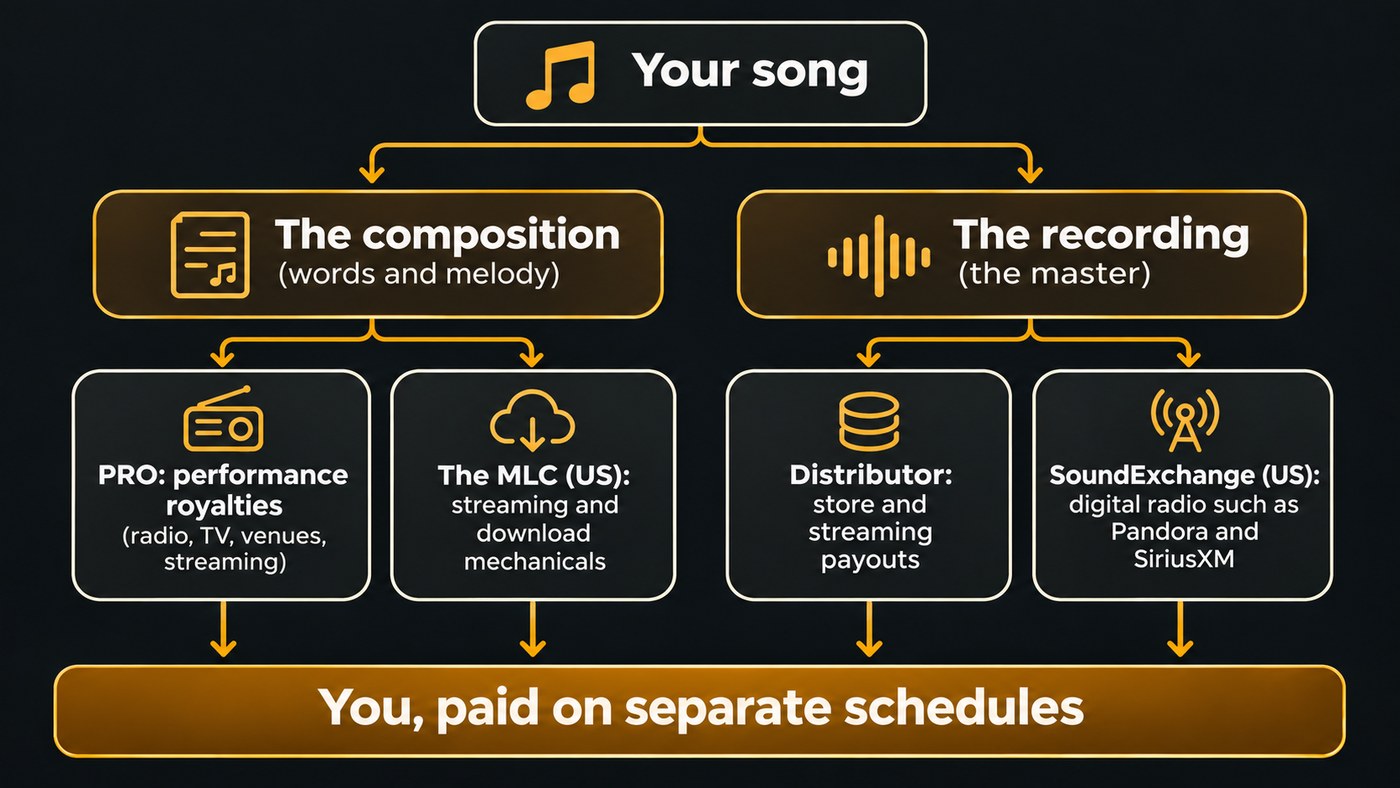
- Your PRO collects performance royalties for the composition.
- The MLC administers the US blanket mechanical license for streaming and download services. Its How It Works page says anyone entitled to digital audio mechanical royalties in the US should become a member, and that streaming services send usage data and royalties every month. It also draws the line itself: "The MLC does not replace other organizations like SoundExchange and the various performing rights organizations (PROs) in the United States, which administer royalties for other rights."
- SoundExchange collects for the recording, not the song. Its digital performance royalties page says services such as Pandora, SiriusXM and webcasters pay it, and that by law 45% goes to featured artists, 5% to a fund for non-featured artists and 50% to the owner of the sound recording.
- Your distributor collects recording royalties from the stores it delivers to and pays them to you. It doesn't register your songs with a PRO by default; some distributors sell publishing administration as a paid extra. We break down who collects what in which distributors offer the best royalty splits.
If you write and release your own songs in the US, that means four registrations: your PRO, The MLC, SoundExchange as a featured artist and recording owner, and your distributor account.
How long performance royalty payments take
Performance royalties take months to arrive, because societies wait for usage reports before they can pay.
- PRS for Music says on its royalty payment dates page that its main distributions happen in April, July, October and December, with monthly payments for online streaming and major live concerts. Its own example: a track played on TV in January may not be reported until April, so payment would usually arrive in July. You get paid once your balance reaches £30 in the UK or £60 internationally, and that threshold drops to £1 each October.
- The MLC pays monthly, approximately 75 days after the end of each calendar month, according to its royalty payments FAQ. Payments in April cover January usage.
- Overseas plays and live claims take longer, since your society waits on a foreign society or on your setlist before it can match anything.
Register before the music is played. A work that isn't registered when the reports arrive is the most common reason a first statement looks empty.
Where Soundverse fits
Soundverse is an AI music platform that takes you from idea to audience. Its Music Business Agent page lists registering works with your PRO, using the details you provide, among its jobs. Its Find My Money workflow runs PRO signup, work registration, a royalty sweep and unclaimed royalty claims, and it can search The MLC's unmatched works and SoundExchange's unregistered lists for your songs and your name.
The page is specific about limits. Each workflow asks you once for what it is missing, such as ISRCs, writers and splits, and is instructed never to invent them. When a site needs a sign-in, the agent stops so you can sign in yourself. Its workflows are set to ask for your OK before anything that costs money, such as a joining fee, and ID-document uploads stay with you. It works in Soundverse's cloud browser or your own Chrome through the Soundverse Computer Use Extension. Results depend on each site, so watch the run.
Licensing is set by plan: the Free plan is for personal use, and the Creator plan comes with a royalty-free license.
FAQ
Can I join more than one PRO? Not for the same rights in the same territory, in most cases. PRS, for example, takes your performing right exclusively when you join. Your society collects from other countries through its agreements with sister societies, so one membership usually covers you abroad.
Do I need a publisher to register songs with a PRO? No. You can join as a writer and register your songs yourself. A publisher or publishing administrator mainly matters for collecting the publisher share, so ask your PRO how it pays that share to self-published writers.
Does my distributor register my songs with a PRO? Not by default. Distributors deliver recordings and collect recording royalties. Some sell publishing administration as an extra, so check what your plan includes before assuming your songs are registered.
Is registering with a PRO the same as copyrighting a song? No. PRS's join page says registering your work is different from copyright. Registration tells the society who wrote the song and who gets paid; keep your own dated drafts and session files as proof of authorship.
Ready to make and release your next song? Sign up for Soundverse free.
More release and rights guides on the Soundverse blog.