What Is the Importance of Delivery Timelines in Music Distribution?
Why delivery timelines matter in music distribution: pitch windows, pre-saves, Content ID, lyrics, release times and a dated plan back from release day.
Delivery timelines matter in music distribution because the day you deliver, not the day you release, decides what is still possible: editorial pitches, pre-saves, lyrics, credits, Content ID and a launch that lands everywhere at once. Deliver four to six weeks ahead and every option stays open. Deliver in release week and most of them close.
This guide is for labels and artist teams running several releases at once. Store processing times are covered in our guide to typical turnaround times for getting music live, so here the question is what each extra week of lead time buys you. Every source was checked on 20 November 2026.
Why delivery timelines matter beyond going live
A release can be live on time and still underperform its plan. Most of the work that shapes release week can only start once the stores have your files and metadata. Each task then runs on its own clock:
- an editorial pitch needs the song in the store's system at least 7 to 10 days before release
- a pre-save link needs a store entry and identifiers
- lyrics and credits take days to appear after you submit them
- Content ID can take weeks to start claiming
Lose a week at the front and you lose it everywhere.
Editorial pitch windows
On Spotify, your release appears in the Upcoming tab of Spotify for Artists after delivery, which Spotify's unreleased music page says can take around 48 hours. You pitch from there. Spotify's pitching guide (updated 17 September 2026) is direct: "Deliver your music at least 7 days before release so our editors have time to listen." A song pitched at least 7 days ahead also goes onto your followers' Release Radar.
Two rules matter for labels. You can pitch only one song per artist at a time, and the next pitch opens once that song goes live. Two singles from the same artist a week apart leave the second with the bare 7-day minimum. Music video pitches are separate and are now rolling out: a video can be pitched while unreleased or within 7 days of its release.
Apple Music's Pitch tool in Apple Music Connect asks for pitches at least 10 days before release for full consideration, and at least seven days for late adds. Admins and Marketing Managers can bulk-upload pitches, and the form asks for campaign moments, the release schedule and focus tracks, which you can only give once your dates are settled.
Pre-save and pre-add setup
Pre-save links need a store entry to point at. Spotify's Upcoming tab is where you copy the release URI for pre-save and marketing campaigns, so the campaign can't start until delivery lands. An Apple Music pre-add depends on delivering the release as an iTunes Store pre-order, and Apple Music Pitch applies its new-release deadlines to pre-add pitches too. A three-week pre-save campaign therefore needs the release delivered about four to five weeks out.
Store ingestion and QA times
Your distributor reviews the release, then each store ingests it on its own schedule, and a rejected release goes through review again. Review queues vary between distributors and change week to week. Our Hindi guide to the fastest platforms for getting a song live compares the figures distributors publish. Plan on your distributor's slowest quoted figure, not its best.
YouTube: Art Tracks and Content ID lag
YouTube's help page for music partners says that after successful delivery, the asset can take up to 48 hours to show in the content management system and the Art Track to appear on YouTube. Claiming takes longer. RouteNote's support hub (modified 21 July 2025) says: "Claims can sometimes take 2-3 weeks to be automatically placed from ingestion of the release to the Content ID system on YouTube."
Deliver at least three weeks before release and Content ID should be matching by the time launch-week re-uploads appear. If your official video premieres on release day, ask your distributor to allowlist the channels that will carry it; our guide to how distribution platforms handle Content ID explains allowlisting.
Lyrics and credits take their own time
Spotify's lyrics come from Musixmatch. Spotify's lyrics page (updated 13 October 2025) says Musixmatch reviews an artist verification and emails you within a few business days, a missing release you add can take up to 48 hours to appear, and lyric changes may take a few days to show on Spotify. Get each artist verified weeks before release, not in release week.
Credits travel with your distributor's metadata. Spotify's credits page says fixes mean asking the distributor to resend metadata, after which credits usually appear within 7 days, and that some distributors don't support credits yet. Send full credits with the first delivery.
Midnight local time or one global moment
You choose how a release goes live, and the choice has to be made at delivery. Spotify's unreleased music page gives both options: a release set for 12:00 AM UTC goes live at the same moment worldwide, while one set for 12:00 AM local time opens country by country. Spotify for Artists shows the earliest date it's available anywhere, so a global UTC release can show a day early for western time zones.
Amuse's timed release article (October 8, 2026) lists stores that support one global time, including Spotify, Apple Music, Amazon, Deezer, TIDAL, TikTok and YouTube Music. On other stores, it says the release goes live at midnight in each local time zone instead. Apple's pitch form also has a Timed Release box.
For a release at 00:00 UTC on Friday 19 February 2027, fans in New York hear it at 7 PM on Thursday, Los Angeles at 4 PM Thursday, Mumbai at 5:30 AM Friday and Sydney at 11 AM Friday. A global moment suits a premiere or livestream. Local midnight suits campaigns built around Friday radio and press in each country.
Coordinating music video, PR and playlists
- Music video. Pitch it to Spotify separately from the song, and schedule the YouTube premiere for the same moment as the audio. Spotify also lets you add a Canvas to upcoming music once it's delivered.
- PR. Journalists plan around a fixed date and a private link. Moving release day after outreach means contacting everyone again.
- Independent curators. Pitch them with the confirmed date, then follow up with the live link.
What goes wrong when you upload late
- No editorial pitch. Under 7 days out, editors may not have time to listen and a pitch no longer puts the song on Release Radar; under 10 days, Apple only considers late adds.
- Dates that don't match across stores. Spotify's help page on music not live on release day says it needs 5 business days, and music delivered inside that window may go live a few days late. Fans see the song on one service and not another, and pre-saves can't complete where it isn't live.
- Metadata fixes after delivery. Spotify's update guide asks for at least 2 business days per update. It also says track structure can't be changed after ingestion without redelivering under a new UPC, which means a takedown, a new release and new pre-save links.
- Missing lyrics, credits and claims. Each one lags the release by days or weeks.
A backward schedule from release day
Here is a single due on Friday 19 February 2027, counted back from release day.
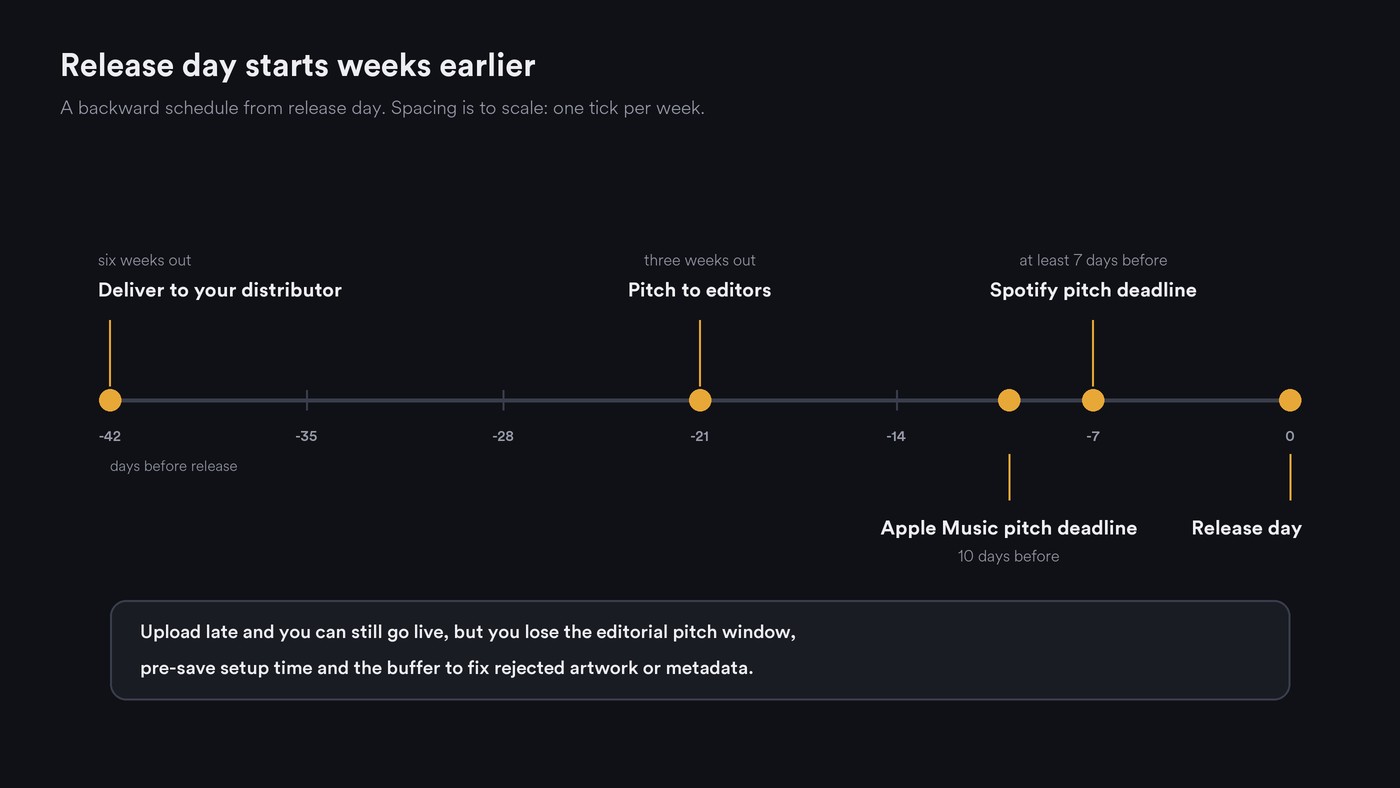
- Before Friday 8 January: final master, artwork, credits with legal names, lyrics, ISRCs and the UPC. Choose local midnight or a timed release.
- Friday 8 January (Day −42): deliver with a future release date. Opt into Content ID if your distributor offers it.
- Friday 15 January (Day −35): confirm approval, check the release in Spotify for Artists and other dashboards, and start Musixmatch verification.
- Friday 22 January (Day −28): build pre-save links, send embargoed press links, add Canvas.
- Friday 29 January (Day −21): submit the Spotify pitch and the Apple Music pitch, or send it through your distributor.
- Tuesday 9 February (Day −10): Apple's full-consideration deadline.
- Friday 12 February (Day −7): Spotify's pitch deadline, and the last safe day to request a metadata update.
- Friday 19 February (release day): check every store, the YouTube premiere and lyrics.
- Friday 26 February (Day +7): confirm credits and lyrics display, and check Content ID claims.
Where Soundverse fits
Soundverse is an AI music platform that takes you from idea to audience. Your distributor handles delivery; Soundverse helps you plan and pitch around it.
Release Planner writes a dated, day-by-day rollout split by platform, with pre-save, smart link and playlist pitch deadlines and a Key Deadlines section for the team. Small labels can size each plan to the artist's audience, region and budget, and its timing research checks for holidays and big releases. It writes the plan; it doesn't submit anything.
Playlist Pitch Description writes the Spotify pitch to a character limit you set and an Amazon Music pitch; choose All DSPs to add Apple Music and Deezer pitches, which you send through your distributor. It submits nothing, and editors decide what they add. After release, Music Business Agent can check stores such as Spotify, Apple Music, JioSaavn and Amazon Music and list where a release is live, missing or mislabeled.
This walkthrough shows the playlist pitch tool writing Spotify, Apple Music and curator pitches from one track.
FAQ
How far ahead should a label deliver a release? Four to six weeks covers every clock in this guide: review, ingestion, pitches, pre-saves, lyrics and Content ID. Add more if your distributor's review queue is running long.
What happens if I miss Spotify's 7-day pitch window? The song still goes live, but a late pitch won't put it on your followers' Release Radar, and editors may not have time to listen. Once it's released, it can't be pitched at all, so start the next release earlier.
Can I change the release date after delivery? Usually, through your distributor, but each store processes the change on its own schedule and Spotify asks for at least 2 business days per update. Pitches, pre-save pages and press dates then need updating too.
Should I release at midnight local time or at one global time? Pick one global time for a fan event such as a premiere. Pick local midnight when each country's press and radio are the focus, and confirm your distributor supports a timed release on the stores you need.
Sign up for Soundverse free and build your schedule back from release day. More release guides on the Soundverse blog.