Why Is ISRC Coding Important for Tracking Music Streams?
Why ISRC codes matter for tracking streams: the 12-character structure, who issues them, how DSPs, SoundExchange and The MLC match plays, and a log.
ISRC codes matter for tracking music streams because they are the identifier stores, distributors and royalty bodies use to recognize one specific recording. Plays are reported and matched by that code, so a missing, duplicated or reused ISRC can split a song's play count or leave its royalties unmatched.
We checked every source below on November 19, 2026, from IFPI and the US ISRC Agency to SoundExchange, The MLC and Spotify. For a first release, our guide to what to prepare before uploading music for distribution shows where the codes fit.
What an ISRC is
An ISRC (International Standard Recording Code) identifies a sound recording or a music video. The US ISRC Agency describes it as a unique, permanent identifier for one recording, whatever format it appears on and whoever owns the rights. The code follows the master from the WAV you deliver to every stream and download, and IFPI's ISRC FAQs say it stays with the track for its lifespan, even when ownership changes.
It identifies nothing else. IFPI says ISRC doesn't identify compositions, lyrics, releases or products, and MIDI files don't get one.
How the 12 characters break down
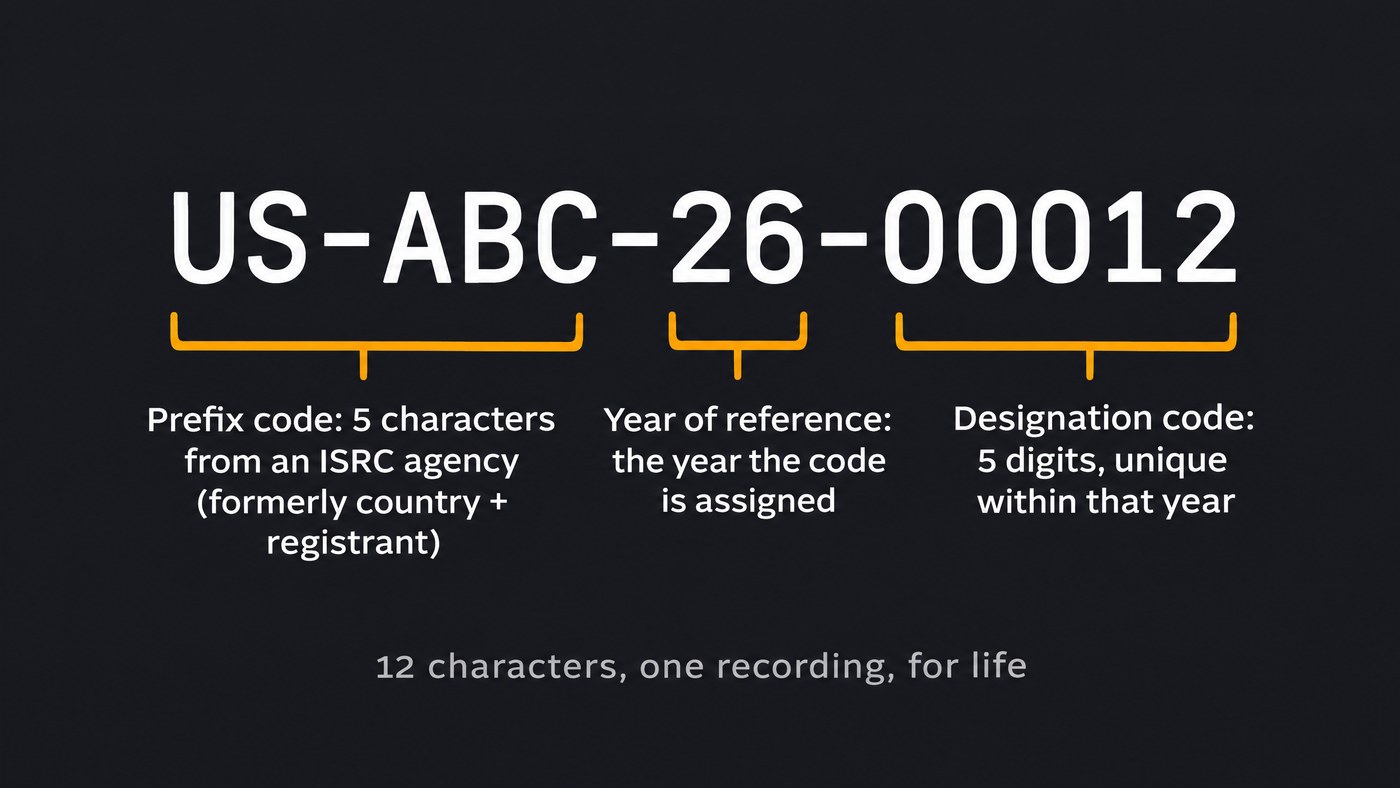
IFPI's FAQ splits every ISRC into three elements. The US ISRC Agency's How It Works page explains each one:
- Prefix code, 5 characters. Two letters followed by three letters or numbers, allocated by an ISRC agency. The agency notes these were formerly called the Country Code and the Registrant Code. In the US, a prefix can start with US, QM, QZ or QT.
- Year of reference, 2 digits. The last two digits of the year the code is assigned. A song you recorded in 2024 and code this year carries 26.
- Designation code, 5 digits. Numbered by whoever assigns the code, usually from 00001, and never repeated within the same year.
The code is the 12 characters; the hyphens and the word "ISRC" are how it's printed. IFPI's Why Use ISRC page adds that the characters don't signify rights ownership or country of origin. The recording year and owner live in the metadata attached to the code.
Who issues ISRC codes
- National ISRC agencies allocate prefixes to recording owners. In the US that's the US ISRC Agency, run by the RIAA, which charges a one-time $95 fee for a Rights Owner Prefix covering up to 100,000 codes a year.
- IFPI acts as the agency where a territory has none. Its online service for self-releasing artists costs £15 plus UK VAT for 30 credits, one ISRC uses 3, and it first checks a dataset of 150 million recordings for an existing code.
- ISRC Managers are distributors and studios appointed to assign codes for owners. The US list includes CD Baby, DistroKid, ONErpm, Symphonic Distribution, TuneCore and UnitedMasters; IFPI lists Spotify and Session (appointed by IFPI Sweden) and LANDR (by Re:Sound in Canada). The US agency warns that codes generated by companies that aren't appointed are invalid and risk collisions.
- Your distributor at upload. Ditto's help center (updated July 21, 2026), for example, says it assigns an ISRC and UPC free.
Only the recording owner, or a manager it appoints, may assign an ISRC, so don't code a client's master with your own prefix. Keep your own record too: IFPI says a distributor may or may not enter the codes it assigns into the International ISRC Database.
Why ISRC codes are important for tracking music streams
The US ISRC Agency's reasoning is practical: partners can reference a recording by its code in usage reports, which is far more dependable than going by artist and title. Here's who relies on it.
- Stores and distributors. IFPI says digital distributors use ISRC in their databases and stores and for sales reporting. Spotify's re-uploading page says a re-upload keeps its play count through track-linking when the audio and metadata of the old and new versions match. Distributors name the ISRC as part of that match: Amuse's help article on re-releasing a single on an album (updated September 9, 2026) says streams sync between the two as long as the same ISRC is used.
- SoundExchange, which collects US digital performance royalties from services such as Pandora, SiriusXM and webcasters. Its ISRC database is filled with codes submitted by recording owners, distributors and ISRC managers, and its All About ISRCs guide (December 21, 2023) asks for them before release or soon after, so usage reports can be matched. The rule it sets is the one to remember: "A single ISRC should only be used for one recording, and each distinct recording should only have one ISRC."
- The MLC. Each month, services under the US blanket license report usage and royalties to The MLC, which matches the recordings in those reports to registered musical works. Its DURP page says recordings it can't match go into an unmatched recordings database, and its help center says the Matching Tool shows the service data tied to each ISRC. The code is the bridge between a stream and a songwriter's mechanical royalty.
- Collecting societies and broadcasters. IFPI says they use ISRC to identify music usage, distribute revenue track by track and report plays.
- YouTube. IFPI notes YouTube Studio has no ISRC field, so the code usually arrives in your distributor's feed.
ISRC vs ISWC vs UPC
- ISRC identifies the recording. A cover of your song is a new recording with its own ISRC.
- ISWC identifies the composition, the song itself. IFPI notes it's maintained by the ISWC International Agency, which CISAC operates, and one ISWC covers every recording of the work. Songwriters handle that side through their PRO; see our guide to registering music with performance rights organizations.
- UPC/EAN identifies the product: the single, the EP, the album. IFPI says each different product needs its own. One recording with one ISRC can sit on a single and an album, each with its own UPC; our post on registering a band's EP walks through ISRCs per track and one UPC per release.
What goes wrong with ISRCs
- Two codes for one recording. Typically a new distributor generates a fresh code after a switch, or a studio and a distributor both code the same master. The US ISRC Agency is blunt: "Do not assign a second ISRC to the recording as this can cause problems in getting paid." Plays split across two IDs, and royalty bodies see two recordings.
- One code on two recordings. IFPI says an assigned ISRC must never be reused, even if the first recording was never released. Give the final master a new code rather than recycling the demo's.
- A new code on a re-upload. Spotify's help page says you may need to re-upload to fix metadata. Carry over the old ISRC and keep the audio, title, artist and duration identical, or the new upload can show up as a separate track with no play history. Our post on reliable upload services covers transfers.
- Versions sharing the original's code. IFPI requires a new ISRC for remixes and edits, playing-time changes over 10 seconds, a new surround mix made from stems, and restorations with creative input. A radio edit, extended mix, sped-up version, acoustic take, clean edit or live recording each gets its own code. A straight remaster generally keeps the original, and a music video always has its own.
- Codes from the wrong source. Your own prefix used on someone else's master, or a code from a service that isn't an appointed manager.
How to keep an ISRC log
IFPI's Using ISRC page lists seven fields anyone assigning codes must keep for each one: the ISRC, main artist, track title, version title, duration, content type (sound recording or music video) and date of first publication. Build your log around them:
- One row per recording, not per release. A single that reappears on the album stays one row.
- Fill IFPI's seven fields exactly as they appear in your distributor's form.
- Add where it lives: each release title, its UPC, the distributor and the release date.
- Add who assigned it and when, plus the file name of the exact master the code belongs to.
- Add the song side: writers, splits, and the PRO work number or ISWC once registered.
- Track registrations: submitted to SoundExchange, matched at The MLC, registered with the PRO.
- Check the log before every upload. Reuse the code for the same recording; open a new row only for a new recording or version.
For old releases you've lost track of, search SoundExchange's ISRC Search or IFPI's International ISRC Database, which IFPI says is free.
Where Soundverse fits
Soundverse is an AI music platform that takes you from idea to audience. It doesn't assign ISRCs or deliver music to stores; your distributor or ISRC agency issues the codes, and delivery to Spotify and other stores runs through your distributor.
Music Business Agent works on real sites while you watch. It can search The MLC's unmatched works and SoundExchange's unregistered lists for your songs and your name, and its store-by-store release check lists where a release is live, missing or mislabeled on stores such as Spotify, Apple Music, JioSaavn and Amazon Music. Its workflows ask you for missing ISRCs, writers and splits and are instructed never to invent them, so your log stays the source.
If you're rebuilding a log for old masters, Copyright Checker fingerprints a track and, when it matches a released recording, shows the title, artist, label and ISRC where known.
FAQ
Can I get an ISRC for free? Usually, through your distributor: Ditto, for example, assigns ISRC and UPC codes at no charge. Your own US prefix costs a one-time $95, and IFPI's online service charges £15 plus VAT for 30 credits, 3 per code.
Does a remix or sped-up version need a new ISRC? Yes. IFPI requires a new code for remixes, edits and versions whose playing time changes by more than 10 seconds. A remaster generally keeps the original ISRC unless it adds significant new creative input.
Do I need a new ISRC when I change distributors? No. The ISRC stays with the recording for life, so enter the existing code at the new distributor. Matching codes, audio and metadata let stores link the play count to the new upload.
Is an ISRC the same as a UPC? No. The ISRC identifies one recording; the UPC identifies the product it's sold on, such as a single or an album, so one ISRC can appear on several UPCs.
Sign up for Soundverse free and run Music Business Agent on your own catalog. More release guides on the Soundverse blog.