How Is AI-Generated Singing Impacting the Way Independent Artists Record Vocals?
How AI-generated singing is changing the way independent artists record vocals: guide vocals, toplines, voice swaps, doubles, session singers, disclosure.
AI-generated singing is changing the work around a vocal session more than the take you release. Independent artists use it to make guide vocals and demos, test toplines, keys and lyric drafts, hear a part in another voice, and build doubles and harmonies, which means fewer scratch takes and more session time spent on the performance only you can give.
The evidence so far points the same way. LANDR surveyed 1,241 music makers between 30 September and 6 October 2025 and published the results on 18 November 2025. In its study, 87% use AI somewhere in their workflow, and 29% use song generators at some stage, particularly for parts such as vocals and instruments. Another 40% were interested in trying them, again for parts or ideas more than complete tracks. Platform rules and tool details below were checked on 14 November 2026.
What AI-generated singing changes, and what it doesn't
- Before the session: guide vocals, demos and topline tests come from AI instead of a scratch take or a paid demo singer.
- In the session: fewer throwaway passes, more attention on feel, timing and the comp.
- After the session: doubles, harmony sketches and alternate voice types.
- Unchanged: the lead that carries your name is still yours to sing, and the rules for using anyone else's voice have tightened.
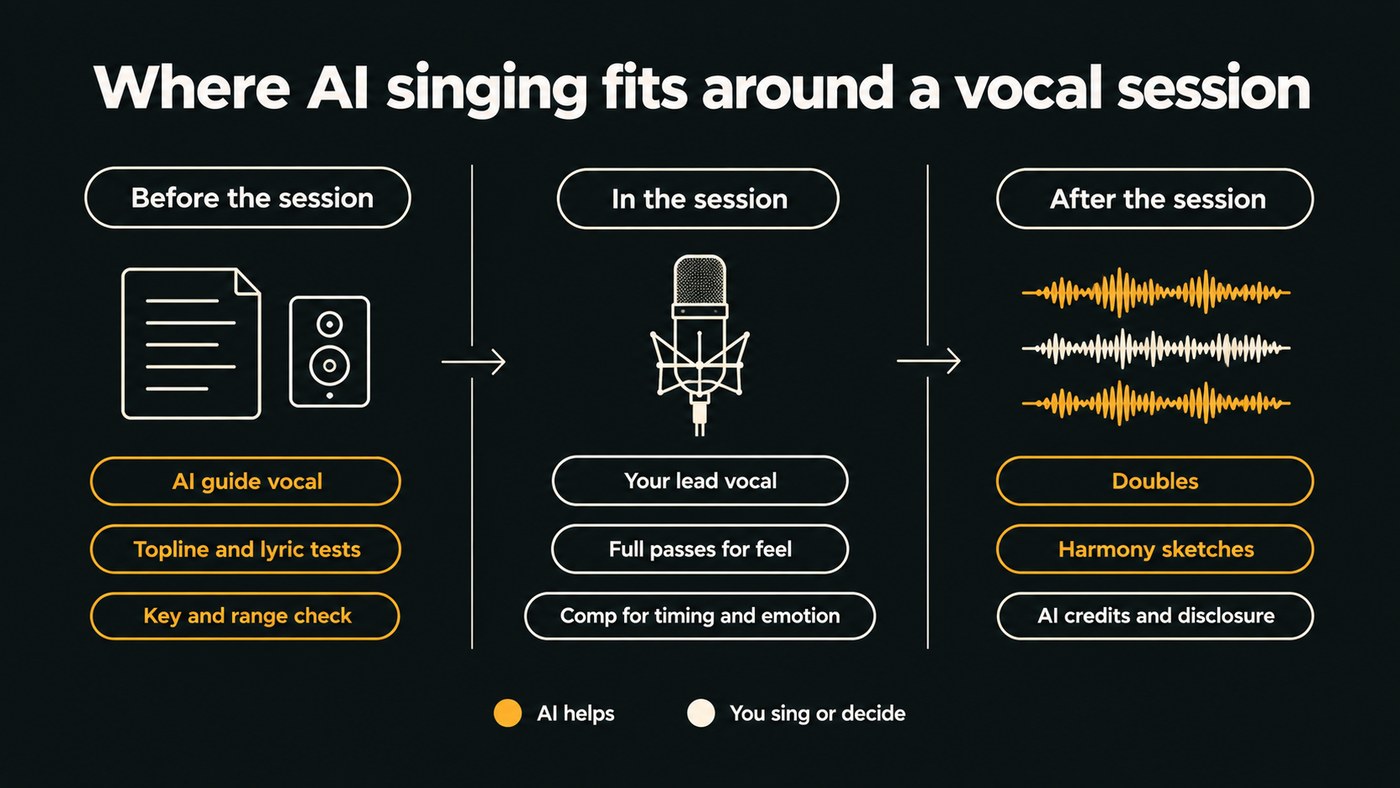
AI guide vocals and demos before the session
The biggest shift happens before anyone steps into the booth. A songwriter used to sing a rough demo or pay a demo singer. Now you can paste lyrics into an AI singing generator, pick a voice type and send the result as a guide.
Soundverse's AI Singing Generator lists this use directly: send a booked singer a sung version of the verse and chorus so they hear one way the lyrics can sit. Each take sings about the first 350 characters of your lyrics, roughly a verse and a chorus, so treat it as a sketch. With a singer's reference recording and their permission, Similar Singing Generator makes the guide in a voice like theirs.
To get the most from a guide:
- Generate it in the key you plan to record, and check the highest and lowest notes against the singer's range.
- Mark breaths and phrase lengths on the lyric sheet. A generated guide doesn't know where your singer needs air.
- Tell the singer it's a map. A singer who copies the guide's phrasing note for note inherits its stiffness.
For a step-by-step demo workflow, see how to create AI vocals for your song demo.
Writing and testing toplines
AI singing also changes how toplines get written. Instead of singing every draft yourself, you can hear two versions of a chorus back to back and keep the one that sings better, or find out a line is crowded before you take it to the booth. Similar Singing Generator suggests both checks: a lyric-draft shoot-out through one reference voice, and a check on a crowded line. AI Singing Generator can also render female and male takes of the same hook, so you can settle the voice type before you write the bridge.
The melody should still start with you. Hum the idea into your phone, or sing it into Soundverse's VocalMIDI One, which turns singing and humming into MIDI notes on the AI Studio timeline, and fix the notes before anyone records.
Re-singing your own take in another voice
Voice conversion lets you sing the guide yourself and hear it in the voice type the song is meant for. Soundverse's Voice Swap keeps the phrasing and timing of your take and changes the voice, with a pitch shift of up to 24 semitones either way, so a song written for a higher voice can be heard in one. It works the other way too: once you've trained a model of your own voice, you can re-sing old demos a collaborator sang for you, with their OK.
Two limits matter:
- Conversion follows the performance. A flat, rushed scratch take becomes a flat, rushed take in a nicer voice.
- Only convert into voices you're allowed to use. Spotify's impersonation policy (25 September 2025) allows vocal impersonation only when the impersonated artist has authorized it.
Fewer takes, and a different kind of comping
When scratch vocals, alternate voice types and demo passes come from AI, the session narrows to what only you can supply. Tuning and tone can be adjusted later. Timing, phrasing, breath and conviction can't be added by any tool, because conversion and pitch correction follow the take you give them.
That changes how you record and comp:
- Record full passes for feel first, then punch in for single lines.
- Comp for emotion and timing. Tuning is the cheapest thing to fix afterwards.
- Keep a clean, dry copy of every lead. If you later train a model of your voice, Soundverse's Train Voice Model asks for 10 minutes or more of clean, dry solo recordings, and your session takes are the obvious source.
Harmonies and doubles
Doubles used to mean singing the part again, tightly in time, two or four more times. Doubling tools now make copies from one take. Soundverse's VocalDuality One adds up to four copies with their own timing, pitch drift and pan, free in AI Studio on every plan, and for rap hooks and ad-libs you set the timing offsets in milliseconds.
Harmonies need more care. Plugins can build parts from your lead, but exposed harmonies sound best when you write the notes and sing or render each part on its own track. A sensible split is to sketch harmony parts with AI, then sing the ones listeners will hear clearly. For stacking technique, see how to mix background vocals.
What it means for session singers
Guide vocals for demos are the work AI singing replaces most directly. Final leads, signature performances, harmony arranging and character still need a singer, and a singer can also choose to license their own voice for AI use. Spotify's statement on its impersonation policy puts that choice where it belongs: "Some artists may choose to license their voices to AI projects—and that’s their choice to make."
If you hire a session singer:
- Say up front whether you'll send AI guides and whether you want to train a model on their takes.
- Get any voice-model permission in writing, with what it covers and how they're paid.
- Credit them, and never train a model on takes they didn't agree to.
Keep your own voice at the centre
The steadiest way to use AI singing is to keep your own voice as the constant. Train a model of it so demos already sound like you: Soundverse's Train Voice Clone needs one take with at least 15 seconds of singing, and Train Voice Model learns from 10 minutes or more for use in Voice Swap. Then record the lead you release yourself, and let AI handle the scaffolding around it. For tools that model one voice in detail, see which AI tools clone a specific vocal timbre best.
This video trains a voice model on at least 10 minutes of clean vocals, then picks it in Voice Swap to re-sing a track in that voice.
Disclosure: what to tell platforms and listeners
Platforms now ask about AI contribution by contribution, and vocals are one of the categories.
- Spotify backs the DDEX standard for AI credits (announced 25 September 2025). In a 2026 update to that post, it says a beta launched on 16 April shows credits for contributions such as vocals, lyrics or production in Song Credits on mobile, when artists disclose through their label or distributor.
- YouTube asks music partners to mark releases as Fully, Partly or No Gen AI. Its help page gives this as an example of Partly Gen AI: "An artist uses GenAI tools to brainstorm lyrical themes, co-write verses, or generate and iterate on melodies, then records the audio in the studio." Its No Gen AI examples include standard pitch correction of minor tuning mistakes in a live vocal.
- Bandcamp does not permit music generated wholly or in substantial part by AI (13 January 2026). It hasn't defined "substantial", so if an AI voice sings your lead, assume it counts.
A simple rule: if an AI voice is audible in the release, disclose it. If AI only shaped the writing and you sang everything, YouTube's examples still call that partly AI. For the other side of the process, see how platforms detect AI vocals.
Where Soundverse fits
Soundverse is an AI music platform that takes you from idea to audience, built for independent artists who release music. Around a vocal session, AI Singing Generator turns lyrics into an a cappella guide in a pop, rap, rock, metal or choir voice, Similar Singing Generator sings new lyrics in a voice like a reference you have the rights to, and Voice Swap re-sings a take in another voice while keeping your performance. Train Voice Clone and Train Voice Model build a model of your own voice. In AI Studio you can open an Agent One song, arm a track and record your vocal over it, then add VocalDuality One doubles. Licensing is set by plan: the Free plan is for personal use, and the Creator plan comes with a royalty-free license.
FAQ
Will AI-generated singing replace recording real vocals?
For guides and demos, it already covers much of the job. The released lead is where your identity lives, and some platforms, such as Bandcamp, don't accept music generated wholly or substantially by AI.
Do I need to disclose an AI guide vocal if I sang the final take?
The guide isn't in the release, but disclosure rules look at the whole process. YouTube's examples treat AI-generated melodies that you then record as partly AI, so answer your distributor's AI question honestly.
Can I train a voice model on a session singer's recordings?
Only with their explicit permission, ideally in writing with the scope and the pay agreed. Soundverse won't start training a voice clone until you confirm the voice is yours or that the singer has given explicit consent.
Which tool should I use for AI guide vocals?
A singing generator if you only have lyrics, voice conversion if you can sing the melody, and a note-based vocal synth if you want control over every note. Our comparison of the best AI singing generator platforms for independent artists goes through the options.
Sign up for Soundverse free and make a guide vocal for your next session.
More guides on the Soundverse blog.