If I Need to Clone a Specific Vocal Timbre, Which AI Tools Perform Best?
Need to clone a specific vocal timbre? Compare Kits.ai, ACE Studio, Soundverse and RVC, how much clean audio each needs, and how to record a dataset.
To clone a specific vocal timbre, use a tool that trains a dedicated model on clean, dry solo recordings of that voice: Kits.ai, ACE Studio, Soundverse's Train Voice Model or the open-source RVC. Instant clones from 15 to 30 seconds work for demos, but fidelity mostly comes from your recordings. Only clone voices you have consent to use.
The brand matters less than people think. The documentation for every tool below points the same way: clean audio, and more of it, counts for more than any setting you change later. These details come from each tool's own documentation, checked on 7 November 2026.
What cloning a vocal timbre actually involves
Timbre is the colour of a voice: the resonance, breathiness, rasp and brightness that make two singers on the same note sound like two different people. AI tools capture it in three ways, and picking the wrong type is a common reason a clone disappoints.
- Voice conversion re-sings an existing performance in the target voice. Pitch, timing and phrasing come from the source take, and only the timbre changes. RVC, Kits.ai, Soundverse Voice Swap and ACE Studio's voice changer work this way.
- Singing synthesis with a cloned voice sings new melodies and lyrics from scratch in the target voice. ACE Studio's Vocal Synth clones and Soundverse's Train Voice Clone with the AI Song Generator work this way.
- Style models learn how an artist's records sound rather than the exact colour of one voice. Soundverse's Artist DNA is an example.
For the closest match to one voice, conversion of a strong human take usually sounds most natural, because the expression comes from a real singer and the model only supplies the colour. Synthesis wins when you need new melodies or lyrics without anyone recording them.
Which AI tools clone a specific vocal timbre best
Kits.ai: the most detailed training guidance
Best for: singers building a high-fidelity model of their own voice for conversion.
Kits offers Instant Voice Cloning from 30 seconds of dry vocals, and says to move to its advanced cloning with 10+ minutes of audio for higher fidelity. Its training docs go further: 30 to 60 minutes of clean, varied audio for the highest-quality models, and the content guidelines suggest about 20 minutes of confident singing in the style you want plus 10 minutes covering low notes, high notes, isolated phonemes and sibilants. The single most useful line for timbre: "Record your dataset in a single session so your AI voice can capture the exact frequency response of the target voice."
ACE Studio: new melodies in the cloned voice
Best for: producers and songwriters who write in a piano roll.
ACE Studio's Vocal Synth cloning turns your voice into a singer you drive from MIDI and lyrics, like its stock voices. It recommends 30 to 100 minutes of singing and notes smaller gains past about 120 minutes. A Basic custom slot sings in one language, while a Pro slot can go multilingual. A separate Voice Changer clone covers conversion, and cloned voices stay private to your account.
Soundverse: a quick clone and a detailed model
Best for: songwriters who want fast demos in a voice and a higher-fidelity model for re-singing takes.
Train Voice Clone needs one take with at least 15 seconds of singing, and the AI Song Generator can then sing new songs in that voice (cloning on Soundverse v9 needs Pro or Max). Train Voice Model is the detailed option: at least 10 minutes of clean, dry solo audio in clips of 60 seconds or more, trained for 10 to 350 epochs in a background job that takes hours, then used in Voice Swap to re-sing existing vocals. Both need the Creator plan or above.
RVC: open source and local
Best for: technical users with a capable computer who want full control.
Retrieval-based Voice Conversion describes itself as a timbre conversion and voice changer framework, released under the MIT license. Its README recommends at least 10 minutes of low-noise speech for training, uses retrieval from the training set to cut down how much of the source voice leaks through, and includes a real-time GUI. Because you run it yourself, consent is entirely your responsibility.
ElevenLabs: spoken voice only
Best for: spoken intros, skits or interludes in your own voice.
ElevenLabs' Professional Voice Cloning docs state that these clones don't currently support singing and that training audio must be spoken voice only. They recommend 30 minutes at the bare minimum and closer to 2 to 3 hours for the best result, and only let you clone your own voice after verification. Use a singing tool for the vocal itself.
Can you recommend AI tools capable of cloning specific vocal styles?
Yes, with one distinction. Style lives in the performance: phrasing, vibrato, runs, breath and attitude. Timbre lives in the voice. Most tools capture one far better than the other.
- Conversion keeps the source style. Soundverse's Voice Swap changes the voice and keeps the performance, and RVC and Kits behave the same way. To get a style, sing or direct the source take in that style, then convert it.
- Train one model per vocal quality. Kits advises against mixing falsetto into a dataset meant for gritty high notes. Soundverse's voice clone page suggests training one clone from a breathy take and another from a belted one.
- Capture a whole catalogue's sound. Soundverse's Train Artist Model builds an Artist DNA from songs you own (its page suggests 10 or more finished songs), and the DNA tool can then make a song, an instrumental or a sung vocal in that style.
- Hear new lyrics in a voice like a reference. Soundverse's Similar Singing Generator takes 30 seconds or more of a vocal you have the rights to, plus your lyrics, and returns a new take.
For a side-by-side of the quick and detailed routes, see voice clone vs voice training.
How to record a dataset that captures the timbre
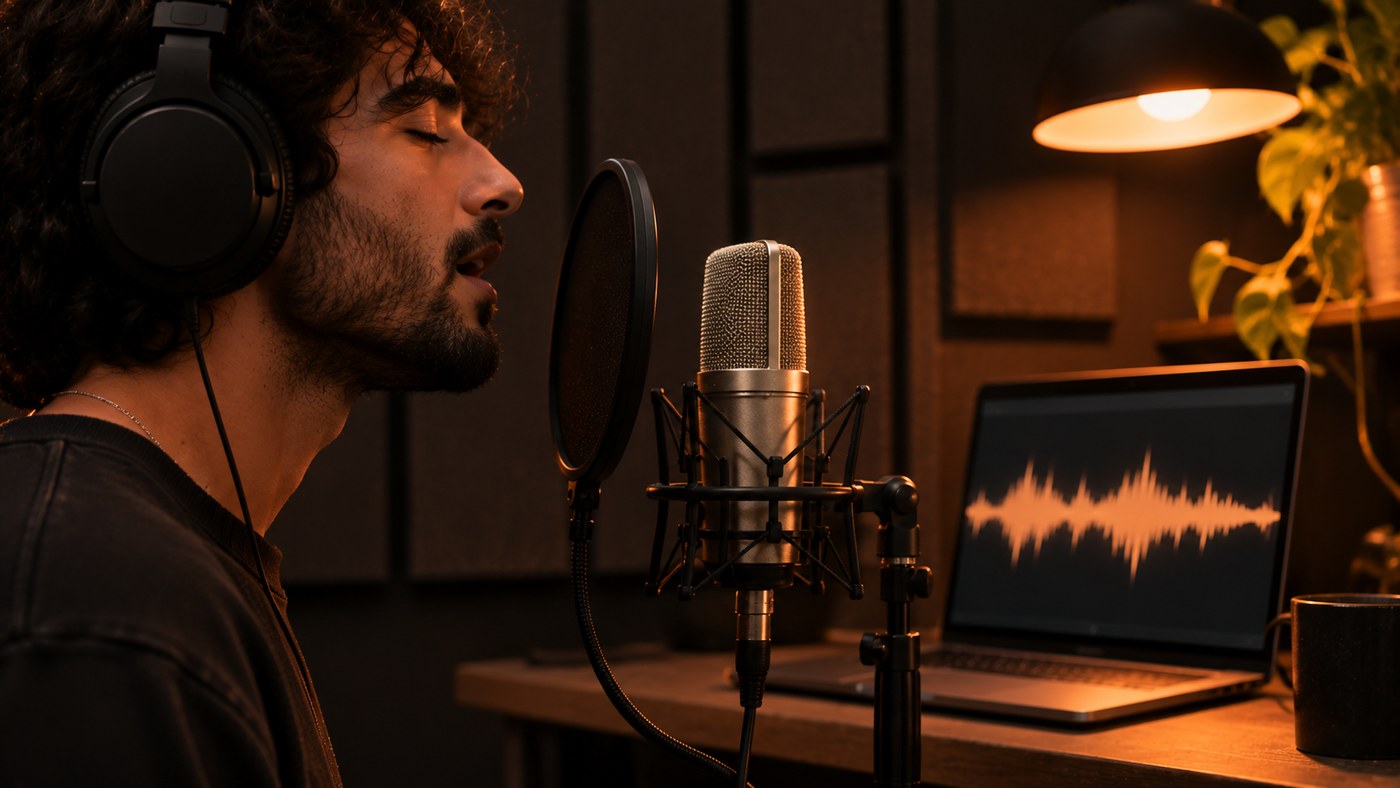
- Record in one session. Same mic, same room, same distance, same day. Kits notes that combining different recordings can reduce the accuracy of the clone.
- Keep it dry and solo. No reverb, delay, doubling, harmonies or backing music. Kits, ACE Studio and Soundverse all say this, and Soundverse notes that music, noise and reverb all lower quality.
- Cover the whole voice. Low and high notes, soft and loud, every vowel and the sibilants. A model can only reproduce what it heard, and takes that stay on a few notes give a narrow voice.
- Hold the mic distance. Kits and ACE both suggest about 2 inches at normal volume, 4 to 6 inches for belting, and never further than 12 inches. ACE also warns against phone, laptop and earbud mics.
- Export lossless. ACE asks for WAV or FLAC at 16-bit and 44.1 or 48 kHz.
- Avoid stem-split vocals where you can. ACE warns that vocals pulled from a mix can be too damaged to train well. If a mix is all you have, use the cleanest lead you can isolate and expect a softer result.
- Test small, then train long. Soundverse suggests a 10-epoch test run to check your recordings before a longer one. Judge the model on a phrase that isn't in the dataset.
Consent, the law and disclosure
Clone your own voice, or a singer's voice with their explicit consent. Soundverse won't start training until you confirm the voice is yours or that the singer has agreed, and ElevenLabs only allows your own voice.
The law is catching up. Tennessee's ELVIS Act, signed on 21 March 2024, added "voice" to the state's Protection of Personal Rights law. In the governor's announcement, RIAA Chairman and CEO Mitch Glazier said: "We applaud Tennessee’s swift and thoughtful bipartisan leadership against unconsented AI deepfakes and voice clones."
Platforms ask for transparency too. YouTube's disclosure rules list AI-generated music among the content you must disclose, while cloning your own voice for voice-overs or dubs is on the list that needs no disclosure. Our guide to legally cloning a voice for music covers the details.
Where Soundverse fits
Soundverse is an AI music platform that takes you from idea to audience, and it gives singers two training routes in one place. Train Voice Clone turns one take with 15 seconds or more of singing into a voice the AI Song Generator can sing new songs in, including on Soundverse v9 with a Pro or Max plan. Train Voice Model learns from 10 minutes or more of your clean recordings, at the epoch count you choose, and puts your voice on existing vocals through Voice Swap while the original performance carries through. New voice models start private. If you're after a style rather than one voice, Train Artist Model builds an Artist DNA from songs you own. Licensing is set by plan; the Free plan is for personal use; the Creator plan comes with a royalty-free license.
This video trains a detailed voice model on 10+ minutes of recordings, then uses it in Voice Swap to re-sing a vocal.
FAQ
How much audio do I need to clone a singing voice?
It depends on the tool and the fidelity you want. Quick clones start from 15 seconds of singing on Soundverse and 30 seconds on Kits.ai. Detailed models want far more: at least 10 minutes for Soundverse's Train Voice Model and RVC, 30 to 60 minutes for Kits' best results, and 30 to 100 minutes for ACE Studio.
Can I clone a famous singer's voice with AI?
Only with that singer's explicit consent. Soundverse makes you confirm the voice is yours or that the singer has agreed, ElevenLabs only clones your own verified voice, and laws such as Tennessee's ELVIS Act now cover a person's voice. If you admire a singer's sound, train on your own voice and borrow the phrasing and style in your performance instead.
Why does my voice clone sound robotic or metallic?
Usually the dataset is the cause: reverb, background noise, headphone bleed, a narrow range of notes or takes from different sessions. A short training run can also trade fidelity for speed. Re-record dry in one session, cover your full range and retrain before you blame the tool.
Sign up for Soundverse free and try Voice Swap before you train your own voice.
More guides on the Soundverse blog.
